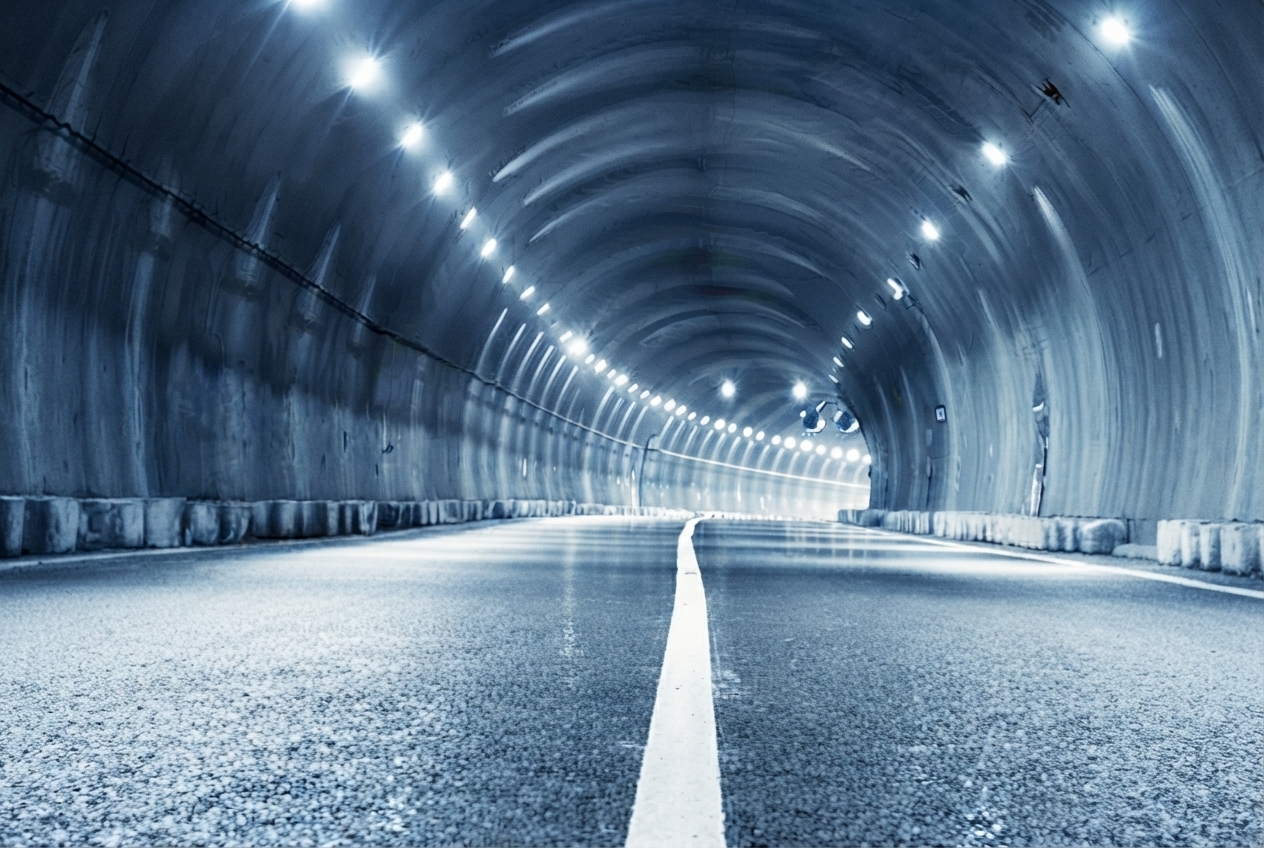
The Bangabandhu Sheikh Mujibur Rahman Tunnel gleaming under modern lights.
Engineering · Mega Project · Chattogram
Bangabandhu Tunnel: South Asia's First Under-River Expressway
Published:
The Bangabandhu Sheikh Mujibur Rahman Tunnel, commonly known as the Karnaphuli Tunnel, is South Asia's first under-river road tunnel. Built beneath the Karnaphuli River in Chattogram, the project was intended to improve connectivity between the two sides of the river, support the city's eastward expansion, and create better links between Chattogram, the southern industrial belt, and the wider regional road network.
The tunnel opened to traffic on October 28, 2023. Since then, however, the project has faced a very different kind of test. Traffic volumes have remained well below the levels projected during planning, while operating and maintenance costs have placed pressure on its financial performance. That has turned the tunnel into an important case study in how Bangladesh plans, finances, and evaluates large infrastructure projects.
🌍 1. Project Overview, Location, and Strategic Rationale
The project was planned around several long-term transport, urban development, and economic objectives.
📍 Location and Route Connection
The tunnel is located in Chattogram and passes beneath the Karnaphuli River. It connects the Patenga side of the city with Anwara Upazila on the southern bank, providing a direct road connection between the two sides of the river. The route also serves areas around the Korean Export Processing Zone (KEPZ), KAFCO, and the wider industrial belt of southern Chattogram.
The tunnel officially opened to traffic on October 28, 2023.
🎯 The "One City, Two Towns" Strategy & Industrialization
One of the main ideas behind the project was to allow Chattogram to expand across the Karnaphuli rather than concentrating population, industry, and traffic on the existing city side. Better road access to Anwara and the surrounding areas was expected to encourage industrial development and attract both domestic and foreign investment.
The broader strategy also connects the tunnel with the KEPZ, KAFCO, Bangabandhu Sheikh Mujib Shilpanagar, the Cox's Bazar corridor, and future port developments such as Matarbari. In theory, these connections could make the tunnel part of a much larger logistics network linking industrial areas, ports, highways, and regional trade routes.
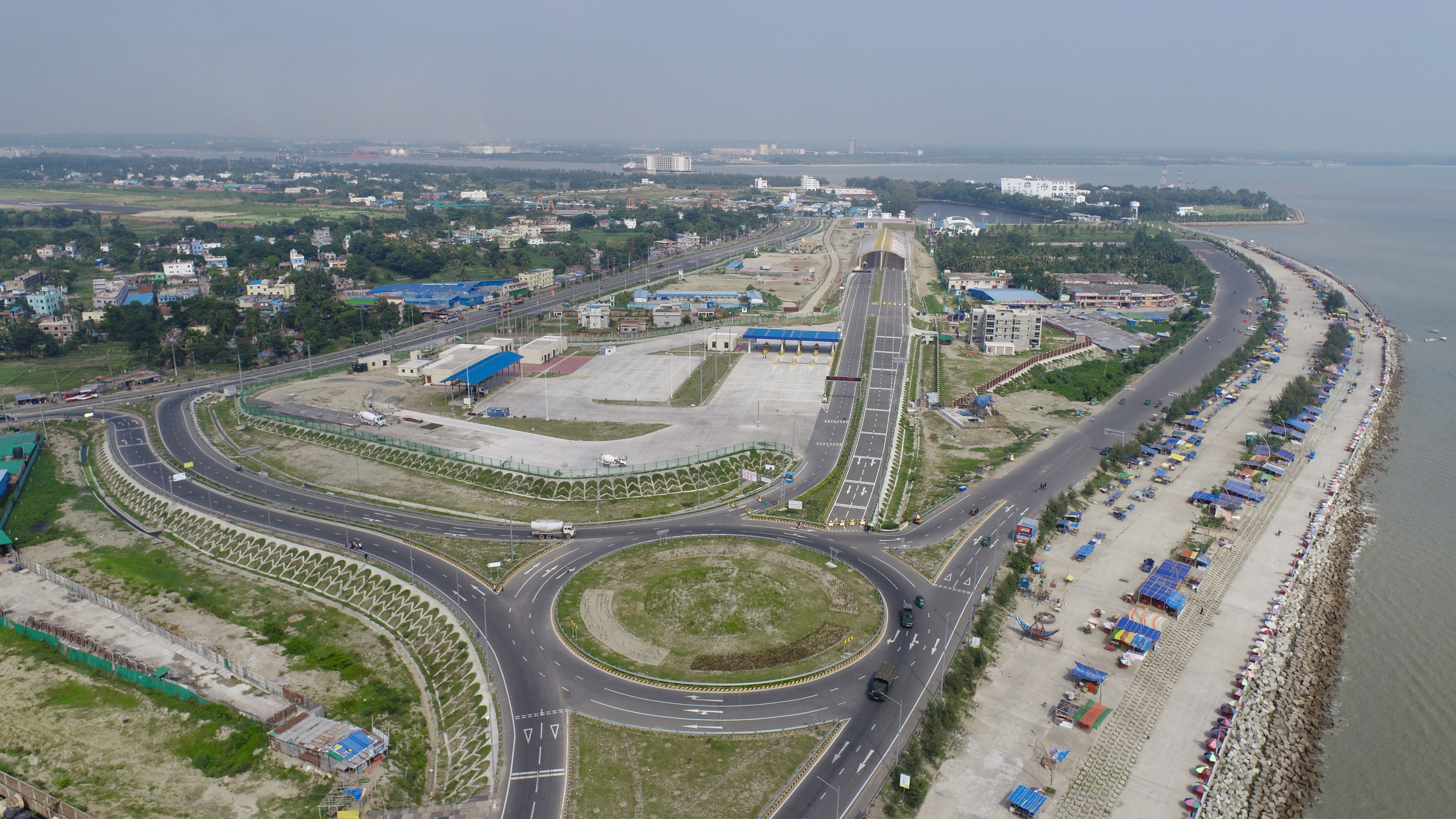
A bird's-eye view of the tunnel construction work.
💰 2. Financial Architecture, Cost, and Investors
A project of this scale required a combination of government financing and foreign lending. The tunnel was implemented under a government-to-government framework involving China.
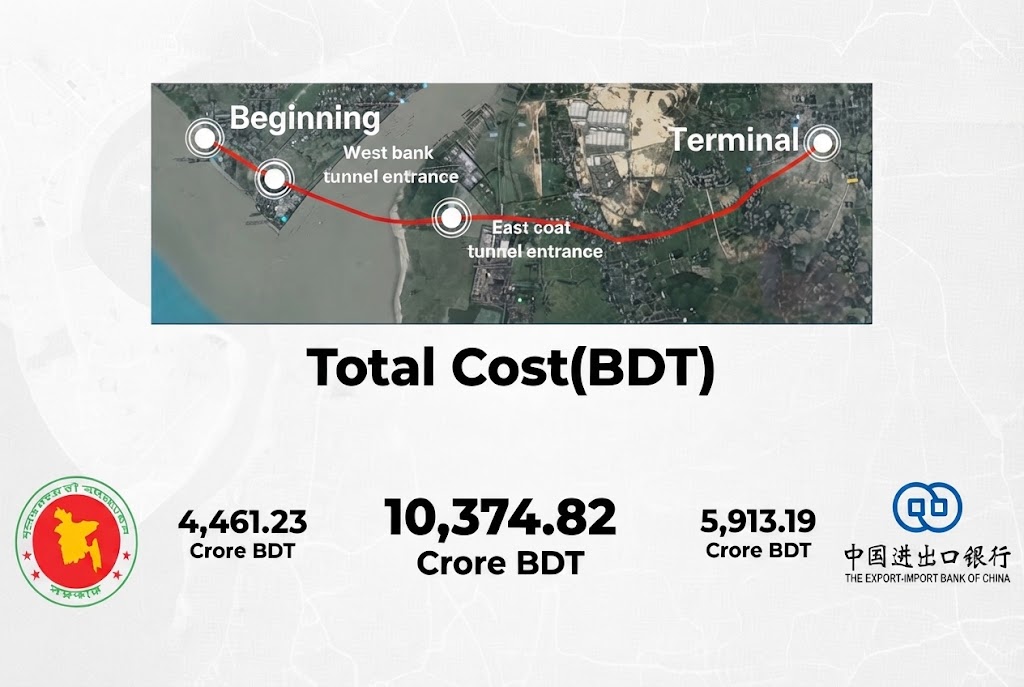
The financier of the Bangabandhu Tunnel
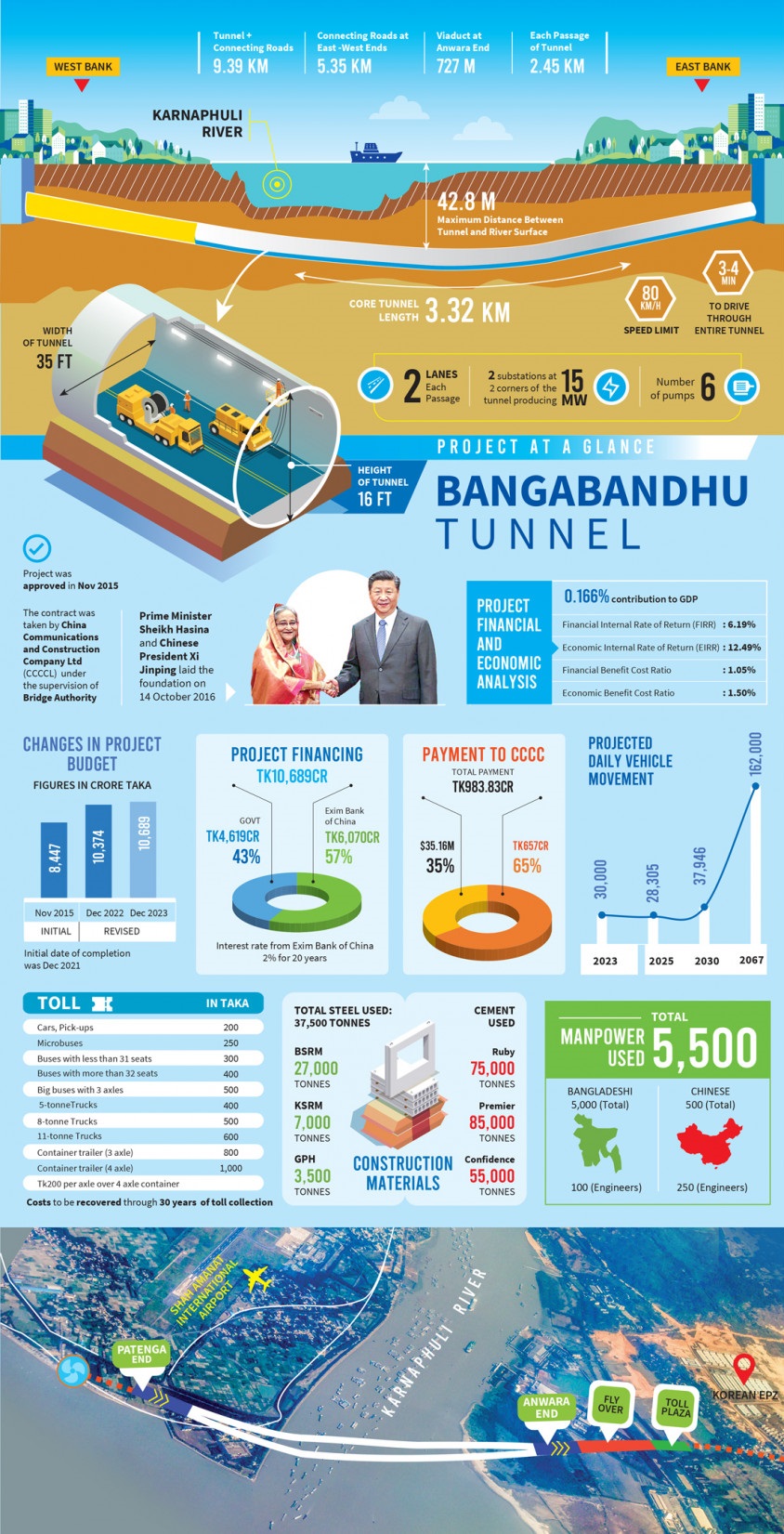
Total Estimated Cost: Approximately BDT 10,374.42 crore, or around US$1.1 billion.
Primary Investor / Lender:Exim Bank of China, which provided a preferential loan of approximately BDT 5,913 crore.
Government Contribution: The remaining project cost was financed by the Government of Bangladesh.
EPC Contractor: China Communications Construction Company (CCCC).
The financing structure also means that the project's financial performance cannot be judged only by its toll revenue. Debt servicing, routine operation, maintenance, energy consumption, staffing, and other recurring expenses all have to be considered when assessing its long-term economics.
⚙️ 3. Technical Specifications, Engineering Milestones, and Obstacles
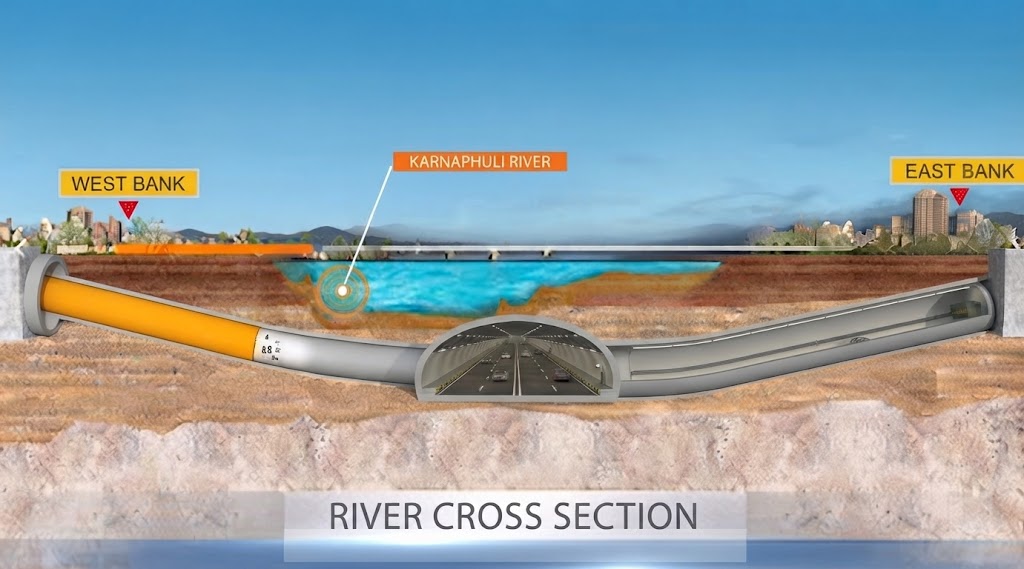
Building a road tunnel beneath the Karnaphuli was considerably more complicated than constructing a conventional highway or bridge. The tunnel had to pass through soft, water-saturated deltaic sediments while maintaining the stability of the riverbed and keeping the navigable river above it in operation.
🌊 Hostile Deltaic Geology and Riverbed Challenges
The Karnaphuli River sits within a deltaic environment where the subsurface contains soft silt, fine sand, saturated sediments, and other relatively weak soil layers. Such conditions create several engineering challenges, particularly when excavation takes place below the groundwater table and beneath an active river.
The tunnelling operation therefore had to control groundwater and soil pressure while preventing excessive ground movement. Maintaining the stability of the excavation was essential not only for the workers and tunnel structure but also for the riverbed and the navigation channel above.
🏗️ Advanced Tunnel Boring Machine (TBM) and Twin-Tube Configuration
The project uses a twin-tube configuration, with two separate tunnel bores carrying traffic in opposite directions. Together, the two tubes provide a four-lane road connection.
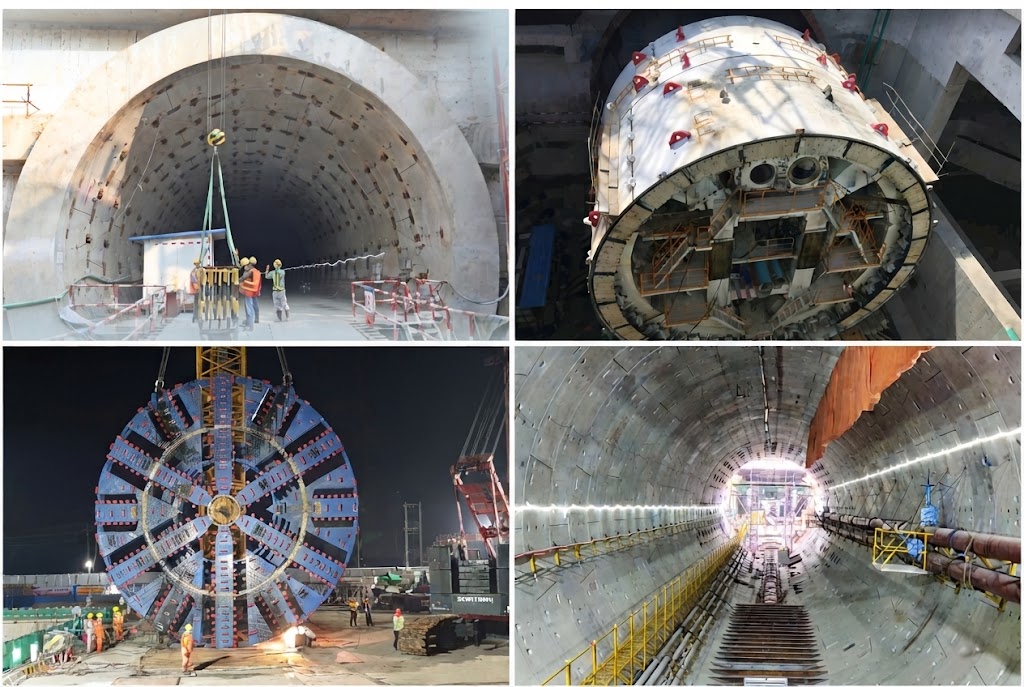
(Clockwise) 1. The entrance to one of the tunnel's tubes, 2. Tunnel Boring Machine, 3. Cutter blades of the tunnel boring machine, 4. Interior of one of the tunnel's tubes.
Main Tunnel Length: 3.32 kilometres (2.06 miles), with a total project length of 9.39 kilometres including viaducts and approach roads.
Internal Diameter: Approximately 10.80 metres for each tunnel tube.
Excavation Diameter: Approximately 12.16 metres.
TBM Technology: A large slurry-shield Tunnel Boring Machine was used to excavate through the soft, water-bearing ground. Precast concrete segments were then installed to form the tunnel lining.
📏 Depth, Clearance, and Safety Infrastructure
The tunnel alignment had to be placed sufficiently deep beneath the riverbed to maintain the navigable channel used by vessels travelling toward Chattogram Port.
Three-dimensional design of the tunnel.
Operating Depth: Approximately 18 to 31 metres beneath the riverbed, depending on location.
Design Speed: Up to 80 km/h.
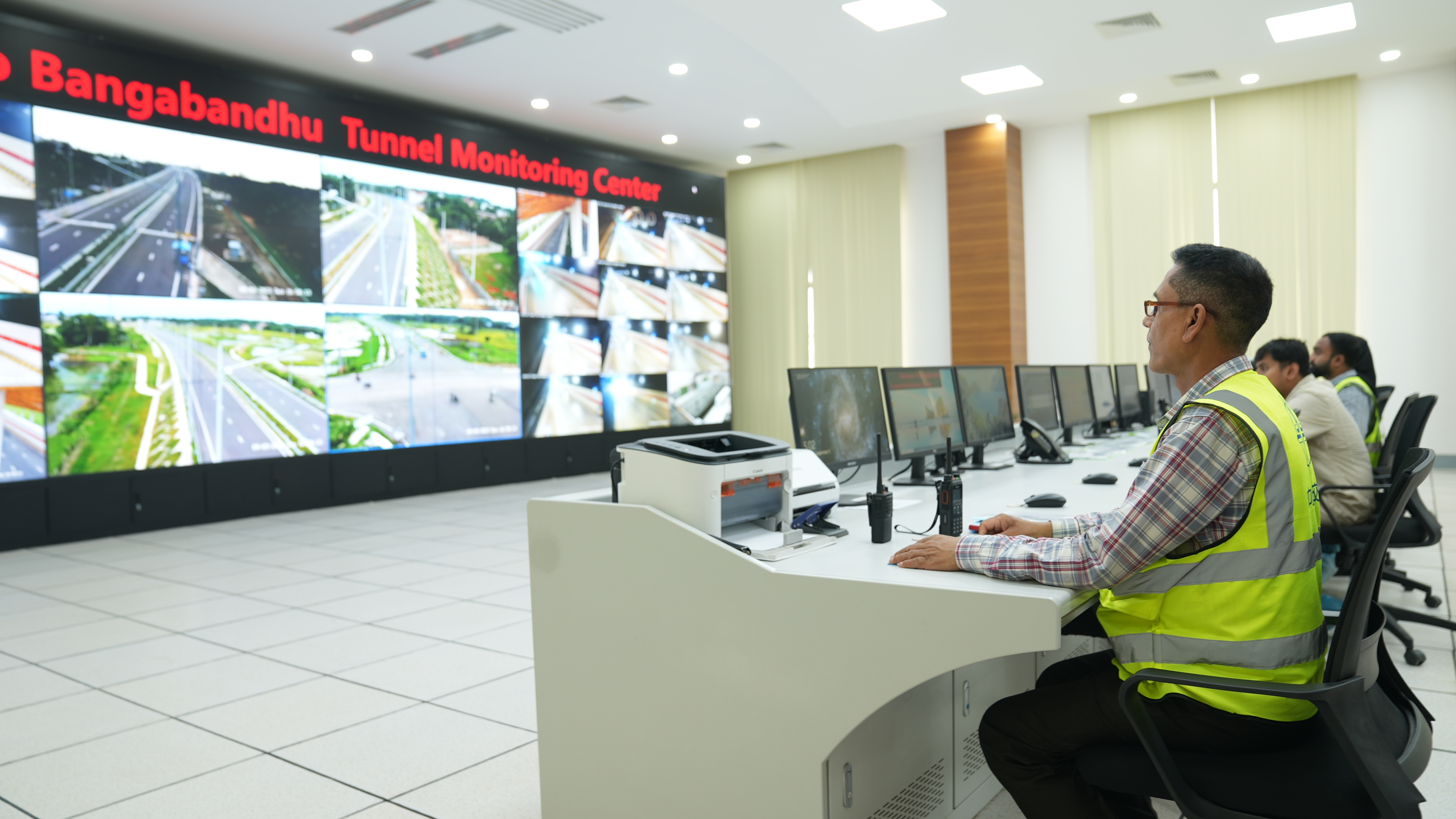
Safety and Ancillary Systems: The tunnel includes mechanical ventilation, fire detection and suppression systems, emergency cross-passages between the tubes, drainage and dewatering systems, lighting, communications, and continuous CCTV monitoring.
At A Glance
Tunnel Length: Main tunnel section of 3.32 kilometres, with a total project length of 9.39 kilometres including approach roads and viaducts.
Structure: Two tubes, each carrying two lanes, providing a four-lane road connection.
Depth: Approximately 18 to 31 metres below the riverbed.
Boring Technology: A custom-built slurry-shield Tunnel Boring Machine was used, with precast concrete segments forming the tunnel lining.
Major Challenges: Soft deltaic ground, groundwater pressure, construction on both sides of the river, land acquisition, and supply-chain disruptions during the COVID-19 period.
Bangabandhu Tunnel at a Glance
💵 4. Toll Structure and Operational Economics
Bangabandhu Tunnel's Toll Plaza
Vehicles using the tunnel pay tolls according to vehicle type. The rates set by the Bridges Division include:
Car, Jeep, Pickup Van: BDT 200
Microbus: BDT 250
Bus: BDT 300 for 31 seats or less; BDT 400 for 32 seats or more; BDT 500 for three-axle buses
Truck: BDT 400 up to 5 tons; BDT 500 for 5–8 tons; BDT 600 for 8–11 tons
Trailer / 3-Axle Truck: BDT 800
4-Axle Truck / Trailer: BDT 1,000, with an additional BDT 200 for each extra axle
📉 Traffic Shortfalls and Revenue Deficits
The biggest financial concern has been traffic. Feasibility projections anticipated daily traffic in the range of roughly 17,000 to 28,000 vehicles. Actual traffic after opening has been much lower, with reported daily averages generally around 3,900 to 4,500 vehicles.
This gap matters because the tunnel has significant recurring costs. Reported monthly toll revenue has been around BDT 3.37 crore, while operation and maintenance expenses have been considerably higher, at approximately BDT 6.95 crore per month. The difference has required public funding to keep the facility operating.
⚖️ 5. Controversies, Criticisms, and Public Debate
The tunnel has become part of a wider national debate about the planning and economic justification of large infrastructure projects. Several criticisms are regularly raised:
"White Elephant" and Vanity Project Labels: Critics argue that the project was given priority before sufficient demand had developed to justify such a large investment.
Traffic Forecasts: Actual traffic has fallen far short of the numbers used in the original feasibility projections.
Approach-Road Bottlenecks: Some connecting roads around Anwara and the southern Chattogram region have remained relatively narrow or congested, reducing the benefit of the high-capacity tunnel itself.
Procurement and Financing: The government-to-government financing arrangement and associated procurement process have raised questions about competition, cost transparency, and value for money.
Vehicle Restrictions: Motorcycles and some forms of non-motorized transport are not permitted through the tunnel, limiting its usefulness for certain categories of local commuters.
🛡️ 6. Busting the Controversies: Counter-Arguments and Defense
There are also reasonable arguments against judging the tunnel entirely on its early traffic and revenue figures.
Long-Term Infrastructure vs. Short-Term Revenue: A tunnel of this type has substantial fixed operating costs, including ventilation, lighting, drainage, safety systems, and technical maintenance. Its strategic value therefore cannot be measured only by its initial toll revenue.
Improving Connecting Infrastructure: Road-widening and improvement projects around Anwara and the southern Chattogram region can gradually remove some of the bottlenecks that currently limit traffic growth.
Operational Efficiency: Authorities can potentially reduce operating costs through improved energy management, maintenance planning, automation, and more efficient staffing.
Industrial Growth Takes Time: The economic case for the tunnel depends partly on development east and south of the Karnaphuli. If industrial zones, ports, logistics facilities, and housing expand as planned, traffic demand could increase over time.
The important point is that both sides of the debate have to be considered. Low traffic is a real problem, but it does not automatically mean that the tunnel has no strategic value. At the same time, future industrial development cannot simply be assumed; it has to actually happen for the projected benefits to materialize.
🚀 7. Future Scope and Outlook
The tunnel's long-term performance will depend heavily on what happens around it. Better approach roads, industrial expansion, port development, and stronger regional connectivity could all increase its usefulness. Without those complementary investments, however, the tunnel may continue to operate well below its intended capacity.
📊 Industrial Decentralization and the "One City, Two Towns" Model
The original planning concept was to help Chattogram expand across the Karnaphuli River. Instead of keeping most population, industry, and commercial activity concentrated on the existing city side, the tunnel provides the physical connection needed for development on the Anwara side.
This approach can work, but urban and industrial decentralization usually takes years. Roads alone do not create a new economic centre. Industries, housing, utilities, logistics facilities, services, and employment opportunities all have to develop alongside the transport infrastructure.
Approach Road of the Tunnel
🏭 Catalyzing Industrial Zones and Deep-Sea Integration
The tunnel is intended to improve access to several important economic areas, including:
The Korean Export Processing Zone (KEPZ) and KAFCO on the Anwara side.
Bangabandhu Sheikh Mujib Shilpanagar and other planned industrial areas in the wider southern region.
The Matarbari Deep-Sea Port and Cox's Bazar corridor, which could become increasingly important as port and highway infrastructure develops.
🚛 Transforming Regional Trade and Supply Chains
One of the tunnel's potential advantages is that vehicles travelling between southern Chattogram, Anwara, and the wider Cox's Bazar region can avoid crossing through some of the city's busiest areas. For freight operators, a more direct route can mean shorter travel times and more predictable journeys.
Whether that potential translates into significant economic gains will depend on traffic growth, road connectivity, industrial development, and the volume of freight moving through the region. The tunnel is therefore best viewed as one component of a much larger transport and economic network rather than as a standalone solution.
📌 Conclusion: A Generational Horizon
The Bangabandhu Sheikh Mujibur Rahman Tunnel is a significant engineering achievement for Bangladesh. Building twin road tunnels beneath the Karnaphuli River through difficult deltaic ground required specialized technology, careful ground control, and a substantial investment.
But the engineering achievement and the economic performance are two different questions. The tunnel has demonstrated that Bangladesh can build this kind of infrastructure, while its low early traffic volumes have raised legitimate questions about demand forecasting, supporting road networks, operating costs, and the timing of the investment.
Its long-term success will ultimately depend on what happens around it. If industrial areas expand, connecting roads improve, freight movement increases, and regional port infrastructure develops as planned, the tunnel could become an important part of Chattogram's transport network. If those developments fail to materialize, its financial burden will remain a serious concern.
For now, the Bangabandhu Tunnel represents both sides of modern infrastructure development: a technically demanding piece of engineering and a reminder that building the structure is only the beginning. The real measure of a megaproject comes from how effectively it serves the economy and the people around it over the decades that follow.