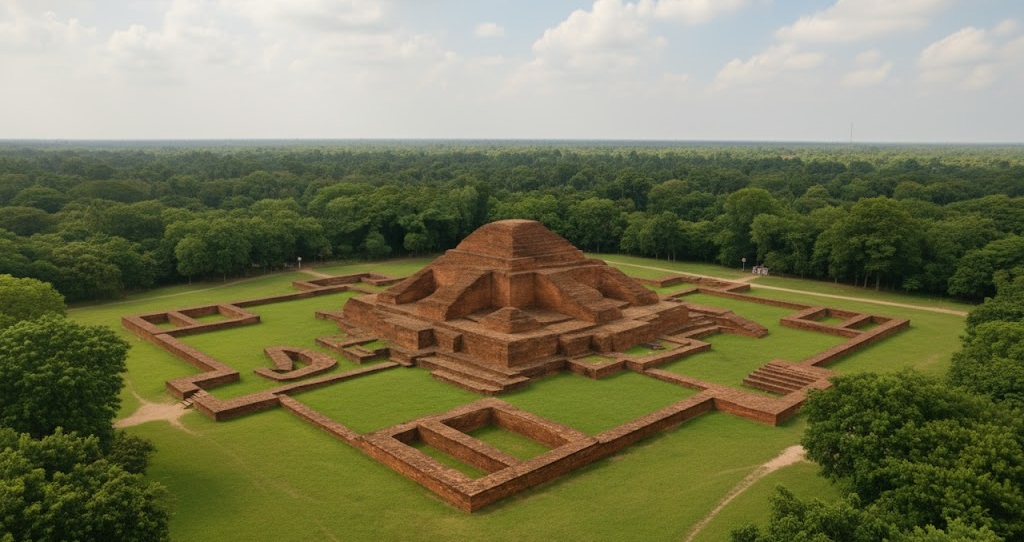
Mainamati: The Land of Buddhist Civilization in Bengal
Published:
Mainamati in Cumilla is a massive archaeological site and an ancient center for Buddhist learning and spiritual life.
It's definitely one of the top archaeological spots in the country, and the ruins still feel full of history.
✒️ Historical Background and Legends
🕰️ 1. Ancient Name of Mainamati
People used to call the area around the hills Devparbat, with the Kshiruda River running to the west. It was a big hub for Buddhism in eastern India.
Over time, as different kingdoms like Pattikera were around, the place eventually took the name Mainamati in the 10th century after Queen Mainamati, wife of King Manik Chandra.
📖 2. Folklore
There's a well-known local story about how it got its name from Queen Mainamati, who was famously wise and knew astrology. After foreseeing that her son Gopichand would die at 18, she prayed hard to save him.
The condition was that he had to become an ascetic. Even after trouble from his wives Aduna and Paduna—and a test involving boiling oil where she stayed safe—Gopichand eventually went off to the forest, returning years later to bring peace back to the land.
👑 3. Ruling Dynasties of Mainamati
A lot of different dynasties ruled this region over the centuries, including:
Gupta Dynasty (320–550 CE)
Gopichand Dynasty
Bhadra Dynasty
Nath Dynasty
Kharga Dynasty (625–705 CE)
Rat Dynasty (640–670 CE)
Dev Dynasty (720–800 CE)
Chandra Dynasty (865–1055 CE)
Paul Dynasty (756–1162 CE)
Varman Dynasty (1055–1145 CE)
Sen Dynasty (1097–1250 CE)
By the late 13th century, it came under Muslim rule, later saw rule by Tripura kings, and became part of British India in 1765 before turning into Cumilla District in 1960.
🏛️ 4. Decline of the Mainamati Kingdom
The area's importance dropped after the 11th century when the capital shifted to Bikrampur.
Between the Sena dynasty and later invasions, people left for places like Tibet, Nepal, and Assam, leaving the religious sites abandoned until they were completely covered by forests.
🪔 5. The Plains Region and the Paul Period
During the Pala era from the 8th to 12th century, Buddhism flourished here under state patronage, turning Mainamati into a major place for learning, monasteries, and pilgrimage.
Copperplate inscription, Mainamati, Comilla.
Key Historical Milestones
6th–10th century: Early settlements and first terracotta constructions.
10th–12th century: Peak of Pala architecture; construction of viharas and stupas.
1960–1970: Beginning of modern archaeology; small-scale excavations.
1973: Large-scale excavations by the Department of Archaeology, Bangladesh.
Excavations brought up coins, statues, and copperplates that prove a structured community lived there.
🌍 Geographical Location and Natural Context
Mainamati sits inside the Cumilla Cantonment area, roughly 8 km west of Cumilla city along the highway. These hillocks—known as the Lalmai-Mainamati range—offered a safe, elevated spot away from floods.
Mainamati, Cumilla.
The southern hills are Lalmai and the northern ones are Mainamati, rising about 10 to 30 meters with streams nearby that helped people farm and settle.
Extent and Nearby Access
From Cumilla city: ~8 km (west).
From Dhaka: ~110 km (2.5–3 hours by road).
Nearest railway station: Cumilla Railway Station.
Mapping guidance: Local excavation trails and tourist paths exist on the hillocks.
🏯 Archaeological Relics and Architectural Analysis
Ongoing excavation.
There are twenty-one main sites found in Mainamati, including Salban Vihara, Kotila Mura, Rupban Mura, and Ananda Vihara.
This is the most famous site here, where excavations started back in 1973.
Salban Buddhist Vihara, Mainamati, Cumilla.
Size: Various statues found in Cumilla district — different shapes and postures.
Around 115 rooms — which were the monks’ living quarters.
A central main temple with four entrances around it.
Artifacts found include Buddha statues, copperplate inscriptions, coins, terracotta vessels, ornaments, and inscriptions.
The uniform bricks show high-level planning, much like what you'd see at Nalanda.
2. Kotila Mura
Kotila Mura, Mainamati, Cumilla.
Located on a hilltop with three main stupas representing the Three Jewels of Buddhism.
3. Rupban Mura
Features a large medieval brick temple structure along with terracotta plaques and statues.
Rupban Mura, Mainamati, Cumilla.
4. Ananda Vihara
A smaller site near Salban Vihara that served a similar purpose for monks studying religion.
Ananda Vihara, Mainamati, Cumilla.
5. Charpotti Mura, Itakhola Mura & Ranir Kuthir
These spots also hold old stupas, brick layouts, and pottery.
Ranir Kuthir, Mainamati, Cumilla.
🧱 Architectural Features
The ruins show elements of Hinayana, Mahayana, and Vajrayana Buddhism.
The precise brickwork, dome-shaped stupas, and lotus designs point to skilled craftsmanship.
Design and Materials
Bricks — flat and uniformly sized, suitable for long-lasting construction.
Dome-style stupas — a dome-shaped stupa is seen above the central temple.
Foundation lines and entrances — each Vihara had entrances and directional paths controlling religious ceremonies.
The style matches other well-known Buddhist hubs of the era.
🏺 Archaeological Museum
The Salban Vihara Museum houses a lot of what was found, including:
Terracotta plaques and statues
Copperplate and bronze plaques
Ancient coins and ornaments
Pottery and religious symbols
It's a great place to look back at how life used to be there.
Various archaeological artifacts discovered in Mainamati.
⚙️ Conservation Status and Monitoring
The Department of Archaeology handles maintenance here, though issues like urbanization and weathering still cause problems.
Challenges
Infiltration due to private constructions
Illegal excavations and theft
Natural degradation — rainfall and land movement
Proposed Solutions
Community-participatory conservation programs
Implementation of walkways and visitor-centered guidelines
Regular report-based tracking and professional restoration
🌄 Conclusion — Mainamati, Silent Witness of the Past
Mainamati isn't just an old site; it's a real piece of our history and culture. Those old ruins and stupas still show how big Buddhism used to be around here.
Places like this remind us that history isn't just about old bricks—it's about the people who lived, believed, and studied there long ago.
It's up to us to take care of it so future generations can appreciate it too.