Mariana Trench: The Dark Empire of Earth's Deepest Secrets
The world's oceans cover nearly 71% of our planet. Beneath those vast waters are places we still know surprisingly little about. One of the most remarkable is the Mariana Trench — the deepest known point on Earth and one of the most extreme environments ever studied.
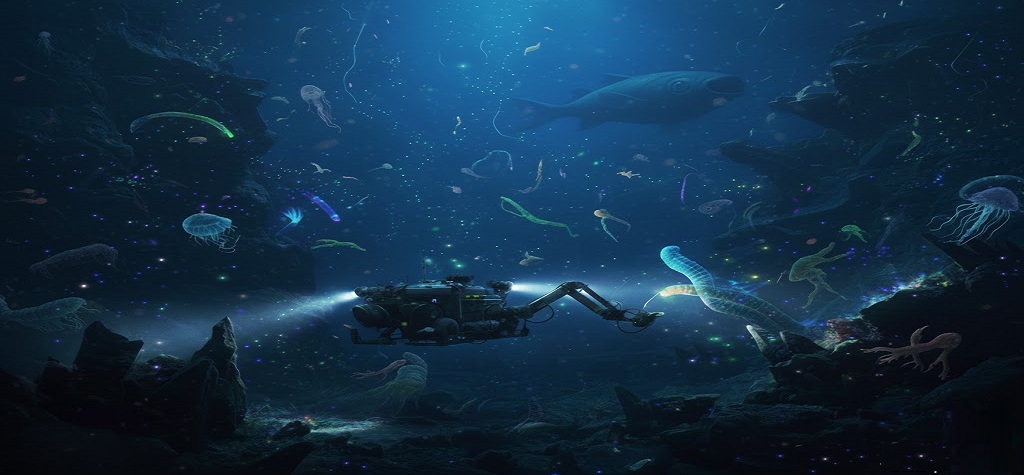
Located in the western Pacific Ocean, the trench is almost like a hidden doorway into Earth's deepest reaches. It was formed through the movement and collision of tectonic plates over millions of years. Extreme pressure, complete darkness, and near-freezing temperatures make exploration extremely difficult, requiring specially designed submersibles and advanced technology. Yet scientists continue to descend into it because the trench may hold important clues about Earth's geological history, the evolution of life, and the biology of the deep ocean.
Where is the Mariana Trench? – Location & Introduction
The Mariana Trench lies in the western Pacific Ocean, about 200 kilometers east of the Mariana Islands, which give the trench its name. It is a crescent-shaped deep-sea trench stretching roughly 2,550 kilometers in length and reaching up to 69 kilometers in width.
Mariana Trench, Pacific Ocean
Challenger Deep is the deepest known point within the Mariana Trench — and the deepest known point on Earth.
The conditions at this depth are so extreme that ordinary marine organisms cannot survive there. Water pressure in the deepest part is nearly 1,100 times greater than at sea level, temperatures remain between 1–4°C, and almost no sunlight reaches the bottom. Even so, scientists have found specially adapted microorganisms, unusual deep-sea creatures, and ecosystems that rely on chemical energy rather than sunlight. These discoveries are helping scientists better understand how life can adapt and evolve under extreme conditions. That makes the Mariana Trench more than a geographical feature; it is also a vast natural laboratory for studying deep-ocean life.
Depth of the Mariana Trench
Subduction Zone – A Door to Another World
Far below the blue surface of the ocean are geological processes that have shaped Earth for millions of years. The Mariana Trench is one of the clearest examples, and it is the deepest known point on the planet.
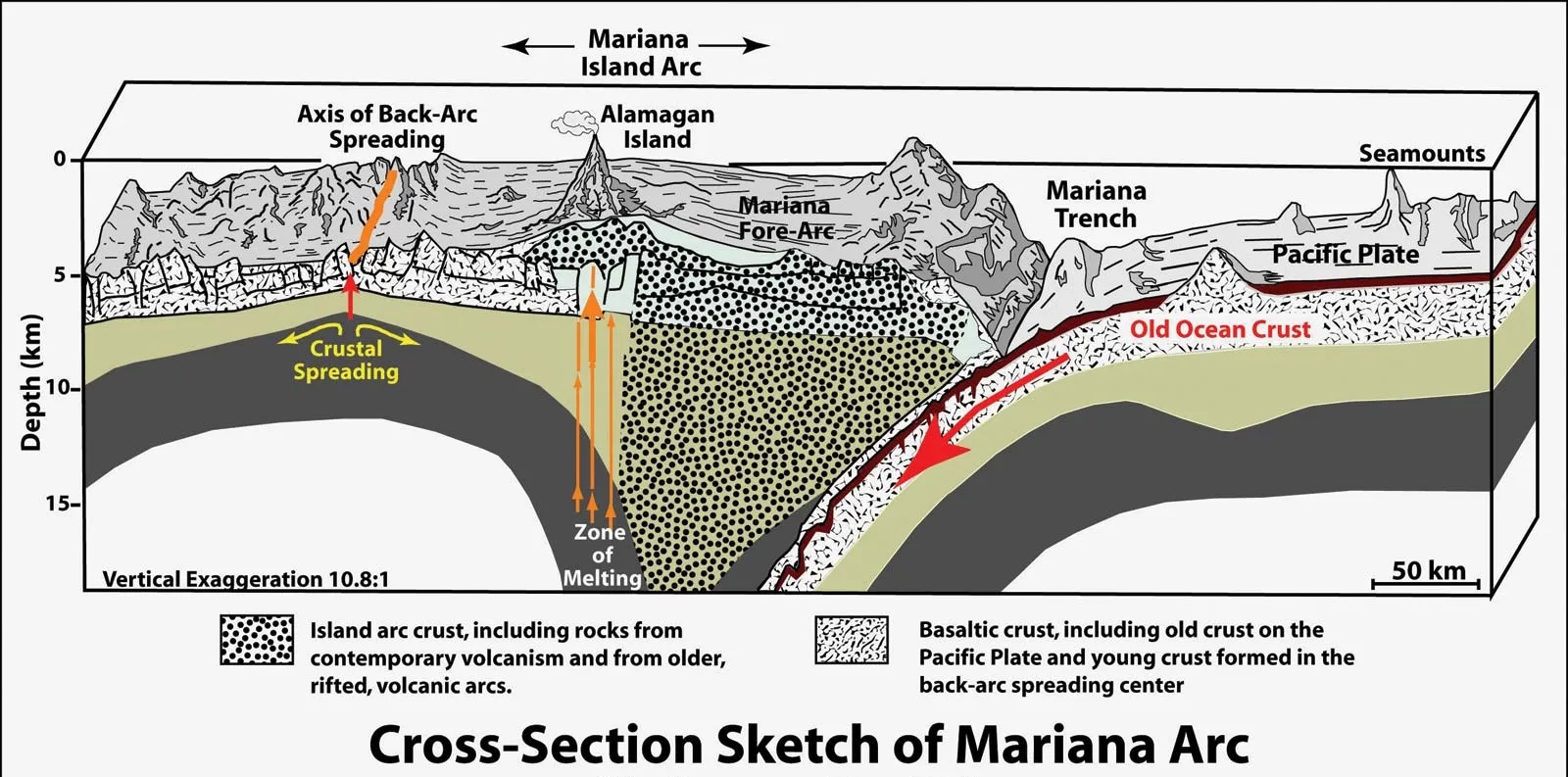
The Mariana Trench formed within a subduction zone, where—
the Pacific tectonic plate is gradually
slipping below the Philippine Sea plate.
Subduction Zone, Mariana Trench, Pacific Ocean
This zone, where one plate sinks beneath another, is what created the trench. Earthquakes and volcanic activity are also common in this region.
Subduction does more than create deep-sea trenches. It is one of the major processes that reshapes Earth's crust. As a heavier oceanic plate moves beneath another plate, its descending edge gradually sinks toward the mantle. Rocks and sediments carried downward can melt, gases are released, and volcanic mountain chains can form above the subduction zone.
Because this tectonic boundary is still active, the Mariana Trench is not simply a geological feature left behind by the distant past. It continues to change today. This is why scientists regard the region as one of the most active and complex geological environments on Earth.
Challenger Deep: A Dark Unknown to Human Eyes
Located in the southern part of the Mariana Trench, Challenger Deep is the deepest known point on Earth. In 1875, the HMS Challenger attempted to measure the depth of the trench, which is where the name Challenger Deep came from.
Challenger Deep, Mariana Trench, Pacific Ocean
Challenger Deep is approximately 10,984 meters (36,037 feet) deep. It is so deep that if Mount Everest were placed inside it, its summit would still be several kilometers below the surface. Water pressure is about 1,100 times greater than at sea level, temperatures remain between 1–4°C, and sunlight cannot reach the bottom. How life manages to survive under these conditions remains one of the most fascinating questions in deep-sea science.
From a human perspective, this place is so dark, cold, and high-pressure that it truly feels like another world.
Deep-Sea Biodiversity – Rulers of the Dark Realm
Despite the absence of sunlight, temperatures of around 1–4°C, and enormous water pressure, the Mariana Trench supports a surprising range of organisms, including extremophiles adapted to life under severe conditions.
Notable creatures found in the Mariana Trench include:
Giant single-celled xenophyophores
Fangtooth fish
Anglerfish (hunts using a light-producing lure)
Snailfish (found at depths beyond 11 km)
Deep-sea shrimp
Hydrothermal vent bacteria
Why can these creatures survive?
Pressure-tolerant proteins
Slow metabolic processes
Bioluminescence — the ability to produce light
Strong cell membranes and fluid-filled tissues
These organisms are some of nature's clearest examples of how life can adapt to extreme environments.
Their unusual forms, behaviors, and adaptations continue to attract scientific attention. Anglerfish, for example, use a glowing lure to attract prey, while xenophyophores build large structures from sediment. Bacteria around hydrothermal vents can produce energy from chemical reactions instead of sunlight. These adaptations show just how flexible life can be, even in some of the harshest environments on Earth.
Scientific Exploration – How Far Have Humans Reached?
1. Trieste Vessel (1960)
Jacques Piccard and Don Walsh became the first humans to reach the bottom of Challenger Deep.
2. James Cameron’s Solo Dive (2012)
Famous filmmaker James Cameron descended alone in the DEEPSEA CHALLENGER submersible.
3. Victor Vescovo (2019)
Using the Limiting Factor submersible, he reached extreme depths and contributed to the discovery and study of previously unknown species.
These missions allowed scientists to measure the depth of the Mariana Trench and learn more about its geology and ecosystems. Each expedition also pushed deep-sea technology further and provided experience for future exploration.
Scientists now use ROVs (Remotely Operated Vehicles) and autonomous underwater drones to explore this dark environment more safely and remain there for longer periods.
Strange Things Found in the Mariana Trench
Although the Mariana Trench is Earth's deepest and one of its most inaccessible environments, human activity has still left traces there.
Plastic bags
Coca-Cola cans
Microplastics
New and unusual bacteria species
Soft corals of the deep sea
These discoveries show that human pollution has reached even the deepest parts of the ocean. Researchers are concerned that microplastics and other chemicals can affect marine organisms, disrupt food chains, and threaten biodiversity.
This isolated environment is a reminder that protecting the deep ocean matters too. If pollution continues to spread into these depths, the unique ecosystems found there could be seriously affected.
Light in the Darkness — Bioluminescence
Sunlight never reaches the Mariana Trench. Temperatures remain around 1–4°C, while the water pressure is high enough to be fatal to a human body. Yet some organisms living in this darkness can produce their own light through a process known as bioluminescence.
Bioluminescence occurs when organisms produce light through chemical reactions, usually involving a compound called luciferin reacting with oxygen.
Uses of bioluminescence
To hunt: Creatures such as anglerfish use glowing lures to attract prey in complete darkness.
To escape predators: Some organisms produce sudden flashes of light to distract predators or help them avoid detection.
To find mates: Some species use specific light patterns to attract potential mates during reproduction.
To communicate: Light can also be used to signal location or coordinate movement in dark waters.
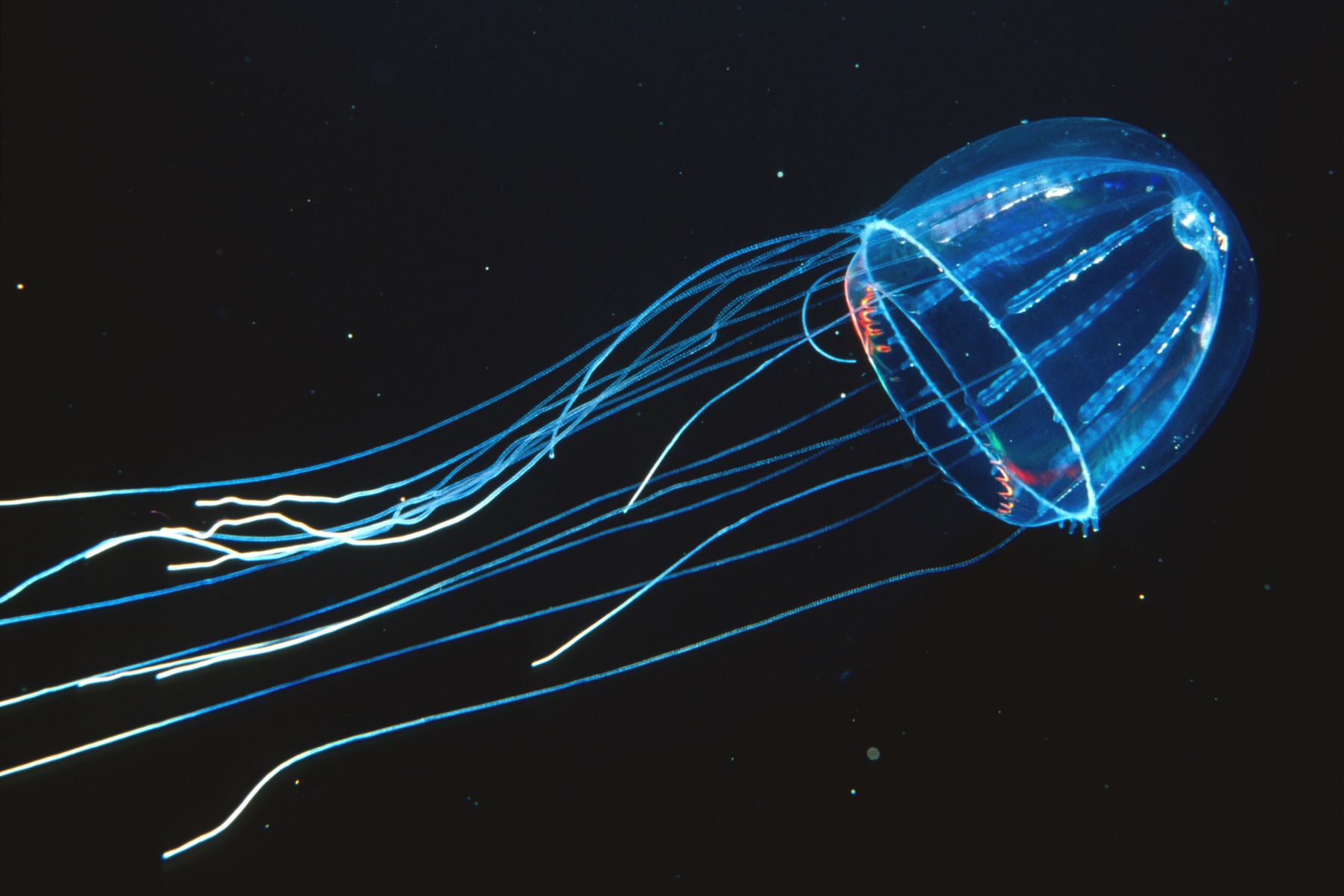
Crystal jellyfish glowing with hypnotic bioluminescence deep beneath the ocean
Why bioluminescence matters to science
Bioluminescence is important not only for marine life but also for science and technology. Research into these natural light-producing processes has contributed to developments in medicine and biotechnology. For example:
Medicine: Luciferin is used in research to detect and study biological processes, including disease-related activity.
Biotechnology: Bioluminescent systems can be used to monitor cells and bacteria.
New lighting technologies: Research into biological light production may contribute to low-energy lighting technologies.
In the darkness of the deep ocean, bioluminescence is more than a survival mechanism. It is one of the ways nature has adapted to an environment where sunlight is completely absent, while also giving scientists another way to study life.
Popular Myths & Misconceptions About the Mariana Trench
Myth 1: There are giant sea monsters in the trench.
There is no scientific evidence for this. Large deep-sea animals such as giant squid do exist, but there is no evidence of mythical “monsters” living in the trench.
Myth 2: The trench reaches all the way to Earth’s core.
That is incorrect. Earth's core begins far below the surface, with the planet's center about 6,371 km deep. The Mariana Trench is only around 11 km deep.
Myth 3: A crashed alien spaceship lies inside.
There is no scientific evidence for this either — it is simply internet fiction.
Artist’s depiction of an extraterrestrial spacecraft deep in the trench
These myths largely come from human curiosity, fear of the unknown, and stories that spread online. The darkness and inaccessibility of the trench naturally encourage speculation, but there is no scientific basis for these legends.
The reality is already fascinating enough. The Mariana Trench is a natural geological structure formed by Earth's tectonic processes, and much of what scientists have discovered there can be studied through geology, biology, and oceanography. As technology improves, more of its mysteries are gradually being replaced by evidence and scientific knowledge.
What Are Scientists Learning from the Mariana Trench?
Earth's formation and geological evolution
Subduction processes
Adaptation of deep-sea organisms
Discovery of new species
Possibility of life in extreme environments
Extent of pollution
How Earth's carbon cycle works
Understanding these processes can open new possibilities in climate science, biology, and other fields.
What Scientists Are Learning from the Mariana Trench
Research in the deep ocean not only improves our understanding of these remote environments but also gives scientists a clearer picture of Earth's wider biological and environmental systems. Studying places such as the Mariana Trench may help improve our understanding of climate processes, identify microbes that could have medical applications, and provide clues about how life might survive beyond Earth.
The ability of deep-sea microorganisms to survive without sunlight, with little oxygen, near-freezing temperatures, and extreme pressure shows that life can adapt to conditions very different from those on the surface. Similar environments may exist beneath the surfaces of other planets or moons. In that sense, the Mariana Trench is not just a marine mystery; it is also an important natural laboratory for studying the limits of life.
Comparison with Other Deep-Sea Trenches
Name of Trench
Depth (meters)
Location
Significance
Cause of Formation
Mariana Trench (Challenger Deep)
~10,984 – 11,094
Western Pacific Ocean
Deepest place on Earth; life survives even under extreme pressure; microbial life influences climate; key to understanding deep geological processes.
Formed due to the Pacific Plate subducting beneath the Mariana Plate.
Tonga Trench
~10,800
South Pacific Ocean
Fastest subduction zone on Earth; major source of earthquakes and volcanoes; important for seafloor seismic research.
Formed as the Pacific Plate sinks rapidly beneath the Tonga Plate (~24 cm per year).
Philippine Trench
~10,540
Philippine Sea
Crucial for understanding Southeast Asian tectonics; source of major tsunamis; an example of complex plate boundaries.
Formed as the Philippine Sea Plate subducts beneath the Eurasian Plate.
The Future of the Mariana Trench – A New Horizon of Research
In the coming years, scientists plan to map the trench floor using more advanced submersibles, sensors, and robotic systems.
AI-powered submersibles
Deep-sea robotic fleets
Biochemical analysis systems
Live deep-sea camera feeds
These technologies will provide new information about the largely unexplored regions beneath our planet's oceans.
With better research technologies, scientists will be able to map the deepest parts of the trench more accurately while also studying seafloor earthquakes, energy accumulation in subduction zones, and the ways new species adapt and evolve.
They will also be able to study deep-sea pollution, the movement of plastics, and the processes involved in carbon storage. In the future, the deep ocean may become a new frontier of exploration, much like space, as researchers continue to push the limits of what we know about our own planet.
Conclusion: Mariana Trench — Earth's Last Frontier
The Mariana Trench is one of nature's most remarkable places. Its extreme depth, enormous pressure, darkness, and isolation make it feel like another world. Humanity has sent people far beyond Earth into space, yet we are still only beginning to understand the deepest parts of our own planet.
Like the unknown universe, the Mariana Trench remains fascinating because it contains countless mysteries, unusual forms of life, and places that humans have barely explored.