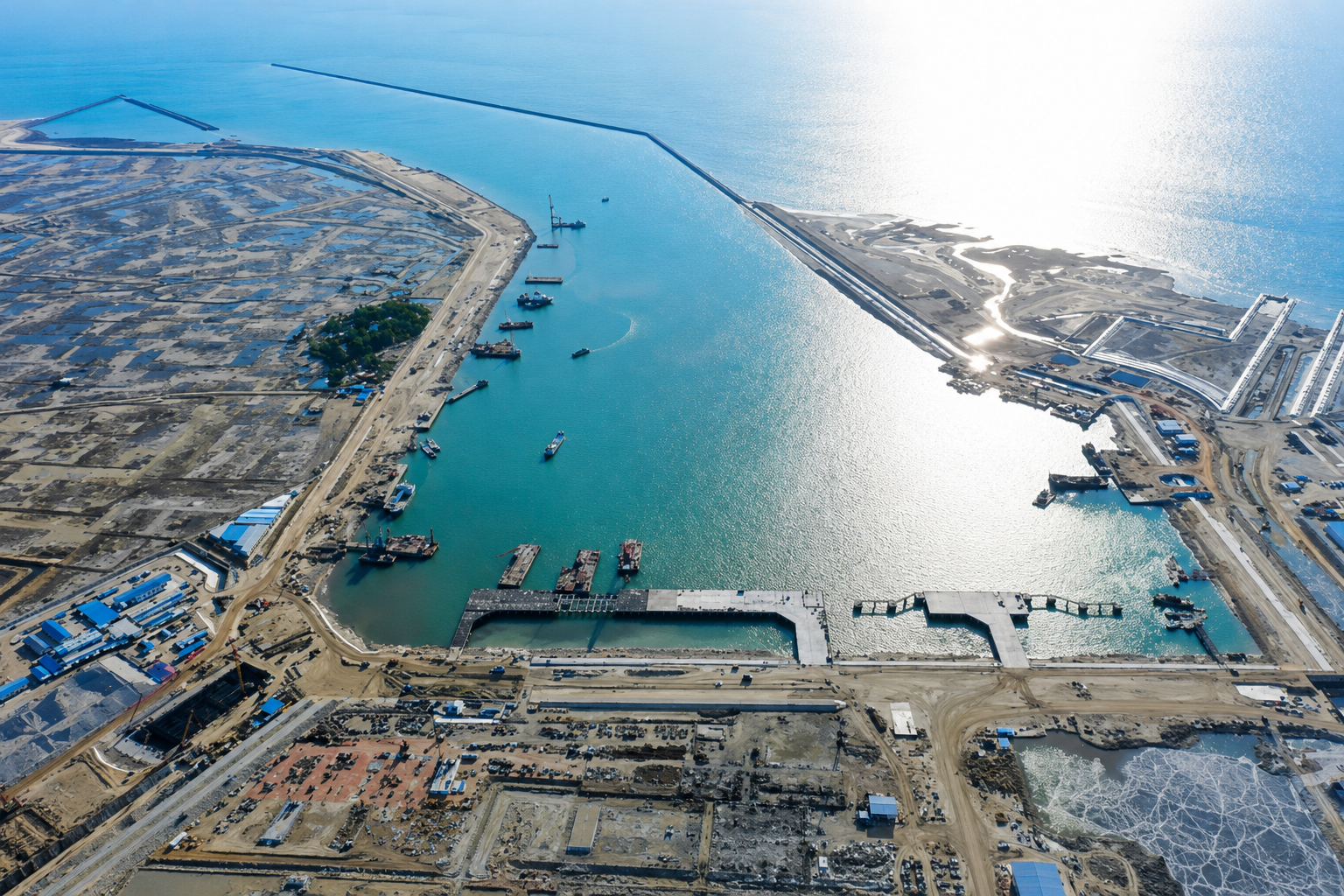
Matarbari Deep Sea Port — A Structural Embodiment of Bangladesh’s Maritime Ambitions.
Mega Project · Maritime Infrastructure · Energy · Bangladesh
Matarbari Deep Sea Port & Power Project: Bangladesh's Future Maritime–Energy Hub
Published:
When we talk about Bangladesh's mega projects, we usually think of bridges, metros, tunnels and highways. But down in Maheshkhali, on the coast of the Bay of Bengal, something quite different has been taking shape.
Matarbari is not just a port, and it is not just a power plant. The idea is to build a new maritime, energy, industrial and logistics hub for Bangladesh.
Deep-sea navigation, massive dredging, a 2×600 MW ultra-supercritical power plant, coal-import facilities, access roads, land acquisition, environmental safeguards, international financing and future regional connectivity all come together here. That is why the real Matarbari story is much bigger than the concrete and steel we can see.
So, let's take a straightforward look at how Matarbari was planned, financed, engineered, constructed and managed—and whether this huge investment can actually change Bangladesh's economic geography.
🌊 1. The Big Dream: Project Planning, Feasibility & Strategic Vision
Mega projects don't start with cranes, dredgers or giant construction camps. They start with a simple question: What problem are we trying to solve?
For Bangladesh, one part of the answer was clear. International trade has long depended heavily on Chattogram Port. As cargo volumes increased, limitations in navigational depth also became more important. That created a need for a new maritime gateway that could handle much larger vessels.
"Don't just expand the old gateway. Build a new one."
That is essentially the thinking behind Matarbari. The plan was not simply to build another port. The larger idea was to create an integrated maritime and industrial hub connecting the Bay of Bengal with Bangladesh's road network, energy infrastructure, industries and, eventually, regional supply chains.
📍 Location: Why Matarbari?
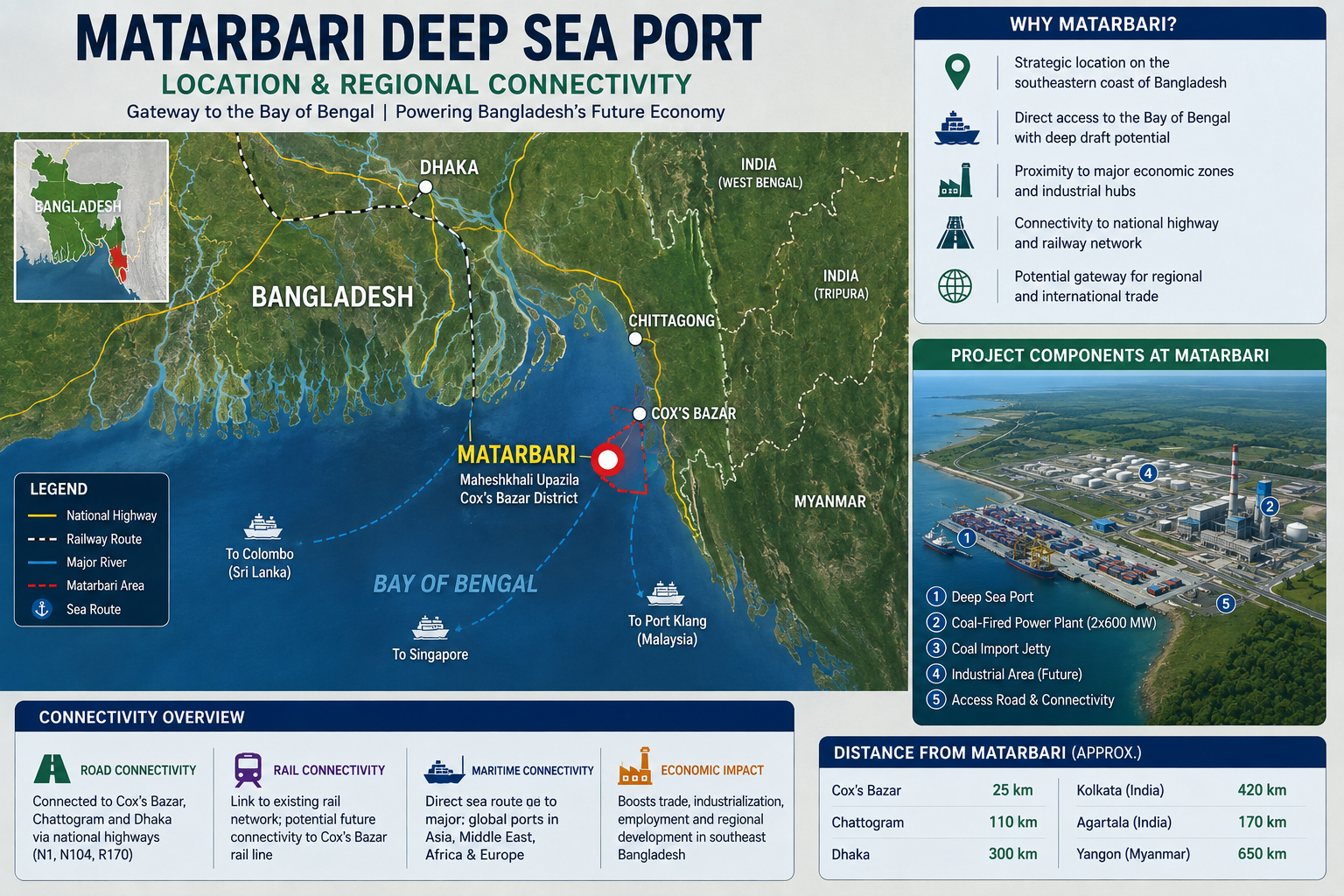
Matarbari is located in Maheshkhali Upazila of Cox's Bazar District, on Bangladesh's southeastern coast. Its location offers something that conventional inland infrastructure cannot: direct access to the Bay of Bengal, along with the possibility of developing a deeper navigation channel.
The location also made sense because the port could be developed alongside the large energy and industrial facilities already being planned for the Maheshkhali–Matarbari area.
Matarbari's strategic location on Bangladesh's southeastern coast
🎯 From Port Project to Economic Corridor
The interesting part is that planners were not treating Matarbari as an isolated harbour. The broader idea brings several pieces together:
Port – the maritime gateway for cargo handling.
Road – moving cargo between the port and the rest of Bangladesh.
Power – providing energy for industrial development.
Industry – creating new cargo and attracting investment.
Logistics – warehousing, distribution and supply-chain services.
Regional trade – potentially connecting Bangladesh with wider Bay of Bengal supply chains.
In simple terms, the port is expected to handle cargo, while industries generate more cargo for the port. Roads move that cargo inland, energy supports industrial growth, and better regional connectivity could open up markets beyond Bangladesh.
A port is useful because ships come to it. A mega-port becomes transformative when an entire economy grows around it.
💰 2. Financial Architecture: Who Is Paying for Matarbari?
There is no realistic way to build infrastructure on this scale from a normal annual development budget. Matarbari is therefore a major example of Bangladesh using international development financing, sovereign funding and institutional investment to build strategic infrastructure.
💴 Port Financing
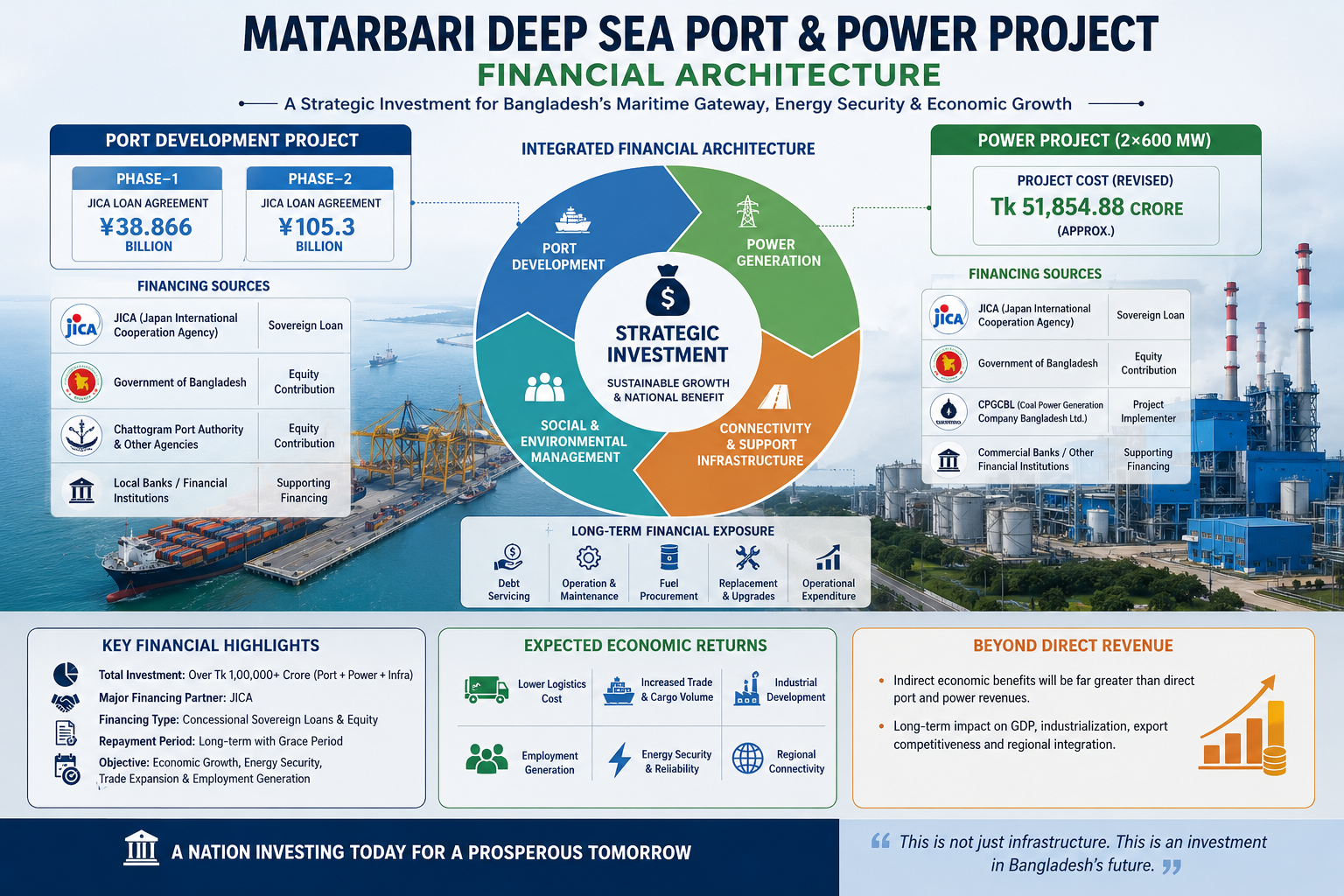
First Phase: The first phase of the Matarbari Port Development Project was supported through a JICA loan agreement of approximately ¥38.866 billion.
Second Phase: A much larger second phase followed with a JICA loan agreement of approximately ¥105.3 billion.
Government Contribution: Bangladesh's public-sector institutions remain responsible for significant parts of the associated infrastructure and development costs.
Long-Term Financial Exposure: Paying for a mega project does not end when construction ends. Debt servicing, maintenance, fuel procurement, replacement equipment and operating costs continue for years.
Financial architecture behind the Matarbari development
📊 The Cost Reality
The power project alone shows how large the financial commitment is. Its original approved cost was reported at around Tk 35,984 crore, while later revisions pushed the reported project cost to approximately Tk 51,854.88 crore.
That naturally raises an important question:
"Is Matarbari going to earn enough to justify what Bangladesh is spending?"
That's a fair question, and there is no way to answer it properly without looking at decades of actual operation.
The economic return also cannot be judged only by direct port revenue. Potential benefits include:
Lower logistics costs.
Faster cargo movement.
Less congestion at existing gateways.
Access for larger vessels.
More reliable supply chains.
Industrial investment.
Employment generation.
Greater export competitiveness.
Potential regional trade.
⚡ 3. The Other Giant: Matarbari 2×600 MW Ultra Supercritical Power Project
Before getting into the port itself, we need to look at the other huge part of the Matarbari project: the 2×600 MW Ultra Supercritical Coal-Fired Power Project, implemented by the Coal Power Generation Company Bangladesh Limited (CPGCBL).
This was not simply a power station built on the coast. It needed an entire supporting system around it.
Generation Units: Two 600 MW-class generating units.
Coal Import Jetty: A dedicated maritime facility for receiving imported coal.
Coal Handling: Systems for unloading, conveying, crushing and storing coal.
Coal Storage: Large-scale fuel storage to support continuous generation.
Transmission: High-voltage infrastructure for sending the generated electricity to the grid.
Township & Support Facilities: Housing, roads and other facilities needed to operate a large industrial complex.
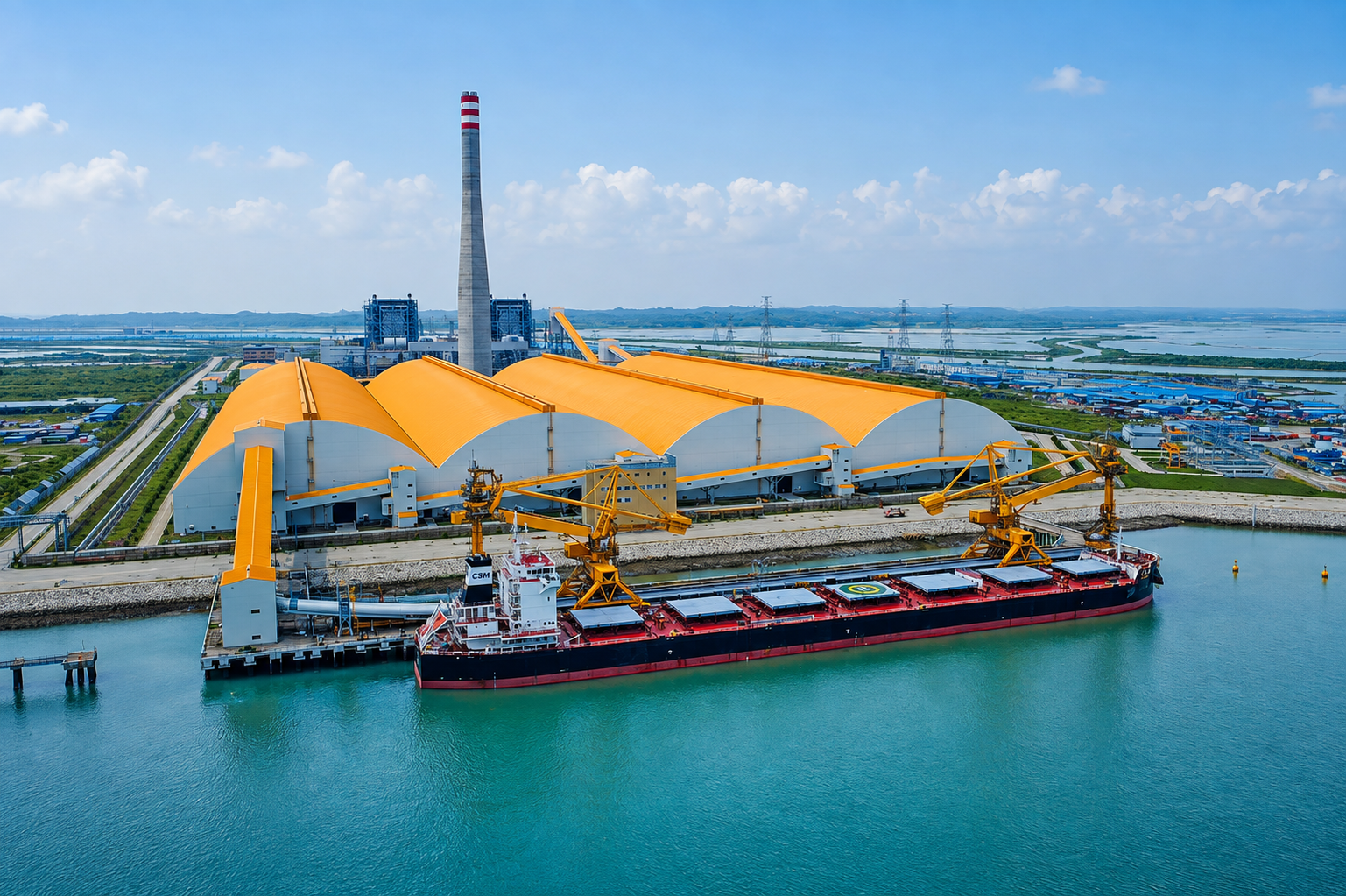
Matarbari 1,200-MW Ultra-Supercritical Coal-Fired Power Plant
🔥 Why Ultra Supercritical?
Ultra-supercritical technology uses higher steam temperatures and pressures than conventional subcritical coal plants. The basic goal is better thermal efficiency—getting more electricity from each unit of coal.
The Matarbari project was designed around an efficiency figure of approximately 41.99%.
More efficient does not mean environmentally neutral. It simply means getting more electricity from the same amount of fuel.
That distinction matters when we look at the environmental and long-term economic implications of Matarbari.
⚙️ 4. Design & Engineering: Building Where the Sea Is the Foundation
Building a deep-sea port is nothing like building a highway interchange. Here, the ground moves, the water moves, the seabed changes and, every so often, the Bay of Bengal makes it very clear that nature is still in charge.
🌊 Marine Engineering Challenges
Engineers have to deal with a long list of variables:
Tidal Variation: Water levels change continuously.
Wave Action: Harbour structures have to withstand repeated wave loading.
Cyclones: The Bay of Bengal is one of the world's cyclone-prone regions.
Sedimentation: Channels can gradually become shallower as sediment builds up.
Scouring: Strong currents can remove seabed material around structures.
Soft Coastal Soil: Foundations have to account for settlement and geotechnical instability.
Ship Manoeuvrability: Turning basins and channels need enough space for large vessels to manoeuvre safely.
Corrosion: Marine structures need long-term protection from harsh coastal conditions.
Extreme Weather: Designs must account for storm surges and extreme wind and wave conditions.
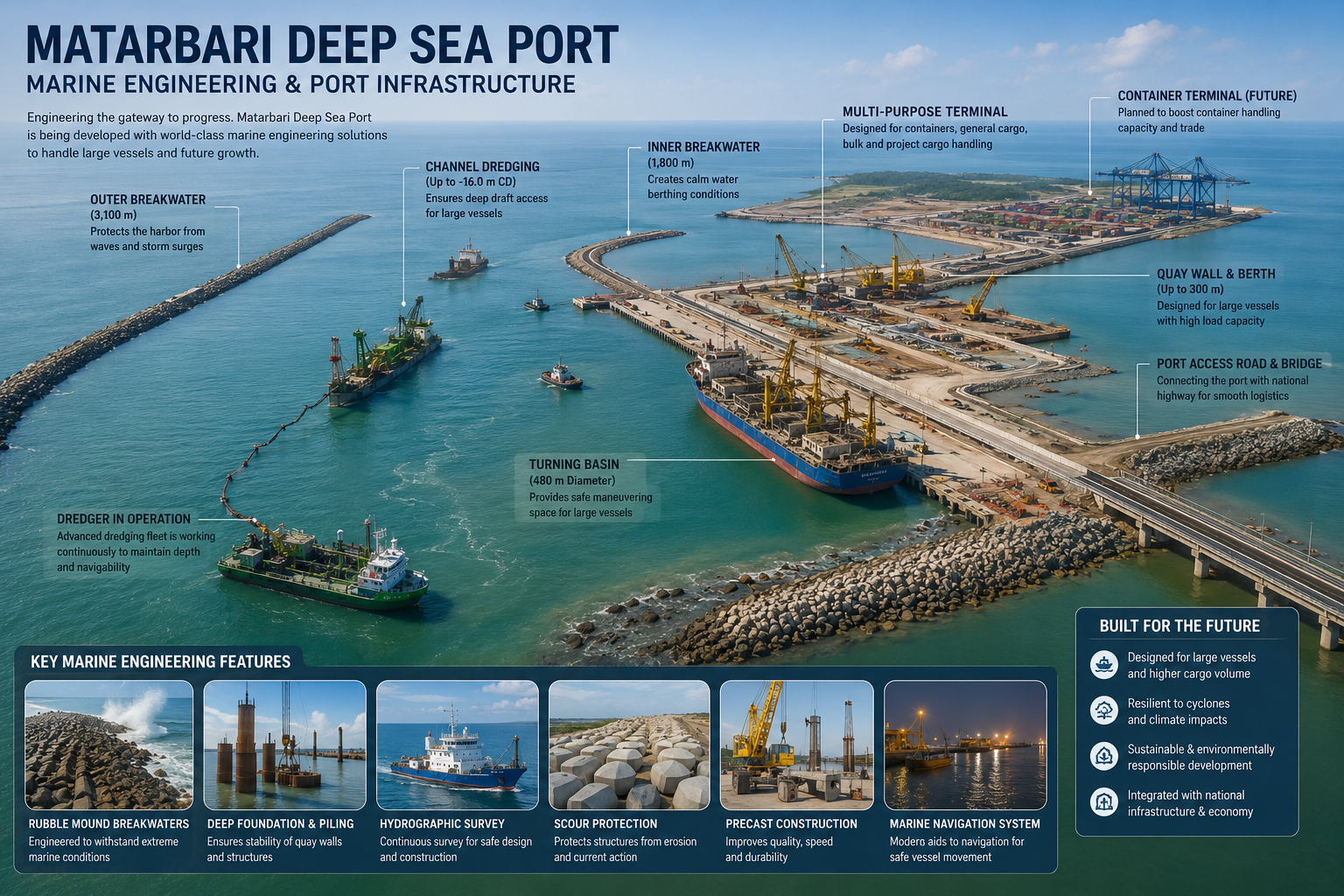
Marine engineering challenges of a deep-sea port
🏗️ Breakwaters, Quays & Harbour Structures
Breakwaters are built to create a relatively sheltered harbour by reducing the impact of waves and storms.
Quay structures, meanwhile, have to carry huge loads from ships, cranes, containers, vehicles and cargo-handling operations.
This is where marine structural engineering, geotechnical engineering and hydraulic engineering all have to come together.
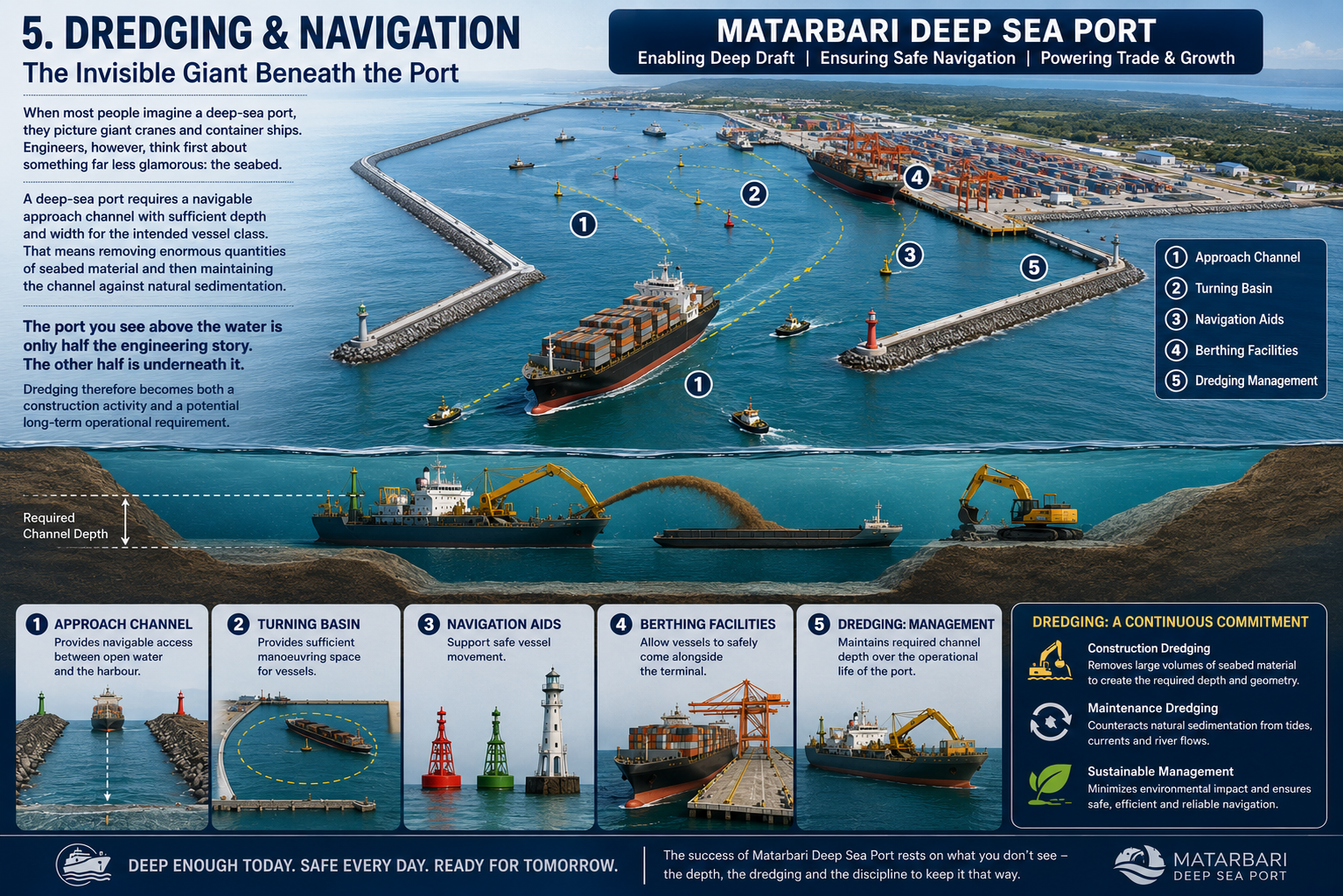
🚢 5. Dredging & Navigation: The Invisible Giant Beneath the Port
When most people imagine a deep-sea port, they picture giant cranes and container ships. Engineers, however, may first think about something much less visible: the seabed.
A deep-sea port needs an approach channel with enough depth and width for the vessels it is designed to handle. That means removing huge amounts of seabed material and then keeping the channel clear as sediment naturally builds up again.
The port you see above the water is only half the engineering story. The other half is underneath it.
Dredging is therefore not just a construction job. It can also remain a major operational requirement throughout the life of the port.
Dredging & Navigation of the Matarbari Deep Sea Port
🛳️ Navigation Infrastructure
Approach Channel: Provides navigable access between open water and the harbour.
Turning Basin: Provides enough room for vessels to manoeuvre.
Navigation Aids: Help vessels move safely.
Berthing Facilities: Allow vessels to come safely alongside the terminal.
Dredging Management: Maintains the required channel depth throughout the operational life of the port.
The second phase of the Matarbari port programme includes major dredging and port-basin development, which shows just how important navigation depth is to the entire business case.
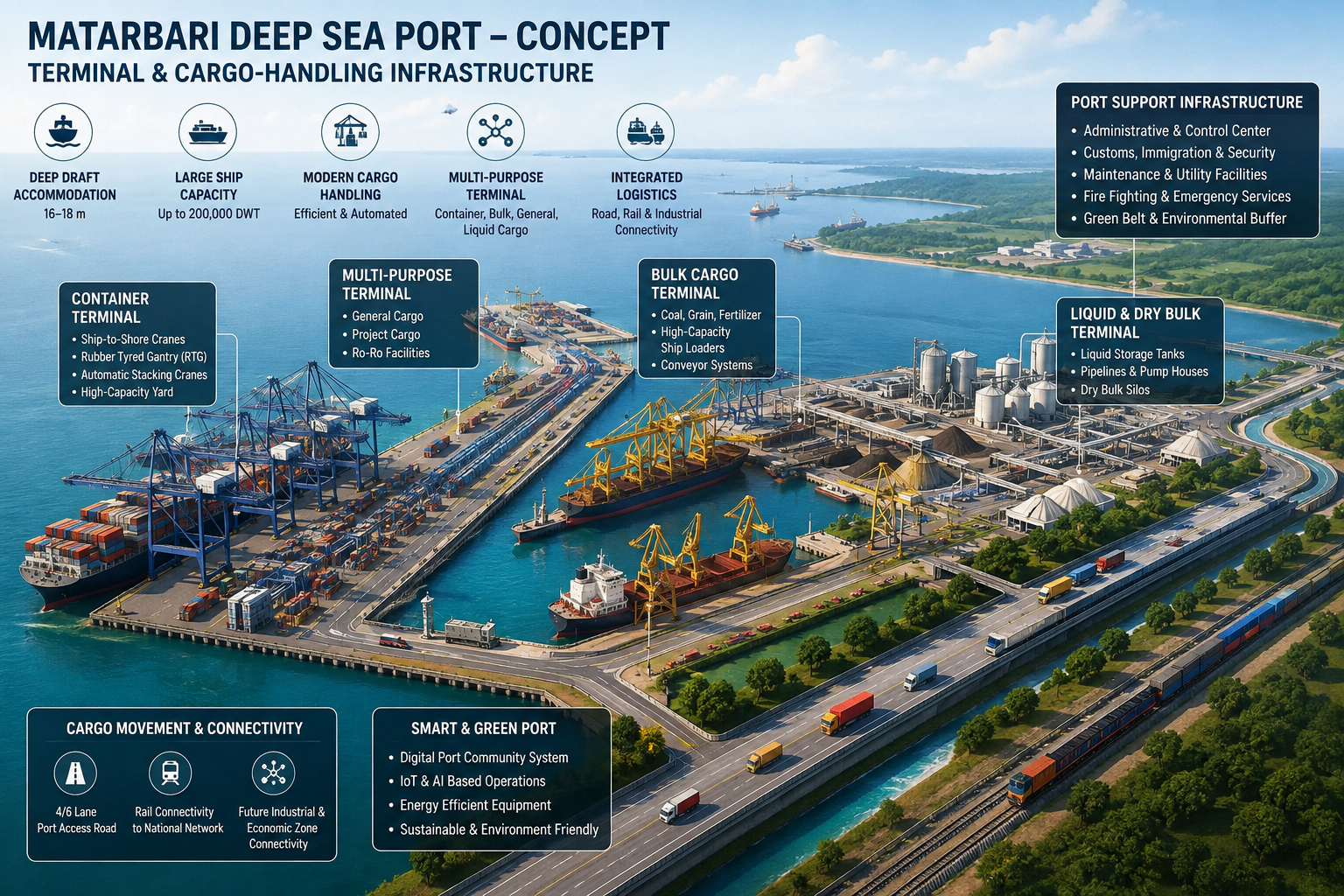
📦 6. Terminal Design: Containers, General Cargo & Multipurpose Operations
A modern port cannot depend on a deep channel alone. Once a ship arrives, the real question is: How quickly and efficiently can its cargo be handled?
Matarbari's development therefore includes multipurpose terminal facilities designed to handle different types of cargo.
General Cargo: Handling cargo that does not move in containers.
Break-Bulk: Cargo that needs specialised handling.
Project Cargo: Heavy and oversized industrial equipment.
Industrial Cargo: Materials linked to future industrial development.
The idea is flexibility. A multipurpose port can adapt to changing cargo patterns instead of depending too heavily on a single type of trade.
Concept of terminal and cargo-handling infrastructure
📋 7. Project Management & Construction Progress
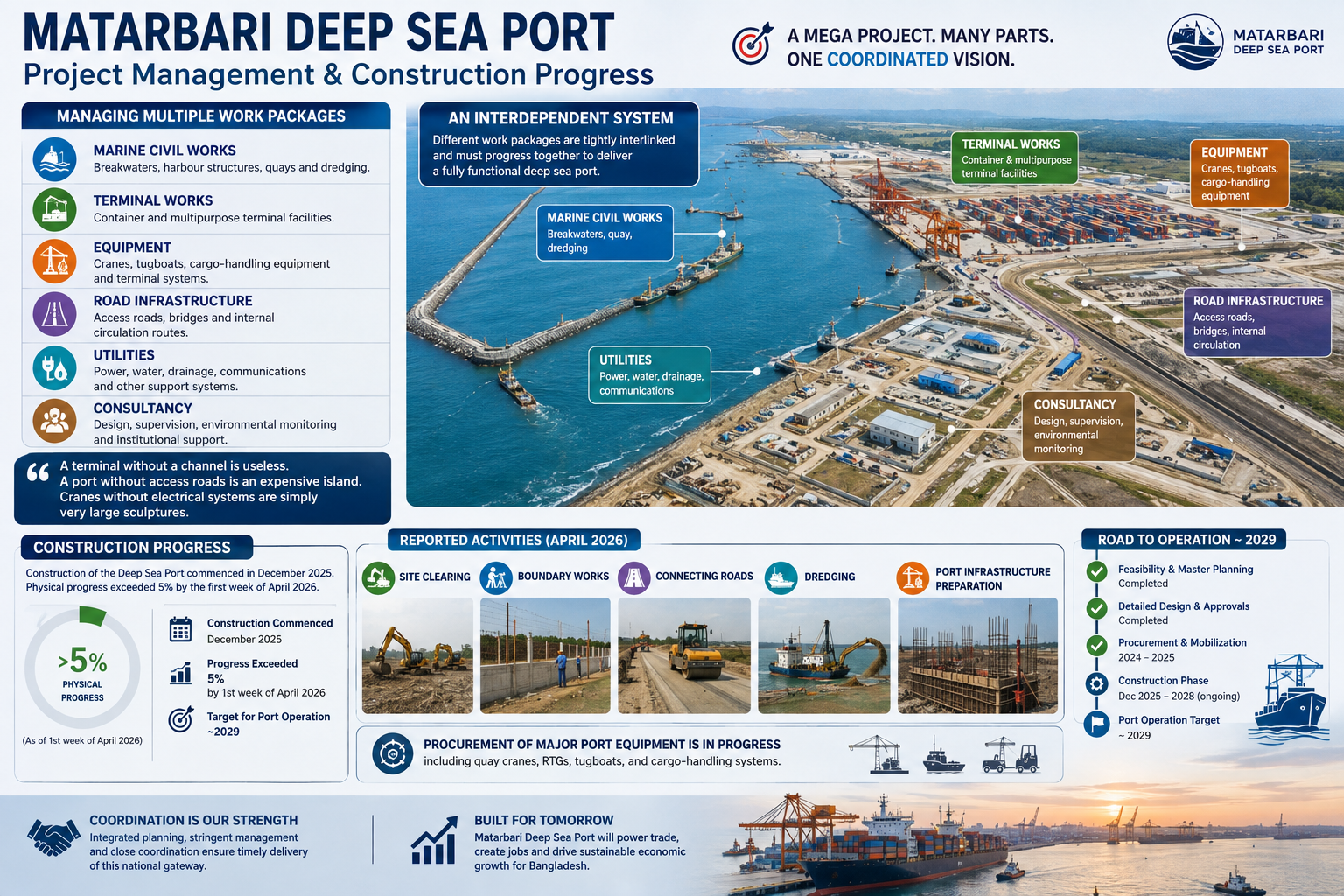
Calling Matarbari "one project" is actually a little misleading. From a project-management point of view, it is more like a programme made up of several interdependent projects and contract packages.
🧩 Managing Multiple Work Packages
Marine Civil Works: Breakwaters, harbour structures, quays and dredging.
Terminal Works: Container and multipurpose terminal facilities.
Equipment: Cranes, tugboats, cargo-handling equipment and terminal systems.
Road Infrastructure: Access roads, bridges and internal circulation routes.
Utilities: Power, water, drainage, communications and other support systems.
Consultancy: Design, supervision, environmental monitoring and institutional support.
Project Management & Construction Progress of the Project
The management gets even more complicated because these different packages depend on one another.
A terminal without a channel is useless. A port without access roads is an expensive island. Cranes without electrical systems are simply very large sculptures.
📈 Construction Progress
Recent reporting in April 2026 indicated that construction of the Deep Sea Port had started in December 2025, with physical progress exceeding 5% by the first week of April 2026.
Reported activities included:
Site clearing.
Boundary works.
Connecting roads.
Dredging.
Preparation of port-related infrastructure.
Procurement of major port equipment was also moving forward, with the programme targeting port operations around 2029.
📑 8. Procurement & Contract Management
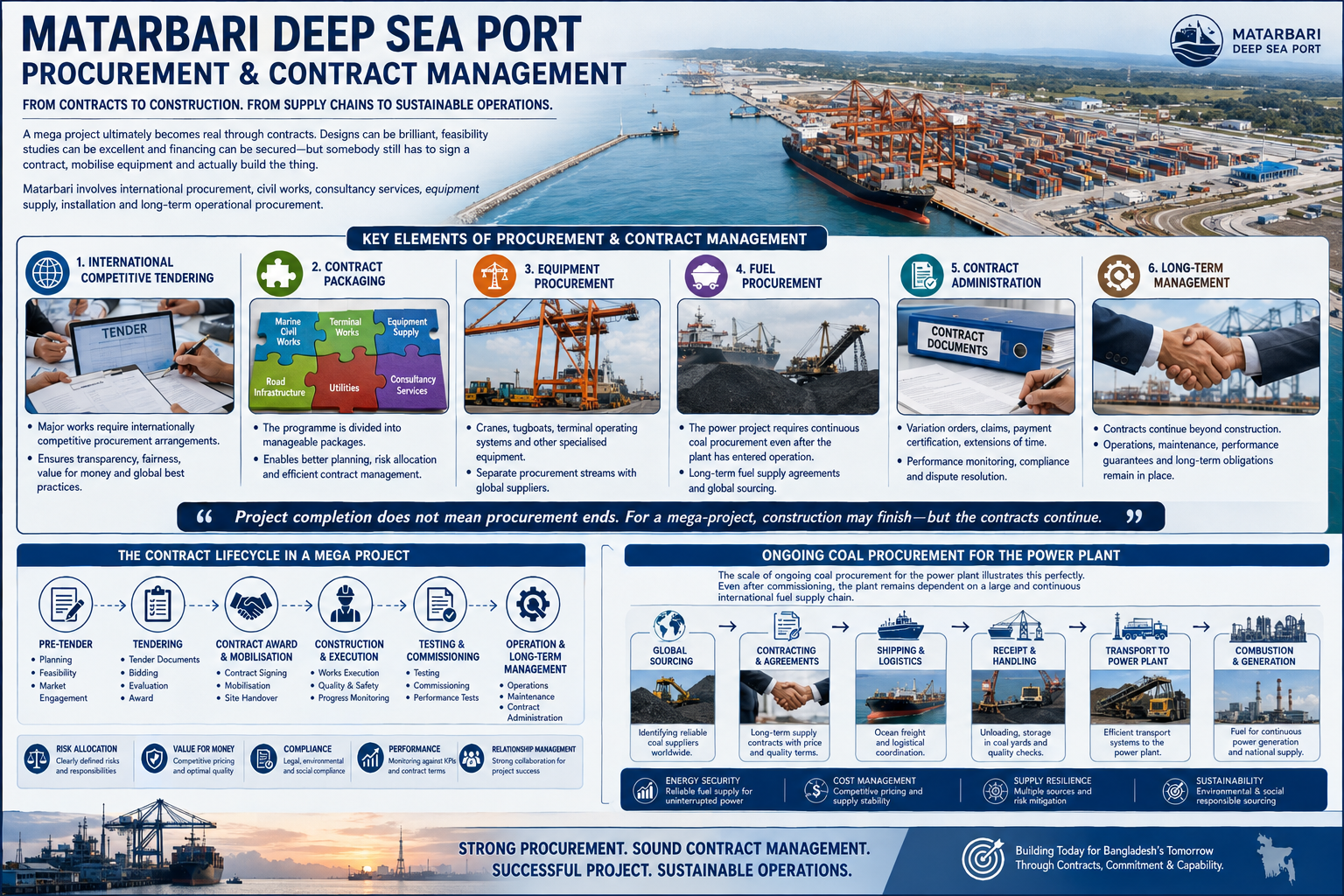
A mega project eventually comes down to contracts. Designs can be excellent, feasibility studies can be solid and financing can be secured—but someone still has to sign the contracts, bring in the equipment and build the project.
Procurement & Construction Management Progress of the Project
Matarbari involves international procurement, civil works, consultancy services, equipment supply, installation and long-term operational procurement.
International Competitive Tendering: Major works require internationally competitive procurement arrangements.
Contract Packaging: The programme is divided into manageable packages instead of treating the entire development as one enormous contract.
Equipment Procurement: Cranes, tugboats, terminal operating systems and other specialised equipment are procured through separate streams.
Fuel Procurement: The power project will need continuous coal procurement even after the plant enters operation.
Contract Administration: Variation orders, claims, payment certification, extensions of time and performance monitoring all become part of the long-term management process.
Project completion does not mean procurement ends. For a mega-project, construction may finish—but the contracts continue.
The scale of coal procurement for the power plant shows this clearly. Even after commissioning, the plant will remain dependent on a large and continuous international fuel supply chain.
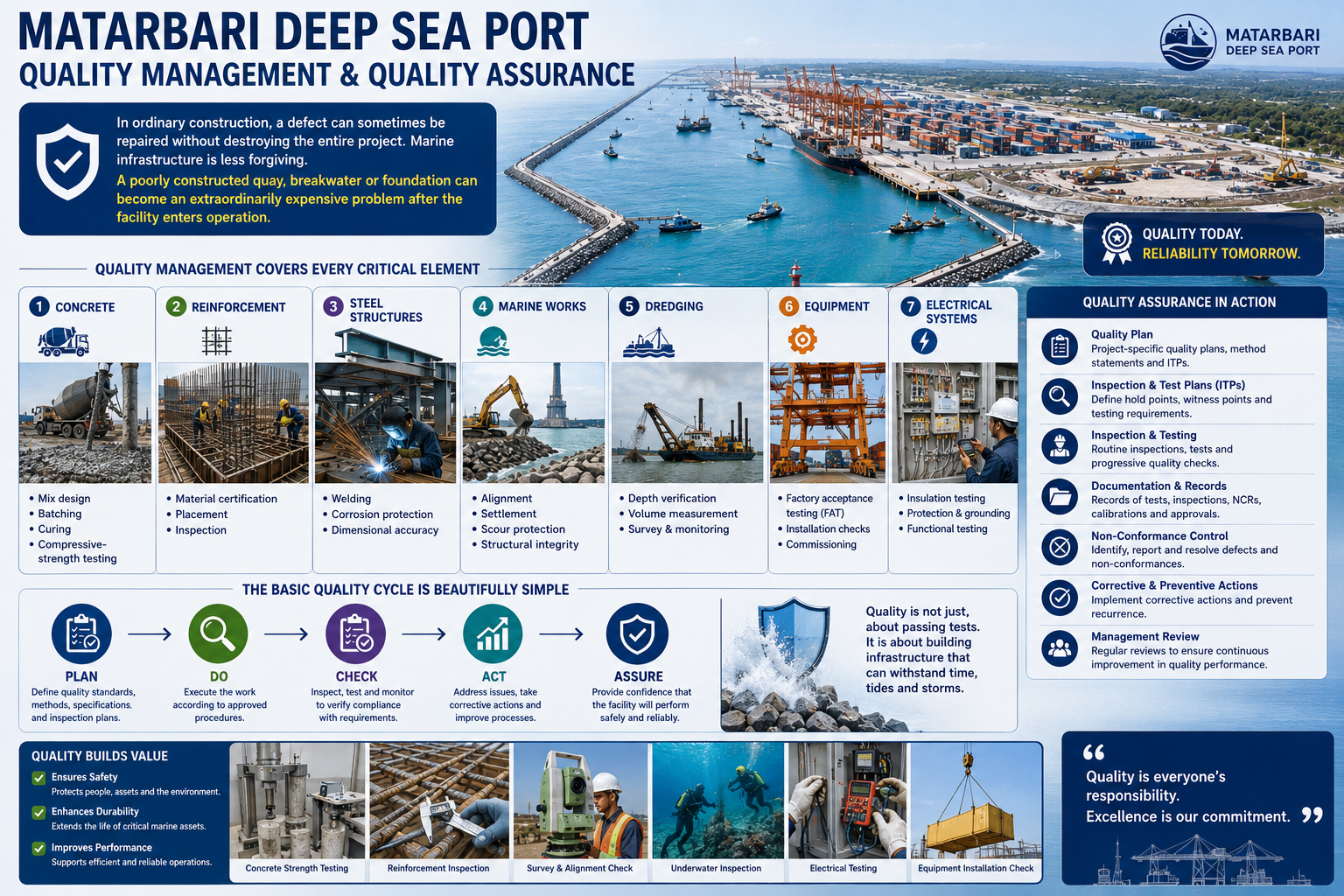
🔬 9. Quality Management & Quality Assurance
In ordinary construction, a defect can sometimes be fixed without putting the whole project at risk. Marine infrastructure is much less forgiving.
A poorly built quay, breakwater or foundation can turn into an extremely expensive problem once the facility is operating.
Quality management therefore needs to cover:
Quality Management & Quality Assurance of the Project
Concrete: Mix design, batching, curing and compressive-strength testing.
Reinforcement: Material certification, placement and inspection.
Steel Structures: Welding, corrosion protection and dimensional accuracy.
Marine Works: Alignment, settlement, scour protection and structural integrity.
Dredging: Depth verification and volume measurement.
Equipment: Factory acceptance testing, installation checks and commissioning.
Electrical Systems: Insulation, protection, grounding and functional testing.
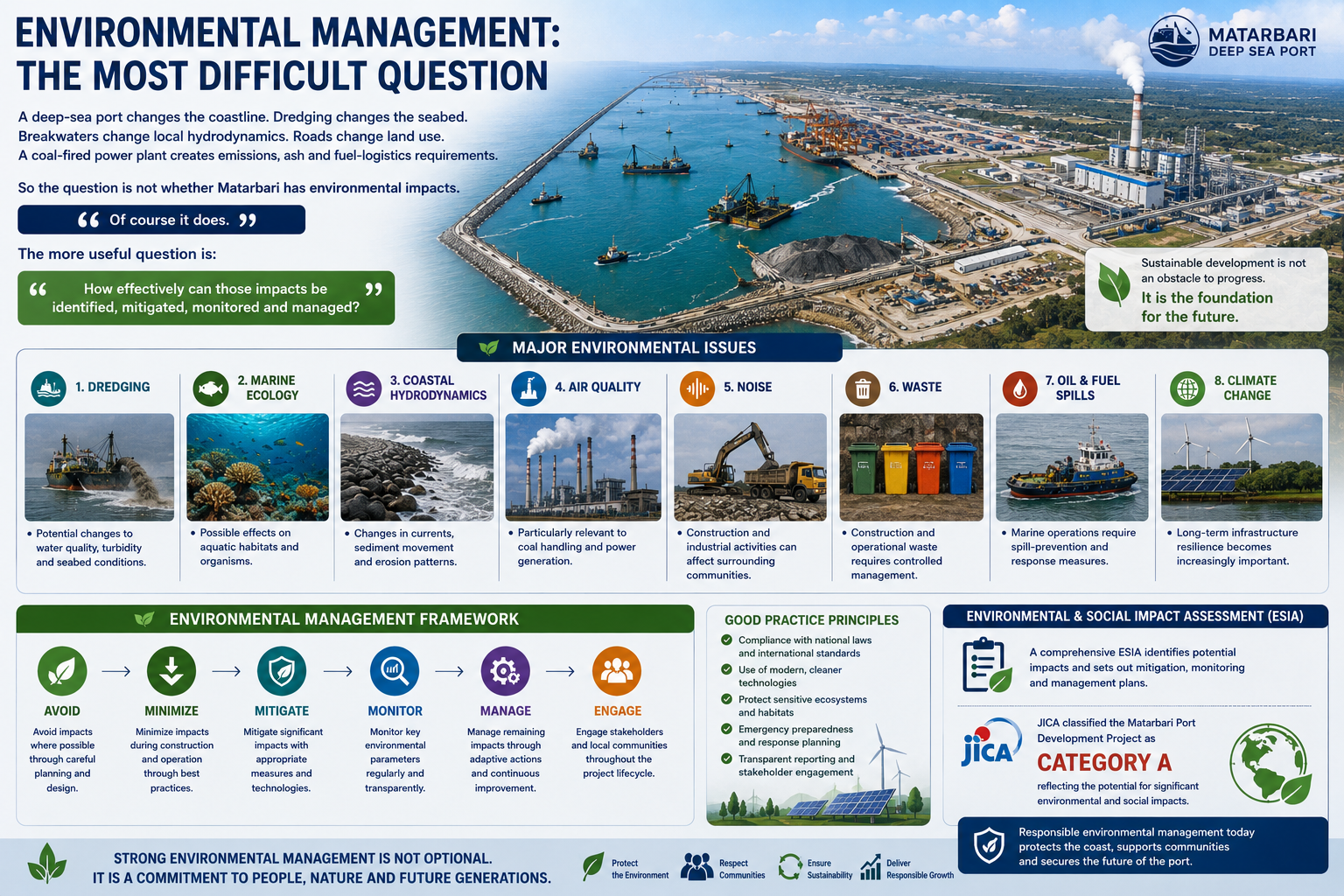
🌱 10. Environmental Management: The Most Difficult Question
This is where the Matarbari story gets more complicated.
A deep-sea port changes the coastline. Dredging changes the seabed. Breakwaters change local water movement. Roads change land use. A coal-fired power plant adds emissions, ash and fuel-logistics requirements.
So the question is not whether Matarbari will have environmental impacts.
"Of course it will."
Environmental Management of the Project
The more useful question is:
How effectively can those impacts be identified, reduced, monitored and managed?
🌿 Major Environmental Issues
Dredging: Potential changes to water quality, turbidity and seabed conditions.
Marine Ecology: Possible effects on aquatic habitats and organisms.
Coastal Hydrodynamics: Changes in currents, sediment movement and erosion patterns.
Air Quality: Particularly important because of coal handling and power generation.
Noise: Construction and industrial activities can affect nearby communities.
Waste: Construction and operational waste needs to be properly controlled.
Oil & Fuel Spills: Marine operations need spill-prevention and response measures.
Climate Change: Long-term infrastructure resilience is becoming increasingly important.
JICA classified the Matarbari Port Development Project as Category A, reflecting its potential for significant environmental and social impacts.
The environmental assessment of Matarbari has changed along with the project itself. Large infrastructure projects often change during detailed design, so environmental assessment cannot simply remain fixed at the feasibility stage.
Environmental assessment and approval have covered areas such as:
Port facilities.
Shipping channels.
Breakwaters.
Access roads.
Transmission infrastructure.
Electrification components.
Changes in road alignment.
Environmental assessment is not necessarily a one-time document.
When the engineering changes, the environmental baseline and mitigation measures may also need to change.
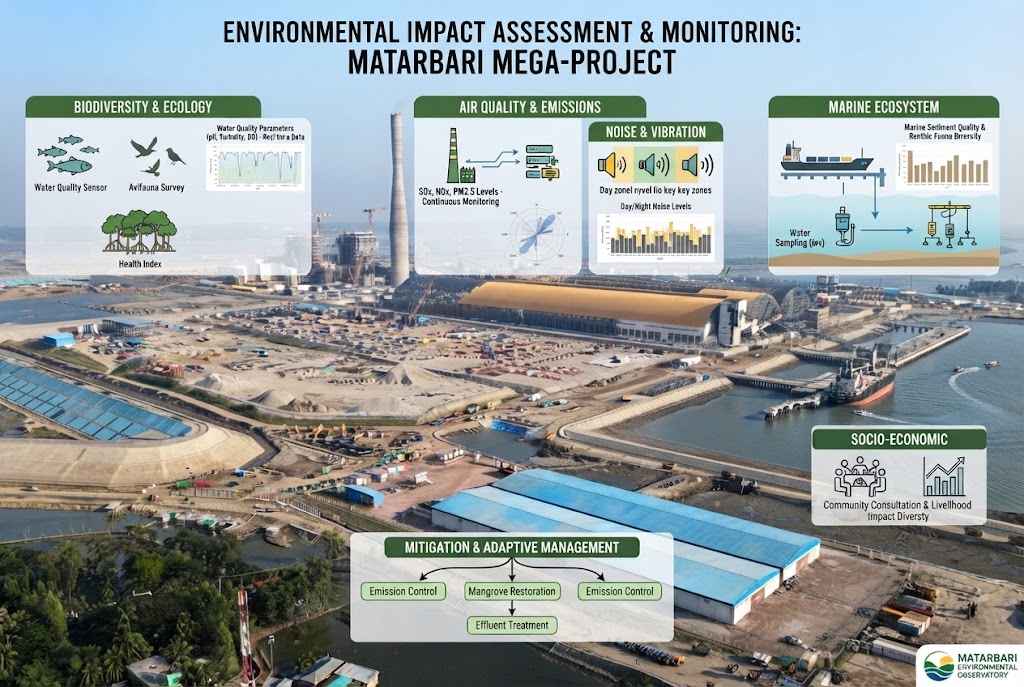
Environmental Impact Assessment & Monitoring of Matarbari (Port & Power Plant)
🔍 Environmental Monitoring
Water quality monitoring.
Air quality monitoring.
Noise monitoring.
Sediment and dredging monitoring.
Marine ecological monitoring.
Waste-management monitoring.
Occupational and community environmental monitoring.
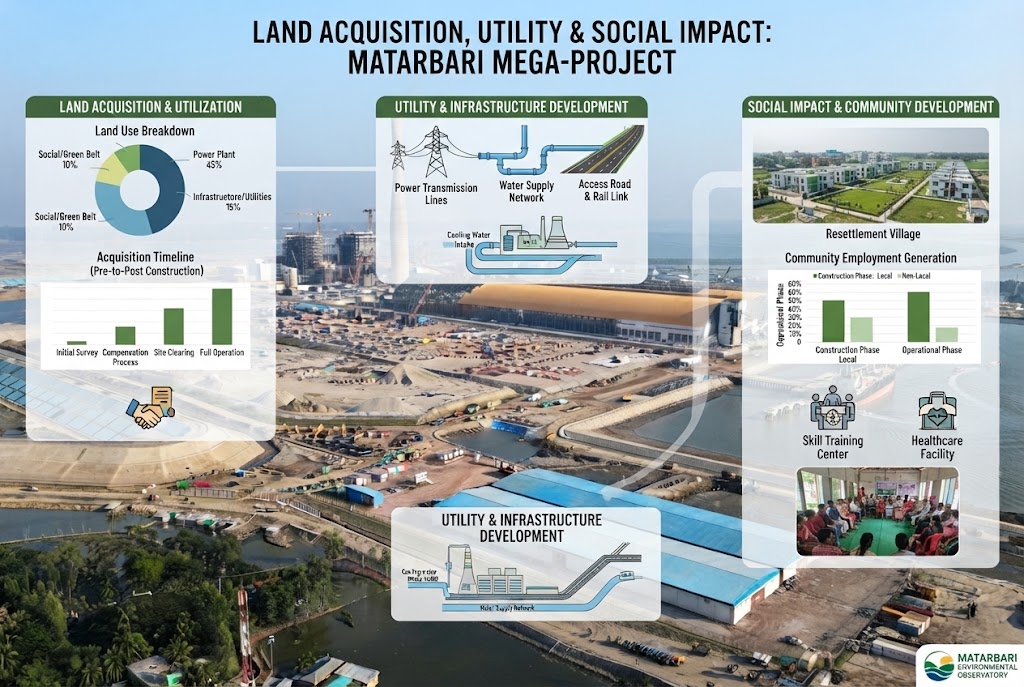
🏘️ 12. Land Acquisition, Utility & Social Impact
Infrastructure ultimately needs physical space.
That means land.
The Matarbari power project alone was developed over approximately 1,414 acres in Matarbari and Dhalghata unions. The port and associated road infrastructure also require land acquisition and resettlement.
The scale of the access-road work gives some idea of what is involved, with an approximately 18.7 km access road along with bridges and connecting infrastructure.
🏠 What Land Acquisition Really Means
Land acquisition isn't just an engineering calculation. Behind every plot being acquired, there may be:
Households.
Agricultural activities.
Businesses.
Livelihoods.
Community networks.
Social relationships.
Compensation is necessary, but compensation alone does not automatically restore people's lives and livelihoods.
🔌 Utility Infrastructure
Electricity.
Water supply.
Drainage.
Roads.
Telecommunications.
Housing.
Security.
Fire protection.
Waste management.
Community facilities.
Land Acquisition, Utility & Social Impact of Matarbari (Port & Power Plant)
The power project itself included township development and rural electrification components, showing that a mega project can bring infrastructure beyond its immediate industrial site.
🦺 13. HSE — Health, Safety & Environment
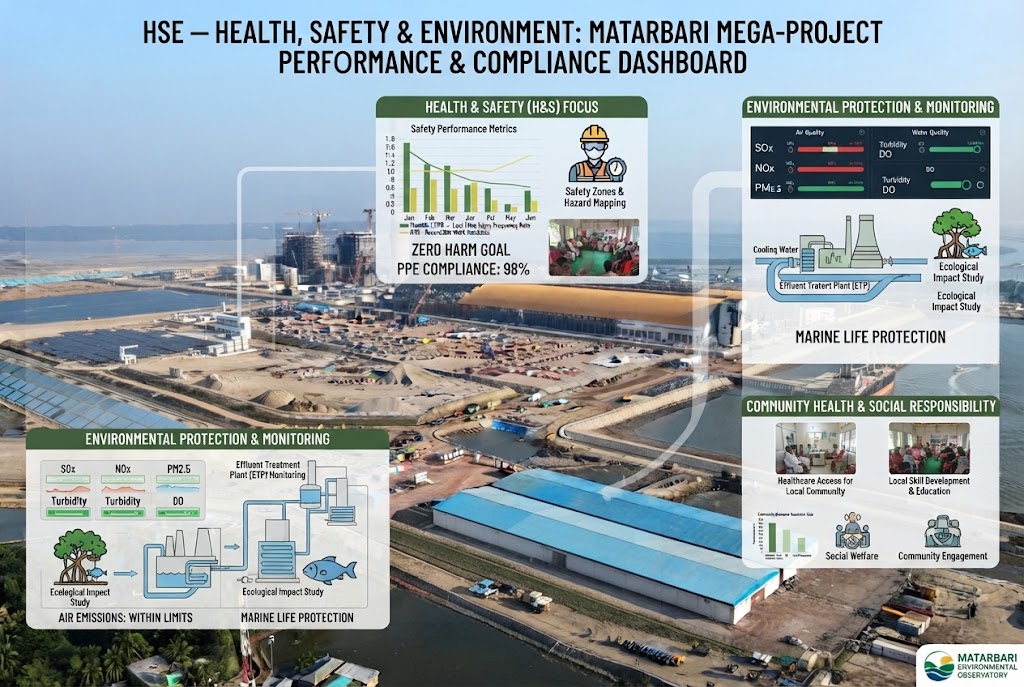
A project involving heavy cranes, dredgers, marine construction, large vessels, coal, high-voltage electricity and massive construction equipment needs a strong HSE system to operate safely.
HSE Dashboard of Matarbari Mega Project
🏗️ Construction Safety
Work at height.
Lifting operations.
Excavation.
Heavy equipment operation.
Marine construction.
Confined-space work.
Temporary electrical installations.
⚡ Electrical Safety
High-voltage systems.
Electrical isolation.
Lockout/tagout.
Grounding and earthing.
Protection systems.
🚢 Marine Safety
Vessel movement.
Dredging operations.
Diving activities.
Navigation.
Marine traffic management.
🔥 Emergency Preparedness
Fire.
Cyclone.
Flooding.
Vessel collision.
Fuel or oil incidents.
Major equipment failure.
Medical emergencies.
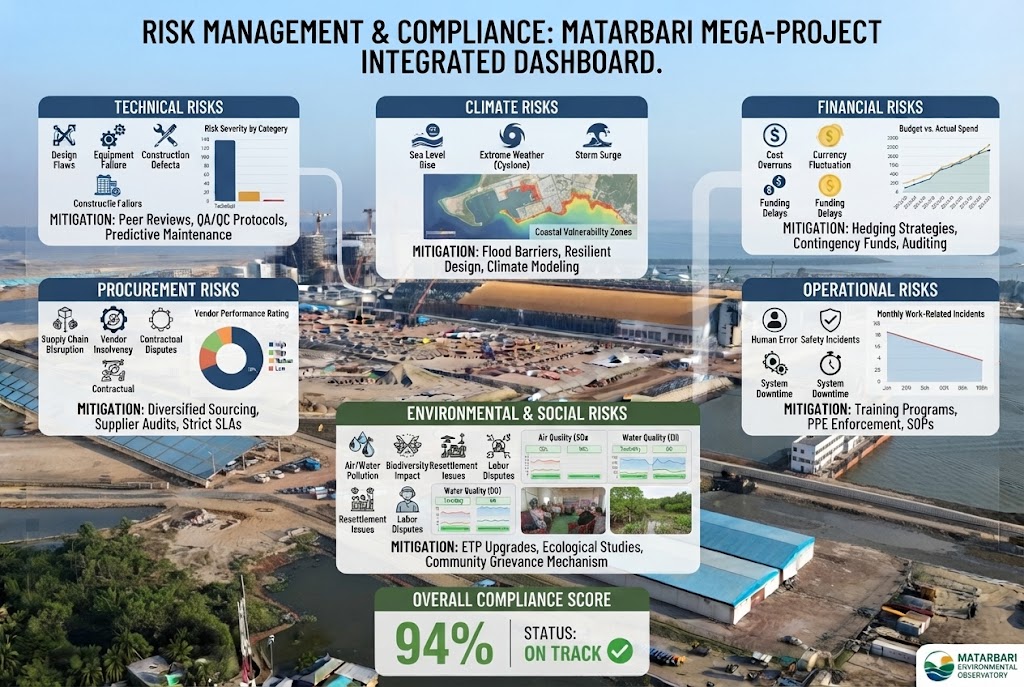
⚠️ 14. Risk Management & Compliance: What Could Go Wrong?
Matarbari has a huge risk register. Some risks are technical, some financial, some environmental, some geopolitical, and some simply come from the sheer complexity of managing thousands of people and hundreds of contracts.
🔧 Technical Risks
Sedimentation.
Soft soil.
Structural settlement.
Equipment failure.
Dredging difficulties.
Marine structural deterioration.
🌪️ Climate Risks
Cyclones.
Storm surges.
Sea-level rise.
Extreme rainfall.
Coastal erosion.
Risk Management & Compliance of Matarbari Mega Project
💵 Financial Risks
Exchange-rate fluctuations.
Interest costs.
Construction inflation.
Imported equipment costs.
Fuel-price volatility.
📑 Procurement Risks
Tender delays.
Contractor performance.
Supply-chain disruption.
Contract disputes.
Variation claims.
⚓ Operational Risks
Lower-than-expected cargo volumes.
Vessel scheduling challenges.
Competition from regional ports.
High operating costs.
Insufficient shipping-line participation.
🌱 Environmental & Social Risks
Dredging impacts.
Coastal ecological impacts.
Air emissions.
Marine pollution.
Land acquisition.
Resettlement.
Livelihood disruption.
Community concerns.
A mega project therefore cannot be judged simply by whether the concrete is finished. The real test is whether the infrastructure remains economically, technically and environmentally viable over the next several decades.
🧪 15. Testing, Commissioning & Handover
Moving from construction to actual operation is a major stage of the project in its own right.
⚓ Port Commissioning
Navigation systems.
Berthing systems.
Quay cranes.
Yard equipment.
Terminal operating systems.
Gate systems.
Electrical systems.
Fire protection systems.
Security systems.
Communication systems.
Customs interfaces.
Vessel operations.
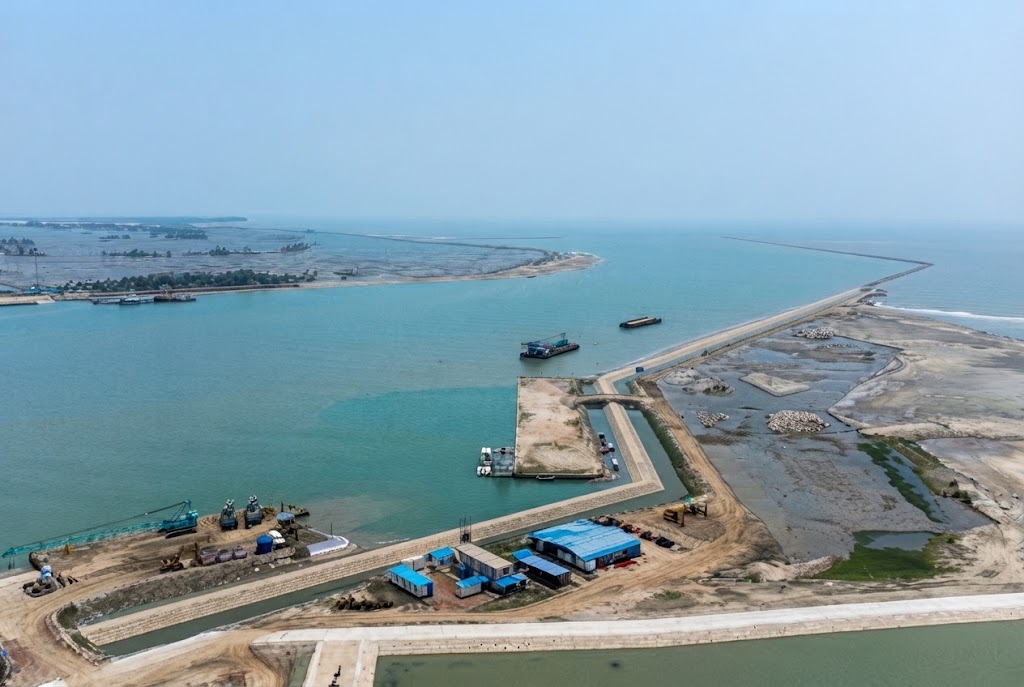
The Channel of the Matarbari Deep Sea Port
⚡ Power Plant Commissioning
Boiler testing.
Turbine testing.
Generator testing.
Synchronisation.
Protection-system testing.
Transformer testing.
Emission-control testing.
Coal-handling testing.
Performance testing.
A plant can physically generate electricity and still not be fully operational from a project-management perspective. Likewise, a port can have a quay and still not be commercially ready.
Handover therefore involves much more than a ribbon-cutting ceremony. It includes documentation, training, asset registers, warranties, maintenance plans, operating procedures and formal acceptance.
⚓ 16. Operational Phase: The Real Test Begins After Opening
Finishing construction is not the final victory.
It is the beginning of the business.
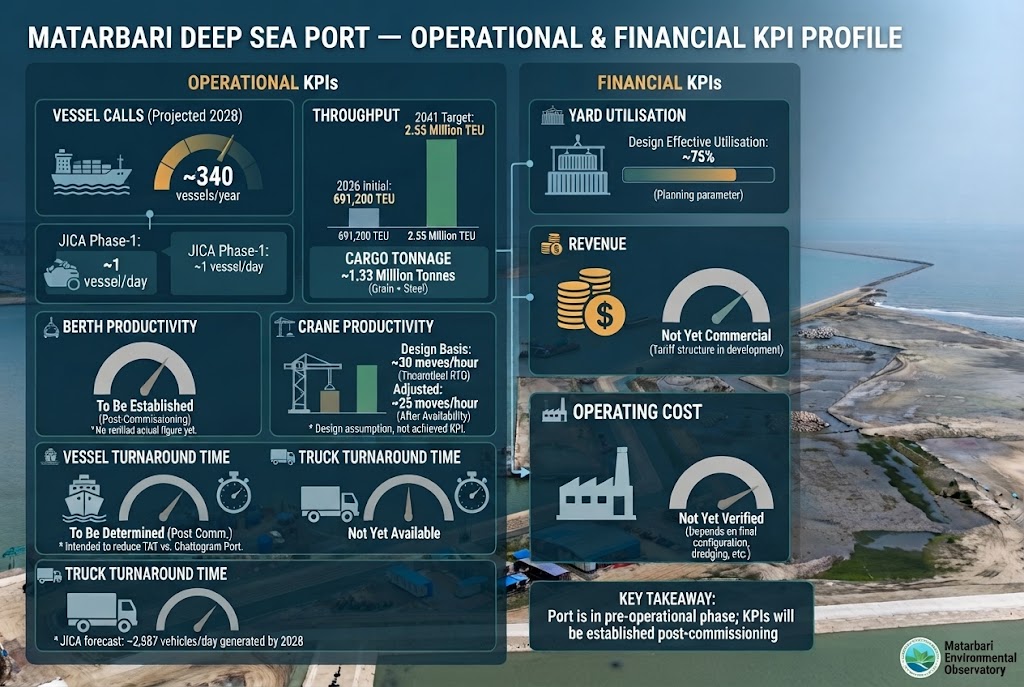
For the port, success will eventually be measured by operational and commercial results, not by how much concrete was poured.
Vessel Calls: ~340 vessels/year projected around 2028
TEU Throughput: 691,200 TEU/year initial design/demand level; 2.55 million TEU/year by 2041
Cargo Tonnage: ~1.93 million tonnes/year of grain + steel in the initial Phase-1 demand case
Berth Productivity: No verified actual operating figure yet
Crane Productivity: Design basis: ~30 moves/hour
Vessel Turnaround Time: No actual Matarbari commercial-port figure yet
Operating Cost: No verified actual Matarbari operating-cost figure yet
Operational & Financial KPI Profile of Matarbari Deep Sea Port
The most impressive port in the world is useless if shipping lines don't want to use it.
The real test of Matarbari will not be how impressive it looks from the shoreline, but how efficiently the global shipping industry uses it.
🌏 17. Regional Connectivity: Bangladesh Beyond Its Own Borders
This may be Matarbari's most interesting long-term possibility.
Bangladesh sits at an important point between:
South Asia.
Southeast Asia.
The Bay of Bengal.
India's Northeast.
Nepal.
Bhutan.
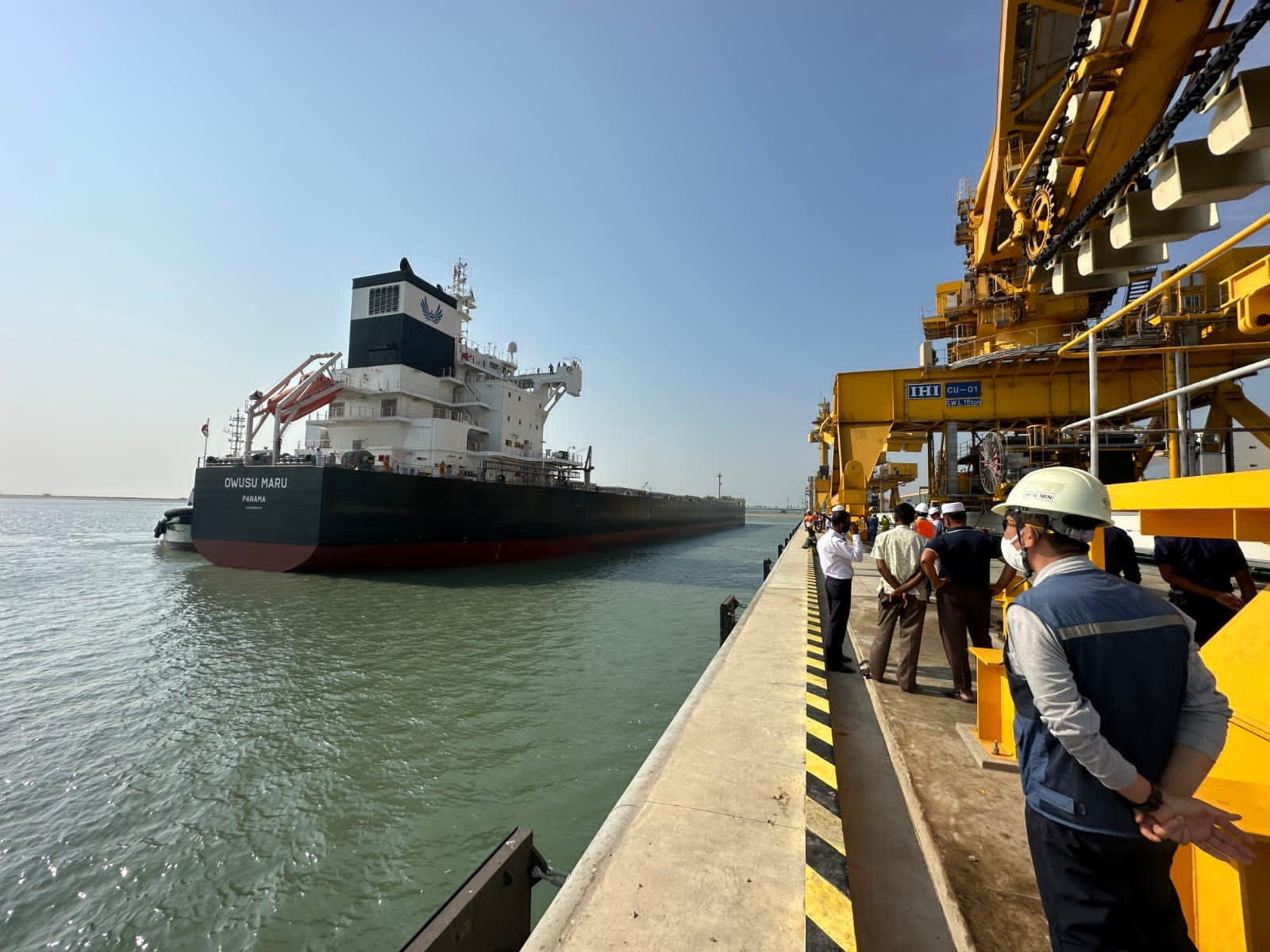
The very first Commercial Vessel Anchored on the Matarbari Port
A successful deep-sea port could improve Bangladesh's position in regional logistics and supply chains.
Matarbari should not be judged only as Bangladesh's next port. It should also be seen as a potential gateway to a wider regional logistics network.
🚀 18. Futuristic Planning: What Could Matarbari Become?
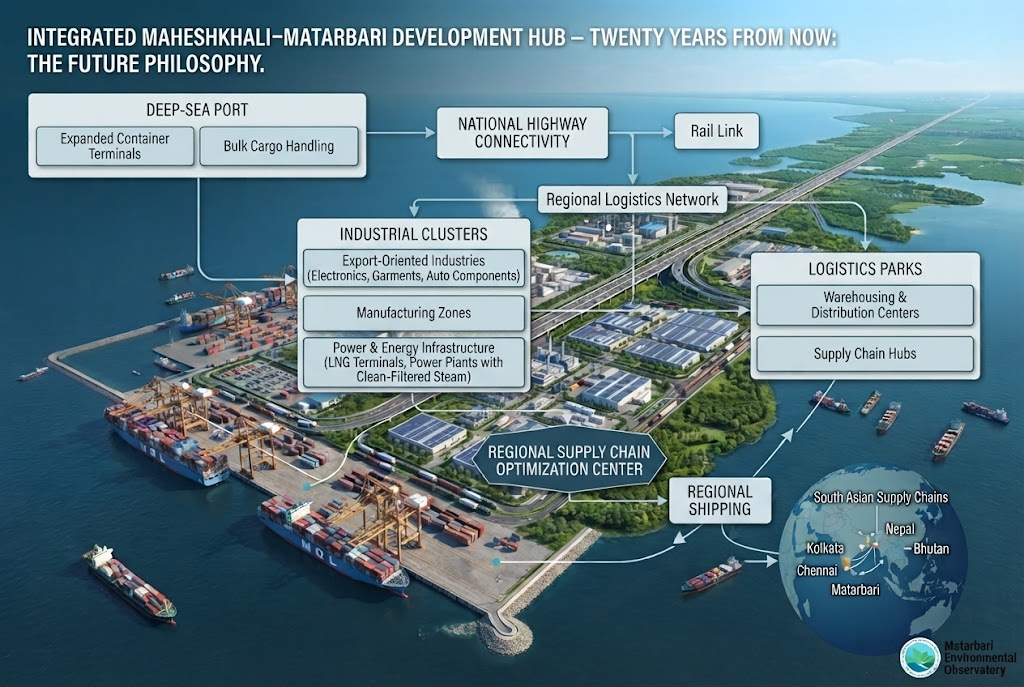
Perhaps the boldest part of Matarbari is that the development was never really about today's cargo alone.
The broader vision has been to create an integrated Maheshkhali–Matarbari development hub.
Imagine the system twenty years from now:
Deep-Sea Port
↓
National Highway Connectivity
↓
Industrial Clusters
↓
Logistics Parks
↓
Warehousing & Distribution
↓
Power & Energy Infrastructure
↓
Export-Oriented Industries
↓
Regional Shipping
↓
South Asian Supply Chains
This is the basic idea behind the project's long-term planning.
Instead of building infrastructure separately, the goal is to create infrastructure that makes other infrastructure economically useful.
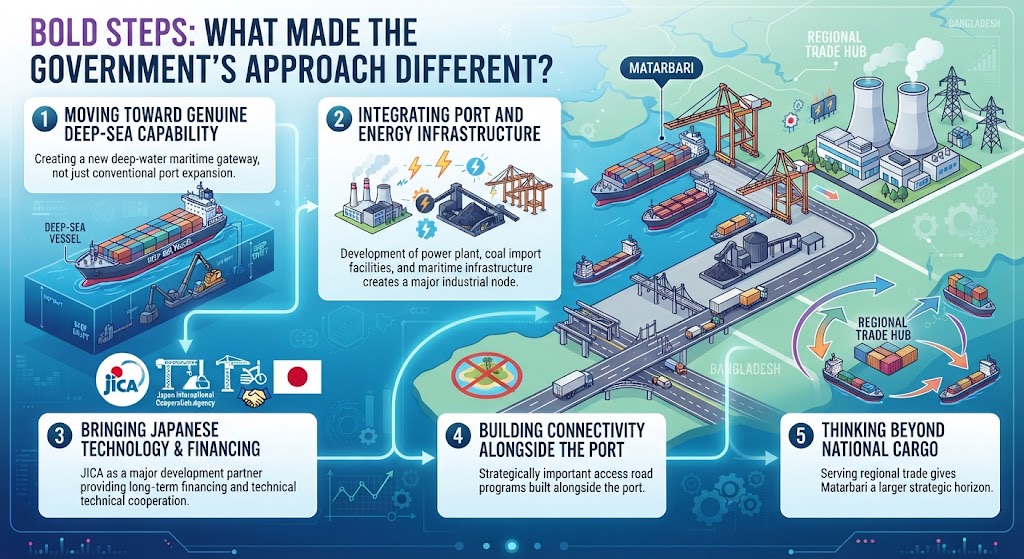
🌏 19. Bold Steps: What Made the Government's Approach Different?
Whatever one's political view of mega projects may be, several decisions around Matarbari were clearly ambitious from an infrastructure-planning point of view.
1️⃣ Moving Toward Genuine Deep-Sea Capability
Instead of relying entirely on conventional port expansion, Bangladesh committed to developing a new deep-water maritime gateway.
2️⃣ Integrating Port and Energy Infrastructure
The power plant, coal-import facilities and maritime infrastructure together created a major industrial node.
Bold Steps: What Made the Government's Approach Different
3️⃣ Bringing Japanese Technology and Financing
JICA became a major development partner for both the port and power infrastructure, providing long-term development financing and technical cooperation.
4️⃣ Building Connectivity Alongside the Port
A port without roads is an island. That is why the associated access-road programme is so important.
5️⃣ Thinking Beyond National Cargo
The possibility of serving regional trade gives Matarbari a much wider strategic horizon.
The boldest decision was not simply building a port. It was betting that the port could become the anchor of a much larger economic ecosystem.
💸 20. Cost, Financial Sustainability & The Reality Check
This is where the discussion gets more complicated.
Mega projects naturally bring up one question:
"How much is this costing Bangladesh?"
That is a fair question.
But there is another question that needs to be asked at the same time:
"What would it cost Bangladesh if inadequate infrastructure held back trade for the next 30–50 years?"
That is much harder to calculate.
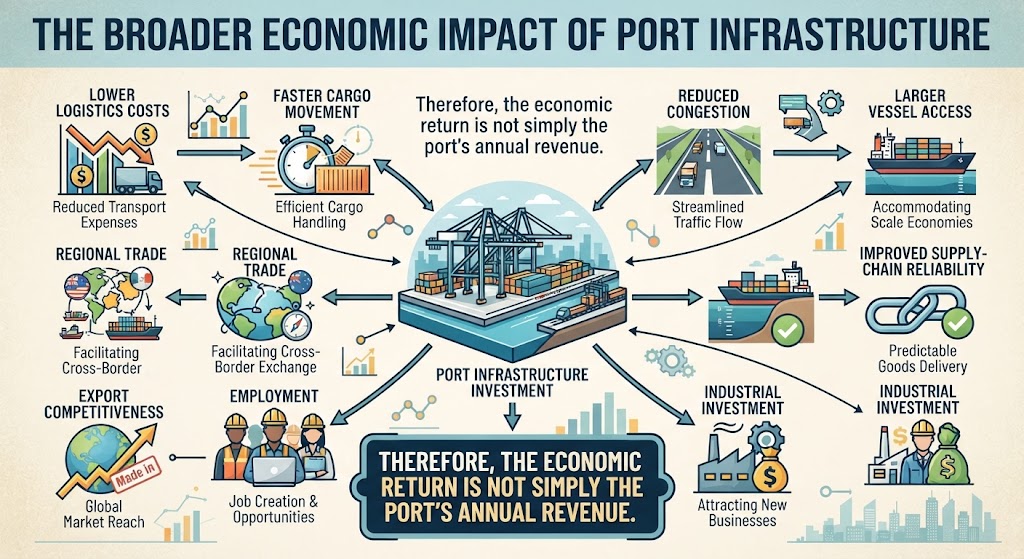
Port infrastructure can create wider economic benefits through:
Lower logistics costs.
Faster cargo movement.
Reduced congestion.
Larger vessel access.
Improved supply-chain reliability.
Industrial investment.
Employment.
Export competitiveness.
Regional trade.
So, the economic return cannot be measured simply by the port's annual revenue.
The real economic return could be much broader than the balance sheet of the port authority.
❓ 21. The Difficult Questions We Cannot Ignore
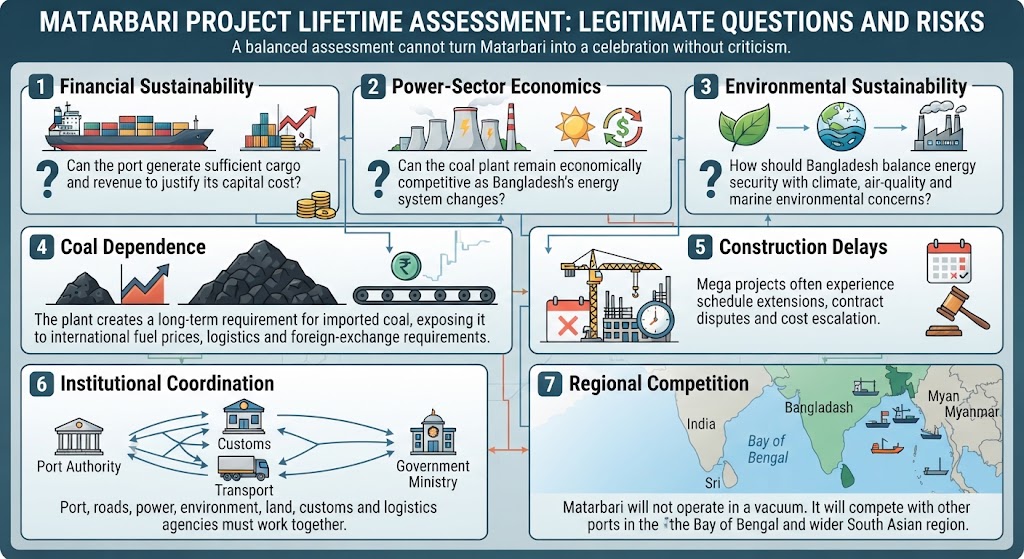
A balanced assessment cannot turn Matarbari into a celebration without also asking difficult questions. There are legitimate issues that will need to be answered throughout the project's life.
The Difficult Questions We Cannot Ignore regarding the Project
💰 Financial Sustainability
Can the port generate enough cargo and revenue to justify its capital cost?
⚡ Power-Sector Economics
Can the coal plant remain economically competitive as Bangladesh's energy system changes?
🌱 Environmental Sustainability
How should Bangladesh balance energy security with climate, air-quality and marine environmental concerns?
🪨 Coal Dependence
The plant creates a long-term need for imported coal, exposing it to international fuel prices, logistics and foreign-exchange requirements.
⏱️ Construction Delays
Mega projects often face schedule extensions, contract disputes and cost increases.
🏛️ Institutional Coordination
Port, roads, power, environment, land, customs and logistics agencies all need to work together.
🌏 Regional Competition
Matarbari will not operate in isolation. It will compete with other ports in the Bay of Bengal and across the wider South Asian region.
These questions do not automatically invalidate the project. They show what needs to be managed carefully after construction.
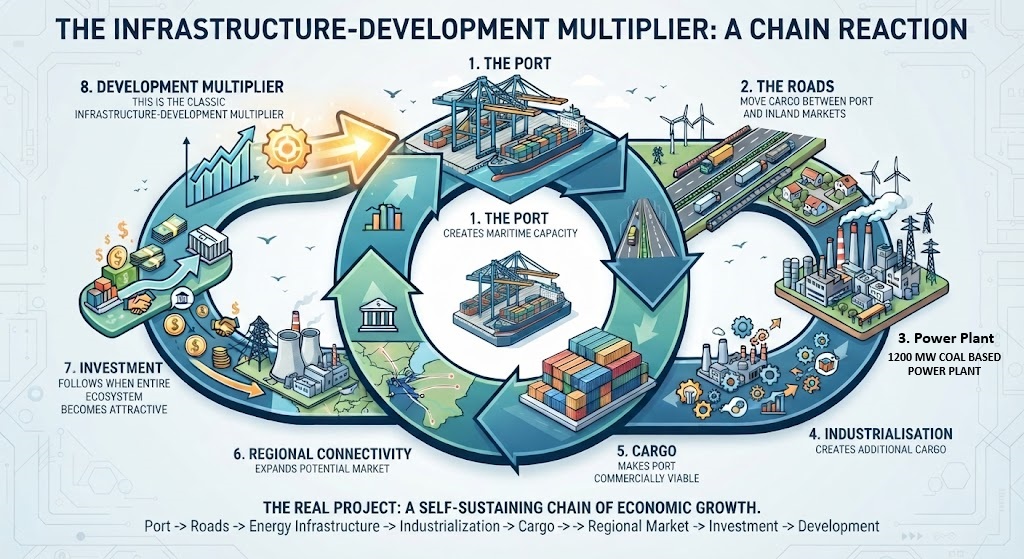
🧭 22. Matarbari as a National Infrastructure Strategy
From a distance, Matarbari can look like a collection of separate mega projects. Look more closely and a pattern starts to appear.
Port → Energy → Road → Industry → Logistics → Regional Connectivity
That chain is the real project.
National Infrastructure Strategy regarding Matarbari Project
The Port creates maritime capacity.
The Roads move cargo between the port and inland markets.
The Energy Infrastructure supports industrialisation.
Industrialisation creates additional cargo.
Cargo makes the port commercially viable.
Regional Connectivity expands the potential market.
Investment follows when the whole ecosystem becomes attractive.
This is the basic infrastructure-development multiplier.
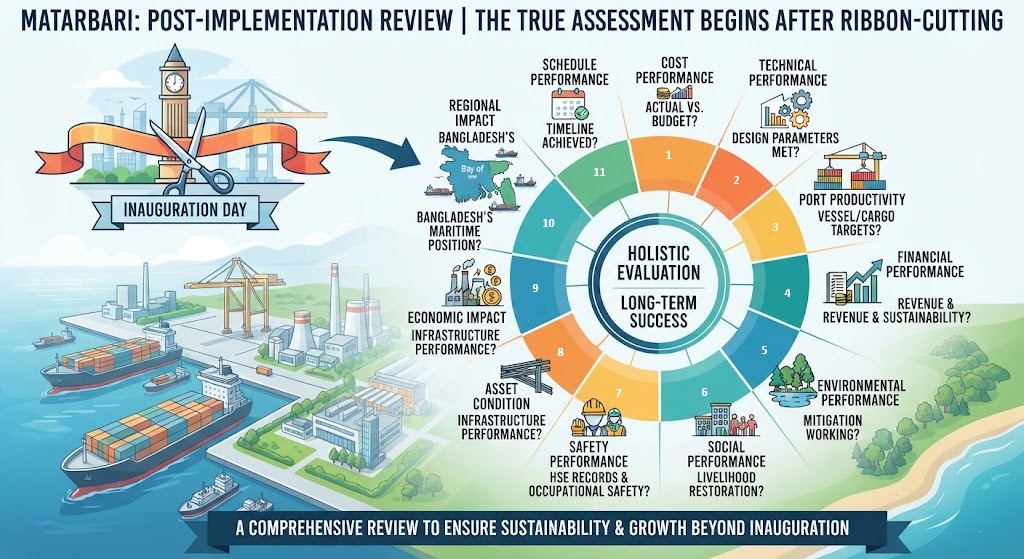
📊 23. Post-Implementation Assessment: How Should We Judge Matarbari?
The real assessment of Matarbari should begin after the ribbon-cutting ceremony, not end there.
A proper post-implementation review should look at at least the following:
Schedule Performance: Was the project delivered according to the revised schedule?
Cost Performance: How did actual expenditure compare with the approved and revised budgets?
Technical Performance: Are the facilities achieving their design parameters?
Port Productivity: Are vessel and cargo-handling targets being achieved?
Financial Performance: Are revenues and operating costs sustainable?
Environmental Performance: Are mitigation measures actually working?
Social Performance: Have affected communities experienced sustainable livelihood restoration?
Safety Performance: What are the project's occupational and operational HSE records?
Asset Condition: Are marine and civil structures performing as designed?
Economic Impact: Has Matarbari attracted investment and generated wider economic activity?
Regional Impact: Has it strengthened Bangladesh's position in regional maritime trade?
The final report card of Matarbari will be written by cargo statistics, operating costs, industrial investment, environmental data and economic growth—not by inauguration photographs.
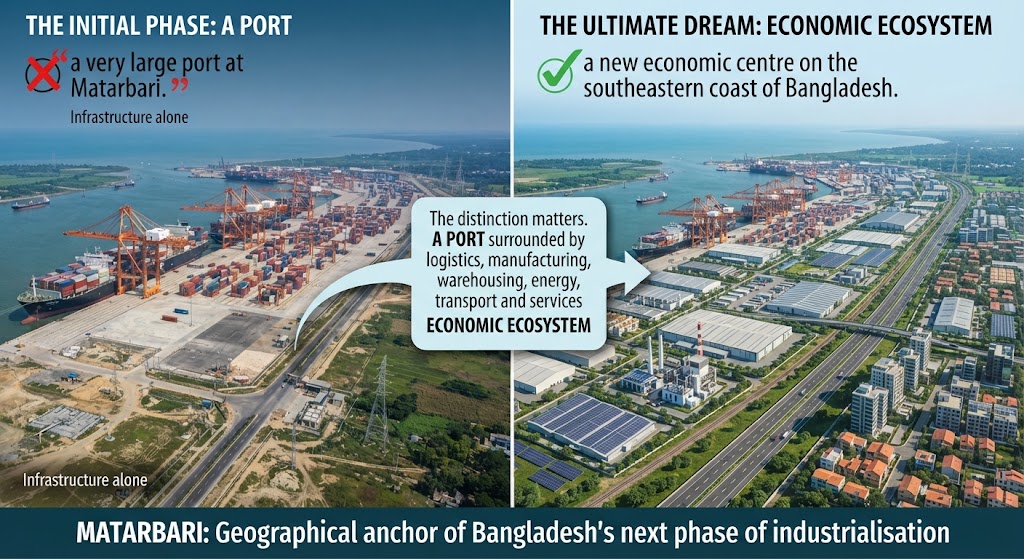
🏭 24. From Mega Project to Mega Economic Zone
The ultimate goal is not simply to have:
"a very large port at Matarbari."
The bigger goal is:
A new economic centre on the southeastern coast of Bangladesh.
That distinction matters.
A port is infrastructure.
A port surrounded by logistics, manufacturing, warehousing, energy, transport and services becomes an economic ecosystem.
The Projected Economic Ecosystem of Matarbari Project
If successfully developed, Matarbari could become one of the geographical anchors of Bangladesh's next phase of industrialisation.
📅 Present Status: Where Does Matarbari Stand?
As of August 2026, the port and power components should not be treated as one project with one completion date. They are separate but closely connected development programmes moving on different timelines.
Present Status of the Matarbari Project
Matarbari Power Project: The power-generation component has entered its operational phase, although fuel procurement, maintenance and other contractual and support activities continue.
Matarbari Deep Sea Port: The port remains in its construction and development phase, with the broader programme targeting operation around 2029.
Access Infrastructure: Roads, bridges and supporting infrastructure remain essential if the port is to operate effectively.
Future Development: The ultimate value of Matarbari will depend on how successfully the port is connected with logistics, industry and regional trade.
Matarbari is no longer just a proposal on a planning document. The question now is whether Bangladesh can turn the physical infrastructure into a commercially and economically successful ecosystem.
Conclusion: Matarbari Is Bigger Than a Port
Matarbari is ultimately a story about ambition. Bangladesh decided to move beyond its traditional maritime gateway and attempt something much bigger:
Create a new deep-sea gateway and build an entire economic ecosystem around it.
The project brings together port engineering, dredging, power generation, roads, bridges, logistics, land, environmental management, finance and long-term planning.
It is an attempt to redraw Bangladesh's economic geography.