Dark
🌙
☀️
Light

🚀 The Multiverse: An Infinite Universe of Possibilities

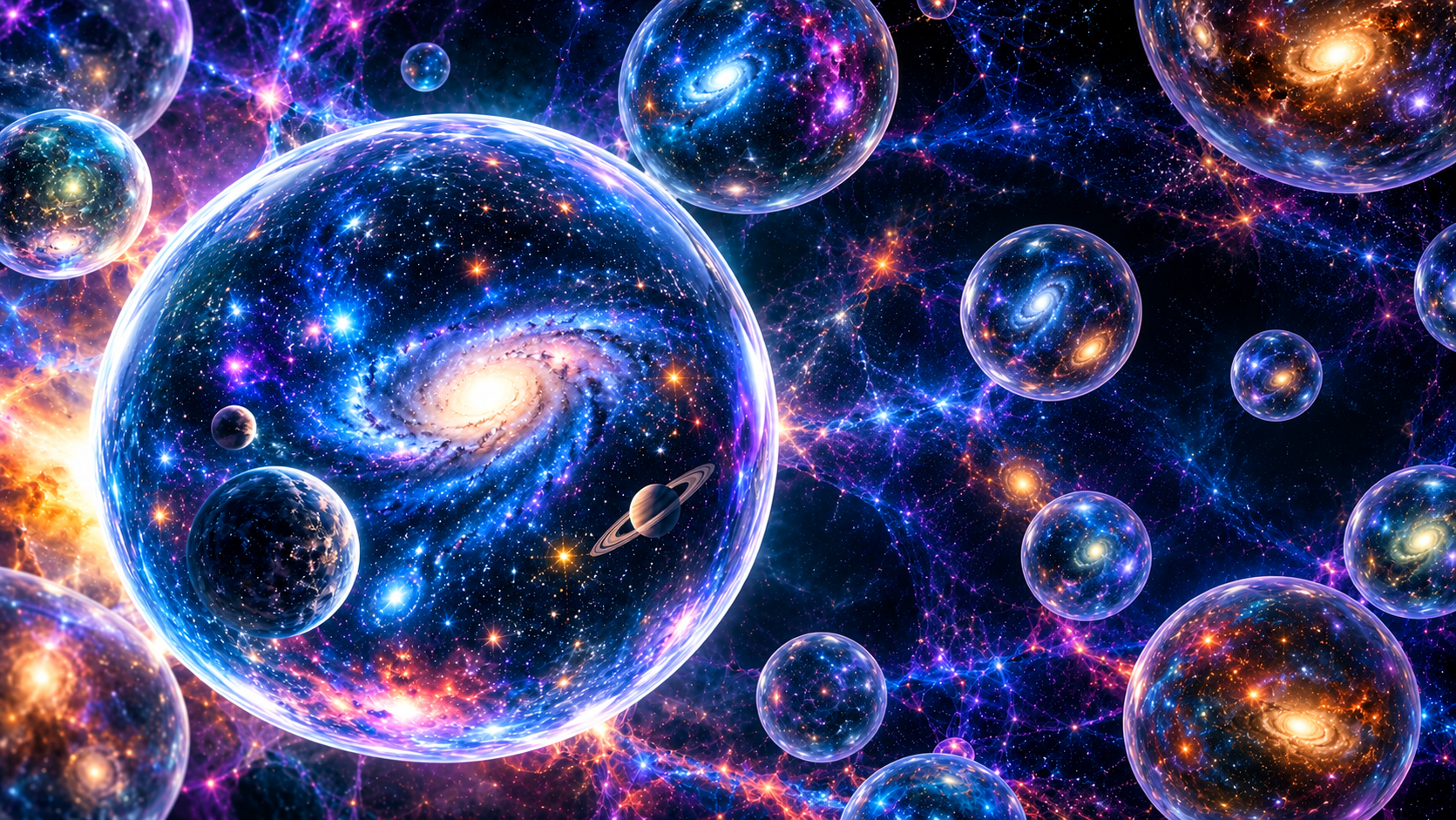
Since ancient times, people have wondered whether there is only one universe. Or could other realities exist beyond the sky, stars, galaxies, and planets we know? Could there be universes where the laws of physics are different from ours? Or worlds where something completely different happened at a turning point in history?

Questions like these have led to one of the most talked-about ideas in science: the multiverse. Put simply, it is the possibility that one or more universes exist beyond our own. Some theories suggest that these universes follow the same physical laws as ours, while others allow for universes with entirely different physical properties.

The multiverse may sound like science fiction, but the idea comes from research in modern physics, quantum mechanics, the expansion of the universe, and string theory. One thing needs to be clear from the start, though: there is still no reliable direct evidence that other universes exist. Any discussion of the multiverse must therefore distinguish between established scientific findings, mathematical models, and ideas that have yet to be tested.

So why do scientists take the idea seriously? What are the possible explanations for a multiverse? And if other universes exist, could we ever find out? Let's explore these questions, starting at the boundaries of the universe we know.

🌀 What Is the Multiverse?

The word multiverse combines multi and universe. It refers to a collection of universes, or a larger reality that may contain other universes alongside our own.

There is an important distinction to make here. When we say "the universe," we often mean everything that exists. In astronomy, however, the observable universe refers to the part of the universe from which light or other signals have had time to reach us since the early stages of cosmic history.

The observable universe is about 93 billion light-years across. Although the universe is around 13.8 billion years old, the expansion of space means that its observable boundaries are now much farther away. These two figures do not contradict each other because space itself has expanded while the light was travelling toward us.

Whether more regions exist beyond the observable universe is a different question from whether a multiverse exists. There may be parts of our own universe that we will never be able to see. But calling them separate universes requires additional theoretical justification.

One way to picture the multiverse is to imagine a vast ocean. We can see only one part of it, but there may be much more beyond our view. The comparison has its limits, though: we can directly verify that other parts of an ocean exist, while we still have no confirmed observations of other universes.

It is also worth remembering that not every multiverse theory describes universes as separate bubbles. Some interpretations involve different branches of quantum reality, while other theories explore extra dimensions or different physical conditions.

🪐 Where Did the Idea of the Multiverse Come From?

The multiverse did not emerge from a single discovery. It grew out of several questions and theoretical frameworks in modern physics. These include the values of the universe's fundamental constants, interpretations of quantum mechanics, and cosmic inflation.

1. Why Does Our Universe Follow These Particular Laws?

Certain fundamental constants and particle properties play a major role in shaping our universe. These include the strength of gravity, the mass of the electron, the interactions between fundamental particles, and the value of the cosmological constant. Together, these properties help create the conditions needed for stars, galaxies, chemical elements, and eventually life to exist.

This raises an obvious question: why do the constants of nature have the values they do? Are they determined by some deeper law of physics, or could they have been different?

This question is often called the fine-tuning problem. Some theoretical models suggest that changing certain constants by enough could make it difficult for stars, complex chemical structures, or environments suitable for long-lasting life to form. However, this does not apply in the same way to every constant. The outcome of a change also depends on whether other constants remain fixed.

One possible multiverse explanation is that if many universes exist with different physical constants, most might not support life, while some could have the right conditions for it to develop. We would naturally find ourselves in a universe where our existence is possible. This reasoning is related to the anthropic principle.

This is not a final answer, however. Many scientists believe there may be a deeper physical reason behind the values of these constants. And even if a multiverse exists, that does not mean every possible set of values occurs with equal likelihood.

2. The Mystery of Quantum Mechanics

Quantum mechanics describes the behaviour of particles at very small scales. At that level, a particle cannot always be described in terms of a definite position or a single outcome in the way we experience things in everyday life. A quantum state can be described as a superposition of several possible outcomes.

Imagine an experiment in which the spin of a particle is measured. Before the measurement, its quantum state may mathematically contain several possible outcomes at once. But when we measure it, the instrument gives us one definite result. How that definite result emerges from the quantum state has been a central question in debates about how to interpret quantum mechanics.

In 1957, physicist Hugh Everett III proposed an interpretation of quantum mechanics that later became known as the Many-Worlds Interpretation (MWI).

According to this interpretation, we do not need to assume that the entire wave function collapses to select a single outcome during a quantum measurement. Instead, the branches associated with different possible outcomes are treated as parts of reality. An observer in each branch experiences a particular outcome.

It is often described in popular accounts as the universe splitting after every decision. But that is an oversimplification of the original idea. The Many-Worlds Interpretation does not have a specific rule saying that a separate universe appears every time someone makes an everyday decision. Its central idea concerns the evolution of quantum states and the effective separation of branches associated with different outcomes.

Quantum decoherence is important for understanding how these branches behave. When a quantum system interacts with its environment, observable interference between different possible states can effectively disappear. This helps explain why we experience definite outcomes that resemble the familiar classical world. However, decoherence alone does not settle every question about quantum measurement.

The most important point is that the Many-Worlds Interpretation is one way of interpreting quantum mechanics. It is not a confirmed discovery of other universes. Other interpretations of quantum theory also exist, and scientists continue to debate which, if any, best describes reality.

3. Cosmic Inflation: The Universe's Rapid Expansion

Cosmic inflation is an idea proposed to explain the universe's early history. According to this idea, space expanded extremely rapidly over a very short period near the beginning of the universe. Inflation helps explain the universe's nearly flat geometry on large scales and certain features shared by widely separated regions.

Although inflation is an important part of modern cosmological models, its precise physical mechanism has not been fully established. Not all inflation models are the same, either. Stronger observational evidence from the early universe is still needed to establish whether inflation actually occurred.

Some inflation models suggest a possibility known as eternal inflation. In this scenario, inflation ends in some regions of space, allowing them to enter a phase of ordinary expansion, while it continues in other regions. This could lead to the formation of many separate regions of space.

In such a model, each region can be pictured as a bubble universe. Our universe could be one example. Other bubbles might have different physical conditions, depending on the particular model.

But we need to be careful here: inflation and eternal inflation are not the same thing. Even if inflation occurred, that would not automatically mean that countless universes exist. The multiverse possibility comes from certain specific inflation models, not from the idea of inflation alone.

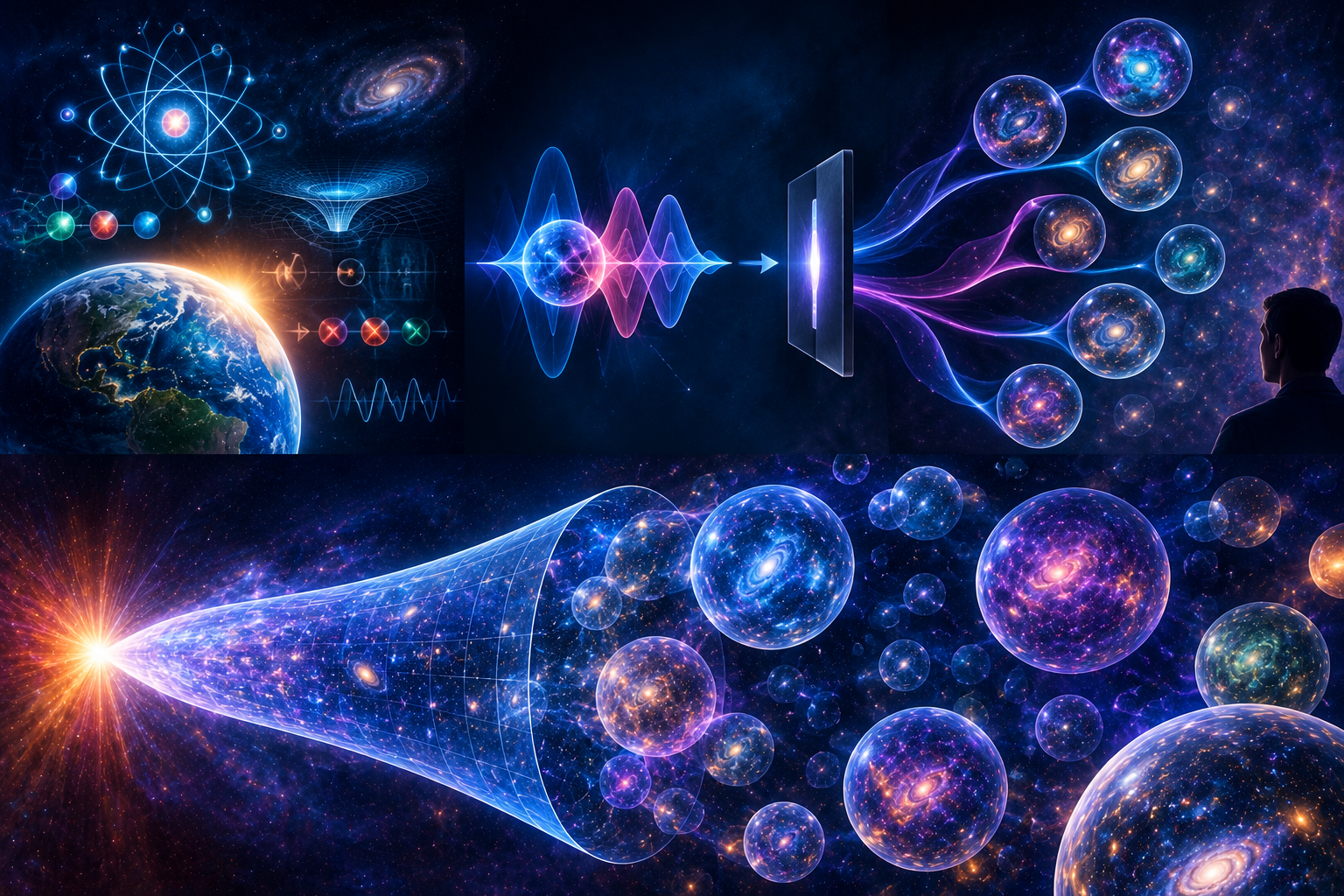
The mysteries of the universe, the quantum world, and cosmic inflation
The Mysteries of the Universe, the Quantum World, and Cosmic Inflation

🌌 What Are the Main Types of Multiverse?

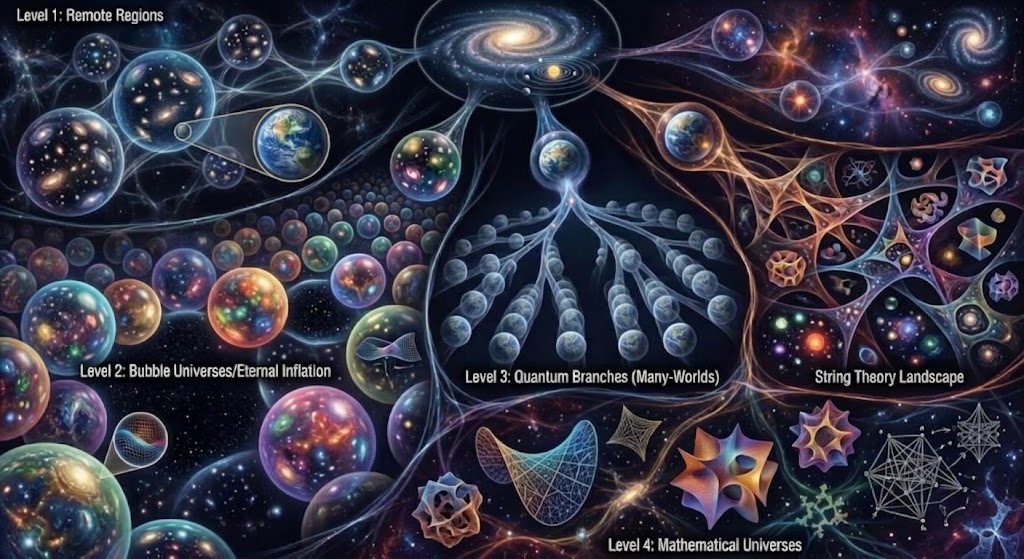
There is no single, universally accepted classification of the multiverse that all scientists use. Still, physicist Max Tegmark's four-level classification, along with ideas from quantum mechanics and string theory, can help us understand the different possibilities. Keep in mind that these ideas do not all belong to the same theory, and the evidence for each varies.

1. More Distant Regions of the Same Universe

The first idea is really about the larger extent of our own universe rather than separate universes. Regions beyond the observable universe may exist where matter and energy follow roughly the same physical laws as they do in our region.

If the universe is infinite, distant regions could contain galaxies, stars, and planets similar to those around us. Some theoretical models even suggest that the same arrangements of particles could repeat elsewhere. But we do not know whether the universe is truly infinite or whether such repetitions actually occur.

In Tegmark's classification, this is the Level I multiverse. The fundamental laws of physics do not need to be different here. The main difference is the location and arrangement of regions beyond the part of the universe we can observe.

2. Bubble Universes and Eternal Inflation

The second idea is linked to certain models of cosmic inflation. In these models, inflation may end in different regions of space, creating separate bubble-like regions. Each region could have its own cosmic history.

In some models, these regions may have different effective physical constants or particle properties. But that does not mean every bubble universe must follow different laws of physics.

One major problem is that other bubbles may be extremely far away, or there may be no practical way for them to communicate with us. Even so, if another bubble collided with our region in the past, scientists could look for possible traces of that collision in cosmic radiation.

3. Quantum Branch Universes: Many-Worlds

The third idea is linked to the Many-Worlds Interpretation of quantum mechanics. Here, separate universes are not imagined as bubbles located in distant parts of space. Instead, the idea involves different branches of the overall quantum state, in which observers may experience different outcomes.

Imagine a quantum experiment with two possible outcomes. In this interpretation, one outcome does not become real while the other disappears completely. Instead, the outcomes are described in different branches. An observer in each branch experiences the outcome in that branch as definite and real.

This is a much more subtle idea than the simple story of a separate world being created for every alternative decision in everyday life. Evaluating the interpretation requires looking at the mathematical structure of quantum theory, the meaning of probability, and decoherence.

4. String Theory and Different Possible Physical Realities

String theory is a theoretical framework that attempts to describe fundamental particles not as point-like objects, but as different states of extremely tiny vibrating strings. One of its main goals is to find a way to understand quantum physics and gravity within the same framework. However, string theory has not yet been established as a complete, experimentally verified theory of nature.

Some versions of the theory require extra spatial dimensions. Different ways of arranging or compactifying these extra dimensions could lead to different effective laws of physics. The vast collection of these possibilities is known as the string theory landscape.

This raises another possibility: if a process such as cosmic inflation allows different physical configurations to be realised, different regions of space could have different effective laws of physics. But the existence of possible solutions in string theory and the claim that each solution exists as a separate universe in reality are two different things.

5. The Mathematical Universe Hypothesis

Another philosophical and mathematical proposal is that realities associated with different mathematical structures could exist beyond our universe. Max Tegmark explored this possibility in his Mathematical Universe Hypothesis.

This idea is much broader than the usual cosmological multiverse. The question is not just whether the constants of another universe might be different. It also asks whether different mathematical structures could correspond to entirely different realities.

This remains a controversial proposal, not an established scientific finding. It raises important philosophical and scientific questions about how different mathematical structures could correspond to real existence and how such a claim could be tested.

A visual representation of the different levels of the multiverse and related scientific ideas
A Visual Look at the Different Levels of the Multiverse and Related Scientific Ideas

⚖️ Fine-Tuning: Is Life Just a Coincidence?

Fine-tuning is an important part of the discussion in favour of the multiverse. Certain features of our universe allow stars to produce energy for long periods, complex chemical elements to form, and conditions that could support life to develop on planets.

But we need to avoid a common misconception. Scientists have not proved that even the slightest change in any natural constant would destroy the universe. The effects of changing a constant depend on which constant changes, how much it changes, and whether other properties change as well. Some changes could make complex structures harder to form, while others could have more complicated effects.

The multiverse argument is that if many universes have different constants or initial conditions, this could offer one possible explanation for why a life-friendly environment exists. But to assess that explanation, we would need to know how the constants are distributed, what kinds of universes can form, and how the probability of observers arising should be calculated. We do not yet have complete answers to these questions.

There is another important question: does the multiverse actually explain fine-tuning, or does it simply say that, among countless possibilities, we happen to live in a universe where our existence is possible? This debate remains unresolved.

So, although fine-tuning motivates some research into the multiverse, it does not by itself prove that a multiverse exists.

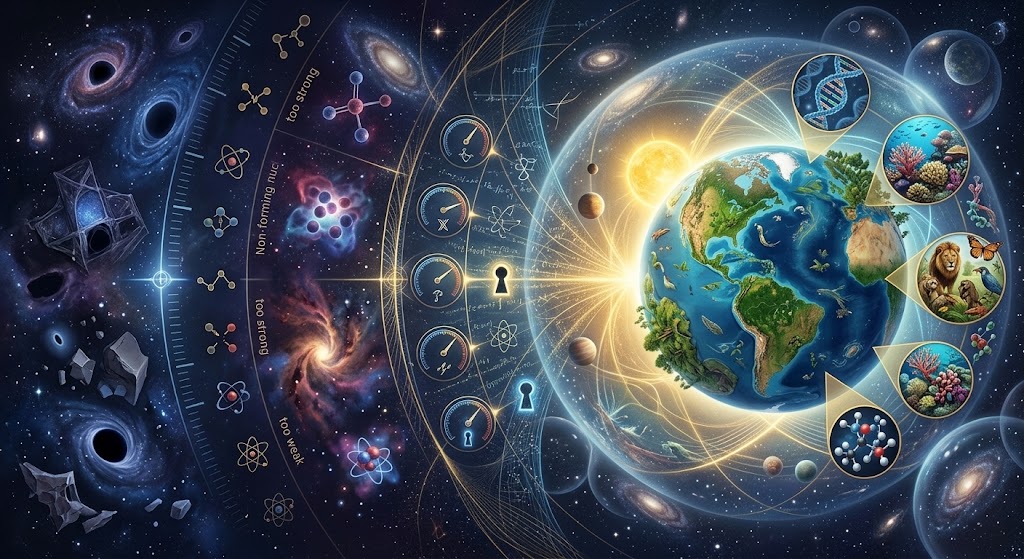
The fine-tuning of the universe
The Fine-Tuning of the Universe and the Scientific Ideas Behind Conditions That Could Support Life

🔭 Is There Any Evidence for the Multiverse?

This is the most important question. Just because an idea is mathematically possible does not mean it must be true in nature. Science evaluates theories based on their explanatory power, testable predictions, and consistency with observations. The same standards apply to the multiverse.

So far, no reliable observation has confirmed that other universes exist. Scientists have investigated some possible clues, however, and there may be more opportunities to look for evidence in the future.

1. The Cosmic Microwave Background

The Cosmic Microwave Background (CMB) is radiation left over from the early universe. It has been travelling through space since the universe was about 380,000 years old, when light began moving relatively freely through matter. It is often described as a picture of the universe in its infancy.

If our universe collided with another bubble universe in the past, some theoretical models suggest that the collision might have left traces in the CMB. Researchers have looked for unusual temperature patterns and other specific signals that could point to such an event.

A study published in 2011 analysed seven years of CMB data from the WMAP satellite to search for possible signs of bubble-universe collisions. The researchers found no convincing reason, based on that data, to add evidence of such collisions to the standard cosmological model. Data from the Planck satellite have also been used in similar searches.

In other words, scientists are looking for signals that can be tested, but no signal has yet confirmed the existence of another universe. Even if an unusual signal were found, other possible explanations would need to be ruled out.

2. Evidence for Cosmic Inflation

Observations of the universe's large-scale structure and the small temperature variations in the CMB are consistent with some models of rapid expansion in the early universe. These findings have made inflation an important area of research.

But finding observations consistent with inflation is not the same as proving eternal inflation or the multiverse. Different inflation models can make different predictions. Evidence supporting one model does not automatically establish every assumption associated with it.

3. Results from Quantum Experiments

The predictions of quantum mechanics have been successfully tested in countless experiments. But that success does not, by itself, prove the Many-Worlds Interpretation is better than other interpretations. The same experimental results can be consistent with several interpretations of quantum theory.

To evaluate the Many-Worlds Interpretation, scientists need to consider its mathematical consistency, how it explains probability, and whether it makes any testable predictions that distinguish it from other interpretations.

4. What Will Scientists Look for in the Future?

Researchers can explore several possible ways to look for evidence of a multiverse:

  • Searching the CMB for specific signals predicted by models of bubble-universe collisions.
  • Collecting more precise observations of cosmic inflation to help distinguish between different inflation models.
  • Looking for possible traces of gravitational waves from the early universe, while recognising that such signals alone would not prove the multiverse exists.
  • Investigating whether any testable differences can be found between interpretations of quantum mechanics.

These lines of research keep the multiverse within scientific discussion. But before any signal can be considered evidence for a multiverse, it must be reliably detected and other possible explanations must also be examined.

🚀 Could We Travel to Another Universe?

In science fiction, we often see characters travel from one universe to another through portals, wormholes, or advanced technology. Real physics is not nearly as straightforward.

The first problem is that the different kinds of multiverse proposed by scientists are very different from one another. If another universe simply means a distant region beyond our observable universe, cosmic expansion and the speed-of-light limit could make reaching it extremely difficult. Some regions may be so far away that no signal from them will ever reach us.

If other universes are bubbles created through eternal inflation, there is no evidence of any usable route between them and our universe. And the branches in the Many-Worlds Interpretation should not be thought of as distant places sitting side by side in the usual sense.

Wormholes appear in some mathematical solutions of general relativity. But we do not know whether stable, traversable wormholes actually exist. More importantly, even if wormholes exist, there is no guarantee that one would lead to another universe.

So, based on what we know today, we have no known or tested technology for travelling to another universe. That does not mean such travel has been proved impossible. It means we do not know whether the physical conditions needed to make it possible can exist at all.

🌍 Could Another Universe Have an Earth Like Ours?

One of the most fascinating possibilities people imagine when they hear about the multiverse is another Earth somewhere out there. Could people like us live on it? Would their lives resemble ours, or would something important have happened differently?

The answer depends on which kind of multiverse we are talking about. Some mathematical models suggest that if the universe is vast enough, matter can be arranged in only a limited number of ways within a given region, making repeated arrangements in distant regions a possibility. Some discussions even consider whether a similar arrangement could recur elsewhere. But this depends on specific assumptions about the size of the universe, the distribution of matter, and other conditions.

The Many-Worlds Interpretation, on the other hand, allows for different outcomes in different branches of a quantum state. But that does not mean every branch contains another version of our familiar Earth, where every historical event happened differently, as science fiction often portrays it. Such images can be useful illustrations in some situations, but they are not a direct or universally accepted description of the theory.

So, another Earth like ours may be possible, but we currently have no evidence that confirms its existence.

🕳️ Are Black Holes Gateways to Other Universes?

The intense gravity of black holes and the mysteries of their interiors have inspired many ideas about the multiverse. Some theoretical research explores possible connections between black hole interiors, quantum theories of gravity, and the formation of new cosmic regions.

But evidence that black holes exist and evidence that another universe lies inside one are two completely different things. What happens beyond a black hole's event horizon raises questions about the predictions of general relativity and the still-unresolved problems of quantum gravity.

Some mathematical solutions contain structures resembling wormholes or connections between multiple regions. But we have not established that such structures exist as stable features of the real universe. There is also no observational evidence or technology showing that real black holes can be used as gateways to other universes.

For now, the connection between black holes and the multiverse should be treated as a topic of theoretical research, not an established scientific fact.

🧩 The Biggest Problems with the Multiverse Idea

The multiverse could offer possible explanations for several questions. But it also faces some difficult problems that scientists and philosophers continue to debate.

1. It Is Difficult to Observe

If another universe cannot exchange signals with ours, verifying its existence becomes difficult. Not everything we cannot see directly should be dismissed as unscientific. However, it is important to have a reliable way to gather evidence in support of an idea.

2. Which Predictions Can We Test?

A good scientific theory should do more than fit existing observations. Ideally, it should make predictions that can be tested through observation and that could turn out to be wrong. Some multiverse models predict specific observable signals, but other versions are much harder to test.

3. How Do We Calculate Probabilities Across Countless Possibilities?

If there are infinitely many universes, or inflation continues for an infinite amount of time, working out which kinds of universes are more common becomes complicated. Even deciding how to count an infinite number of regions presents a major theoretical challenge. This is often called the measure problem.

Without solving this problem, it can be difficult to make reliable calculations about how likely different kinds of universes are.

4. A Mathematical Possibility Is Not the Same as Real Existence

Finding a possible structure in a mathematical model does not mean nature has brought it into existence. String theory may have many possible solutions, but that does not mean each one exists as a separate physical universe. In the same way, the success of quantum theory does not automatically prove one particular interpretation of it.

5. Does the Multiverse Answer Every Question?

Suppose countless universes exist. We would still have to ask why the rules governing the multiverse are the way they are. Why does a process capable of creating these universes exist? And how do we explain the existence of the multiverse itself?

In other words, a possible answer to one question can lead to even deeper questions. That does not make the idea invalid, but it does mean we should not present the multiverse as the final answer to every problem.

🎬 The Multiverse in Science Fiction vs. Science

The multiverse has become a familiar idea in films, comics, and television series. We often see different versions of the same character, alternative histories, and journeys from one universe to another. These stories have helped make the concept familiar to a wider audience.

But the multiverse in science fiction is usually designed to serve the story. Characters may be able to switch universes, meet alternate versions of themselves, or change decisions made in the past. In real physics, we do not know of any established method that would make these things possible.

Scientific discussions of the multiverse are more limited and cautious. Researchers ask whether a particular theoretical framework allows for multiple universes, whether the framework is consistent with observations, and whether any of its predictions can be tested.

Science fiction can stretch our imagination. But an idea becoming popular is not the same as that idea being scientifically proven.

🔬 What Might We Learn About the Multiverse in the Future?

What we learn about the multiverse will depend mainly on two things: how accurately we can develop theoretical models and how much new information we can gather through observations.

More precise CMB measurements, searches for gravitational waves, studies of the universe's expansion history, and research into the behaviour of fundamental particles could give us a clearer picture of the early universe. These findings may help us test different inflation models separately.

However, even if a future observation supports a particular multiverse model, that would not prove every version of the multiverse. Similarly, if a model's predictions fail to match observations, that would count against that specific model, but it would not automatically rule out every possible multiverse idea.

That is often how science progresses. While searching for an answer to one question, we may come across an entirely new question. What matters is keeping clear the difference between what we know, what we think might be true, and what we still do not know.

📚 Further Reading and References

If you want to explore the multiverse in more depth, the research papers and scientific references below are good places to start. They discuss the theoretical foundations of the idea, possible observational evidence, and its limitations.

Editor's note: Scientists do not all agree on whether the multiverse exists, what forms it might take, or what evidence could confirm it. This article distinguishes established observations from theoretical models and speculation. As new research emerges, our understanding of these ideas may change.

🌠 Conclusion — Our Endless Curiosity About the Unknown

The idea of the multiverse challenges us to rethink the limits of the reality we know. Perhaps our observable universe is not all there is. Perhaps some versions of cosmic inflation could lead to multiple bubble universes. Or perhaps reality can be described through multiple branches, as suggested by one interpretation of quantum mechanics.

But none of these possibilities has yet provided conclusive proof that other universes exist. Some ideas build on established physics, others depend on specific theoretical assumptions, and some are more philosophical in nature. Treating them all as the same thing makes it harder to understand both their scientific significance and their limitations.

The existence of the multiverse has not been proven. But we can still ask a scientific question: is the universe we know all there is to reality?

What I find most fascinating about the multiverse is not just the possibility that another Earth might exist somewhere. It's what the idea reminds us about how much we still don't know. No matter how far our understanding of nature has come, some fundamental questions remain unanswered. How did the universe begin? Why does it follow these particular laws? Is there anything beyond the reality we can observe? Scientists are still searching for answers.

Perhaps a new observation will one day change how we understand the universe. Some multiverse models may stand up to testing, while others may be ruled out. It's also possible that future scientists will find that our current theoretical frameworks aren't enough to answer these questions.

For now, we know that we live in a vast universe, much of which remains beyond our understanding. And science moves forward because we keep trying to understand what we don't yet know.

Share Your Thoughts

Or Send Me an Email!


যুক্ত হোন ডিজিটাল জগতে!

SSL Labs Verified Mozilla Security Verified Safe Browsing Verified Valid HTML Verified Fast PageSpeed Verified