🌌 ʻOumuamua: The First Interstellar Visitor That Baffled Astronomers
In October 2017, astronomers spotted something they had never seen before. A small, fast-moving object was passing through our Solar System, but it clearly did not belong here. It came from interstellar space, passed the Sun, and then continued back into the darkness. The object was named ʻOumuamua, a Hawaiian word meaning “a messenger from afar arriving first.”
Since its discovery, scientists have tried to understand what ʻOumuamua actually was. Was it an asteroid, a comet, or something we have never encountered before? Its unusual shape, motion, and slight acceleration made it one of the strangest objects ever observed in our Solar System.
🔭 Discovery: A Stranger in Our Sky
On October 19, 2017, astronomer Robert Weryk noticed a faint object moving rapidly across images taken by the Pan-STARRS 1 telescope. At first, there was nothing obviously extraordinary about it. It looked like another small asteroid.
But as astronomers collected more observations, something important became clear: its orbit was hyperbolic. In simple terms, it was moving too fast to remain gravitationally bound to the Sun. It had come from outside our Solar System and would eventually leave it again.
For the first time, astronomers had identified an object from another star system passing through our own. It was officially designated 1I/ʻOumuamua:
1 – the first object identified in this category
I – stands for “Interstellar”
ʻOumuamua – the Hawaiian name chosen in connection with the discovery
🌌 Interstellar Trajectory
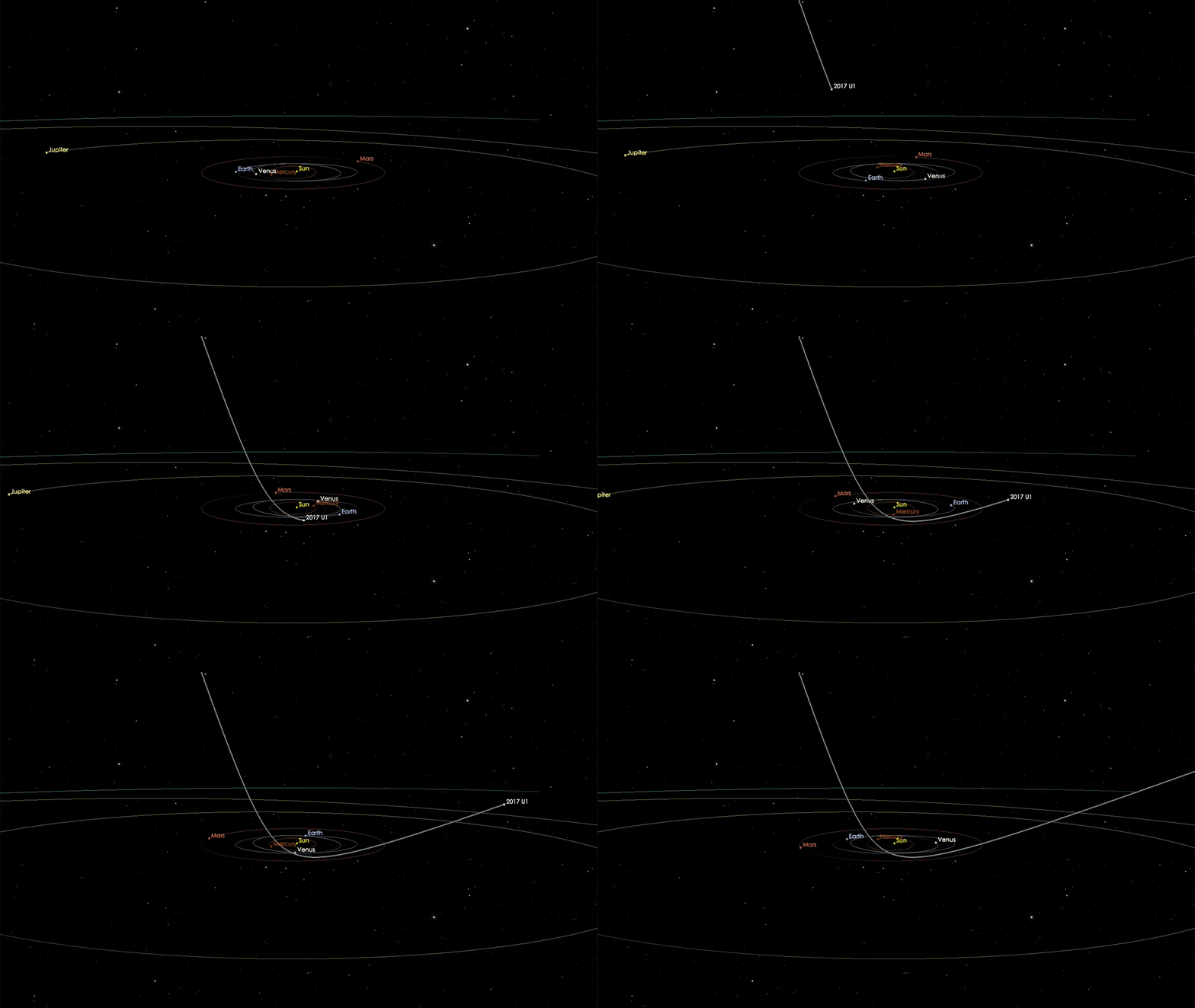
Figure 1: ʻOumuamua’s hyperbolic trajectory through the Solar System — entering from Lyra and exiting toward Pegasus.
ʻOumuamua entered the Solar System from the direction of Lyra. It crossed the inner Solar System and passed closest to the Sun on September 9, 2017. At that point, it was travelling at nearly 315,000 km/h (87 km/s). After passing the Sun, it continued outward toward the constellation Pegasus and will never return.
Before reaching our Solar System, ʻOumuamua may have spent millions or even billions of years travelling between stars. We do not know where it came from or which planetary system it originally belonged to. For us, it was a brief visitor from a much larger galactic neighbourhood.
🪐 Physical Characteristics
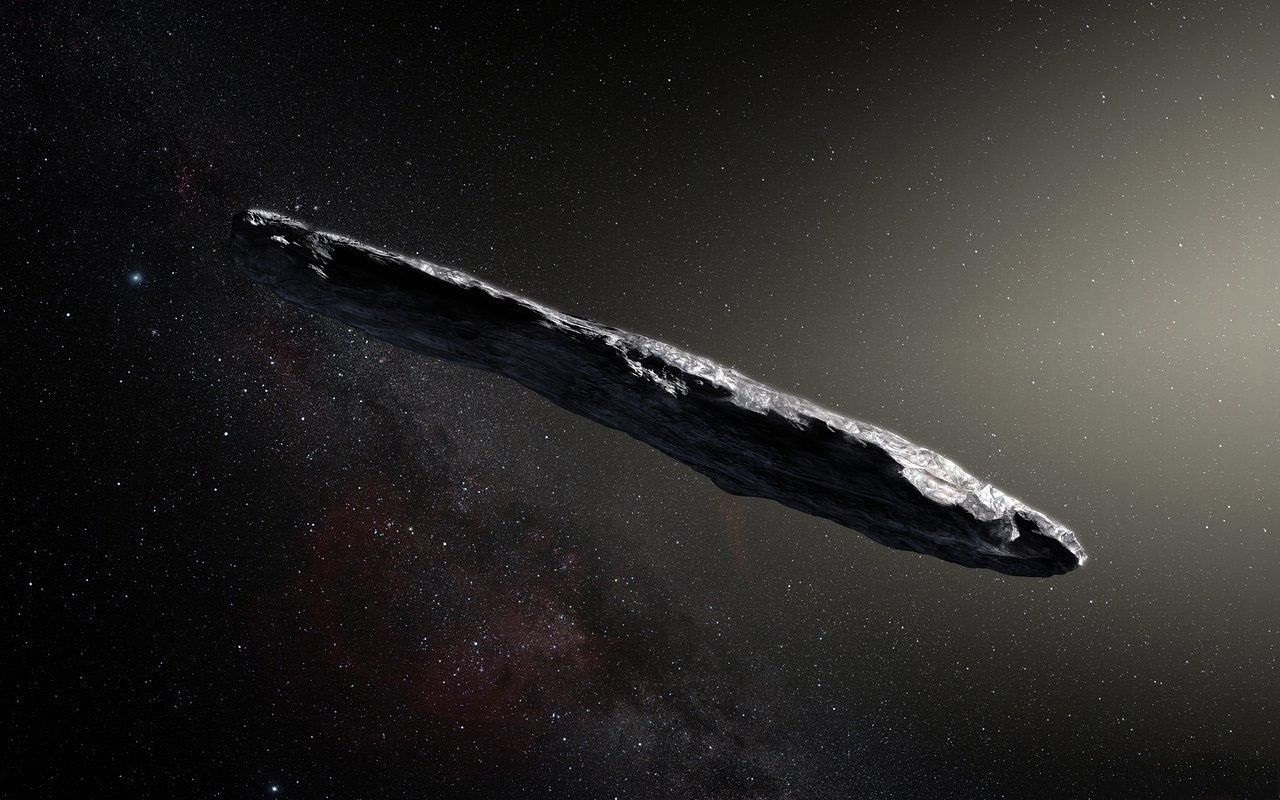
Figure 2: Artist’s concept of ʻOumuamua — possibly a long, cigar-shaped object tumbling through space.
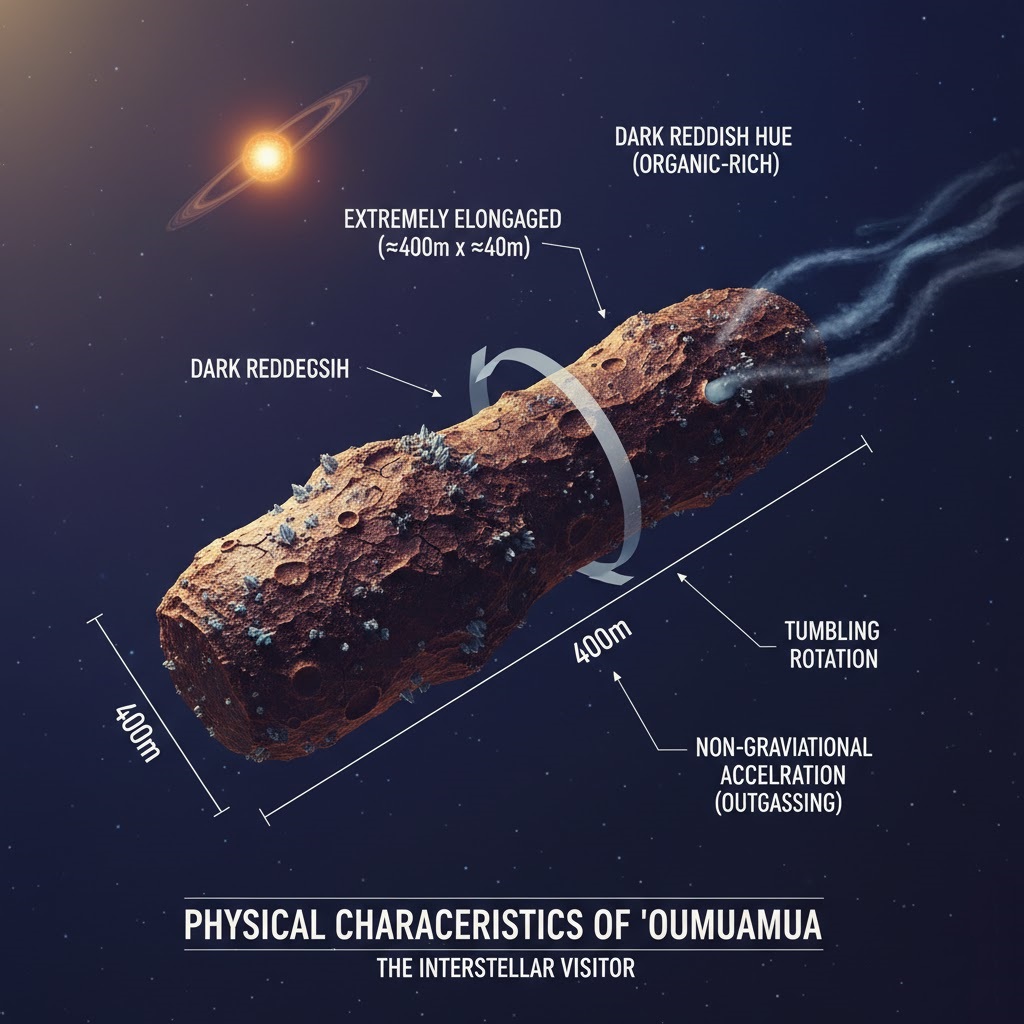
Length: 100–400 meters
Width: roughly 10 times smaller than its length
Shape: extremely elongated — possibly cigar-like or pancake-shaped
Color: reddish, possibly caused by long exposure to cosmic radiation
Rotation: tumbling end-over-end roughly every 7–8 hours
What made ʻOumuamua especially unusual was the combination of its apparent shape, colour, rotation, and motion. Nothing quite like it had been observed among the known asteroids and comets of our Solar System.
☄️ A Comet Without a Tail?
Figure 3: Unlike typical comets (left), ʻOumuamua (right) showed no visible gas or dust tail.
When a comet gets close to the Sun, sunlight heats its surface and can cause gas and dust to escape. That material forms the familiar coma and tail. ʻOumuamua, however, showed no visible outgassing or cometary tail.
Yet there was another surprise. As it moved away from the Sun, ʻOumuamua showed a small but measurable acceleration that could not be explained by the Sun’s gravity alone. Something appeared to be giving it a gentle push. The challenge was figuring out what could produce that push without leaving the usual signs of a comet.
🧬 Competing Theories: What Was ʻOumuamua Really?
1️⃣ A Hidden Comet (Invisible Outgassing)
One possibility is that ʻOumuamua was a comet that released gas without producing an obvious visible tail. Hydrogen, carbon monoxide, or other volatile material could, in theory, have escaped from the object and produced the small amount of thrust that astronomers detected.
2️⃣ A Hydrogen or Nitrogen Iceberg
Another proposal suggested that ʻOumuamua could have been made of extremely volatile ice, such as hydrogen or nitrogen ice. If such material evaporated as the object passed through the Solar System, it could have produced the observed acceleration without creating a clearly visible tail. The problem is that other researchers have questioned whether these fragile materials could survive the long journey between stars.
Figure 4: Movement Method of Oumuamua
3️⃣ A Cosmic Dust Pancake
Another idea is that ʻOumuamua may have been an extremely thin sheet made of solid material or cosmic dust. If it were only a few millimeters thick but hundreds of meters across, sunlight could exert noticeable pressure on it. In that case, it could behave somewhat like a natural solar sail.
4️⃣ An Alien Artifact?
The most controversial explanation came from Harvard astrophysicist Avi Loeb, who suggested that ʻOumuamua could possibly have been artificial — perhaps a solar sail or a probe created by an extraterrestrial civilization. The idea attracted enormous public attention, but most scientists consider an artificial origin unlikely because there is no concrete evidence that ʻOumuamua was engineered. Even so, the discussion helped renew public interest in the search for extraterrestrial intelligence, or SETI.
🌠 ʻOumuamua’s Significance to Science
Whatever ʻOumuamua ultimately turns out to have been, its discovery changed the way astronomers think about objects moving between star systems. It showed that:
Interstellar objects exist and can pass through our Solar System.
Our telescopes are now sensitive enough to detect some of these visitors.
Such objects may give us a chance to study material that formed around other stars.
Figure 5: Pan-STARRS1 telescope.
The discovery also changed the way scientists think about future interstellar visitors. NASA, ESA, and other space agencies and research groups have considered ways to detect these objects earlier and, if possible, send spacecraft close enough to study them directly.
🧭 The Next Visitor: 2I/Borisov
Figure 6: 2I/Borisov — the second known interstellar object, discovered in 2019, looked like a typical comet.
In 2019, astronomers discovered 2I/Borisov, another object from interstellar space. Unlike ʻOumuamua, Borisov looked much more like a familiar comet, complete with a visible coma and tail.
Borisov was important because it confirmed that ʻOumuamua was not a one-off observational oddity. Objects from other star systems really do pass through our Solar System. The fact that we have detected only a small number so far also suggests that many more may have passed through unnoticed.
🚀 Legacy of ʻOumuamua
ʻOumuamua was visible to astronomers for only a relatively short time before it became too faint to observe. But that brief encounter left a lasting impact on astronomy. It reminded us that:
The Solar System is part of a larger galactic ecosystem, where material can move between different star systems.
There is still a great deal we do not understand about the objects moving through our galaxy.
Even a small visitor passing through our Solar System can change the questions we ask about our place in space.
🌠 Final Thoughts
“We are not alone — not necessarily in life, but in the shared journey of matter and mystery that binds the stars together.”
📚 References
Meech, K. et al. (2017) Nature — “A brief visit from a red and extremely elongated interstellar asteroid.”
Bialy, S., & Loeb, A. (2018) Astrophysical Journal Letters — “Could Solar Radiation Pressure Explain ʻOumuamua’s Acceleration?”
Desch, S. & Jackson, A. (2021) Journal of Geophysical Research: Planets — “ʻOumuamua as a Nitrogen Ice Fragment of an Exo-Pluto.”
NASA Jet Propulsion Laboratory — ʻOumuamua trajectory data archive
🌄 Conclusion — Mainamati, Silent Witness of the Past
Mainamati is not just an archaeological site. It is a living record of Bangladesh’s past — its civilization, culture, and religious history. The thousand-year-old Viharas, stupas, and ruins still give us a glimpse of the Buddhist culture that once flourished here.
The site reminds us that civilization is about more than bricks and stone. It reflects what people knew, believed, built, and passed on to those who came after them. Standing among the ruins of Salban Vihara, it is easy to imagine the prayers that once filled this place — “Buddham Sharanam Gacchami…”.
Preserving this heritage is our responsibility. Proper maintenance, public awareness, and genuine care are essential if Mainamati is to remain meaningful for future generations.