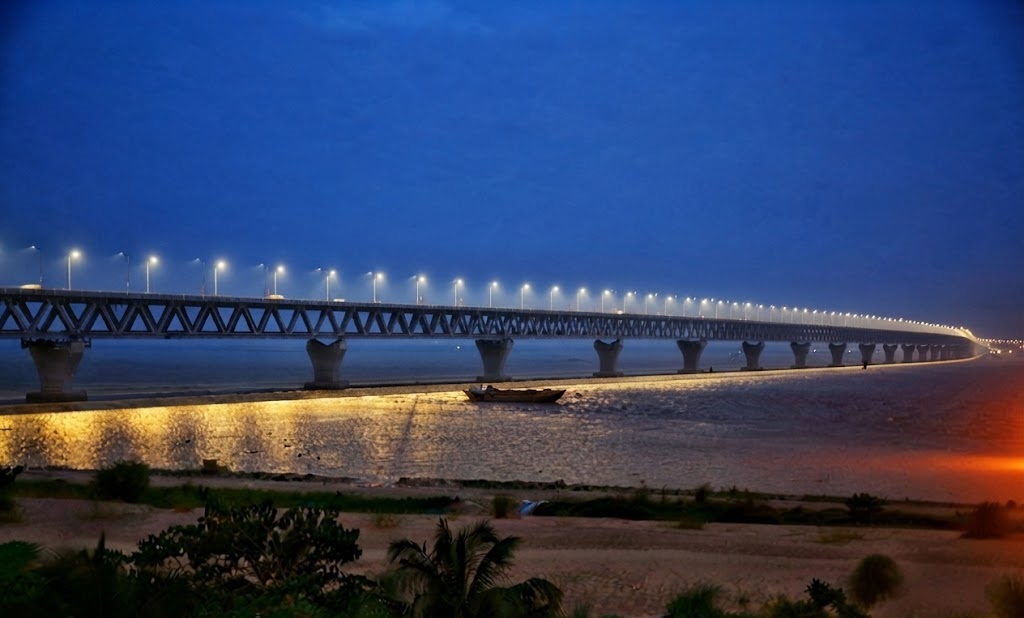
Glowing under a deep twilight blue sky with its golden reflection on the Padma River.
Engineering · Mega Project · Bangladesh
Padma Bridge: The Pride of Bengal and a New Horizon of Connectivity
Published:
For generations, connecting the two banks of the Padma River was a long-standing dream. The Padma Multipurpose Bridge finally turned that dream into reality. But it is more than a structure made of steel, concrete, and piles. It represents Bangladesh's determination to take on one of the country's most difficult engineering challenges and build a major transport link almost entirely with its own resources.
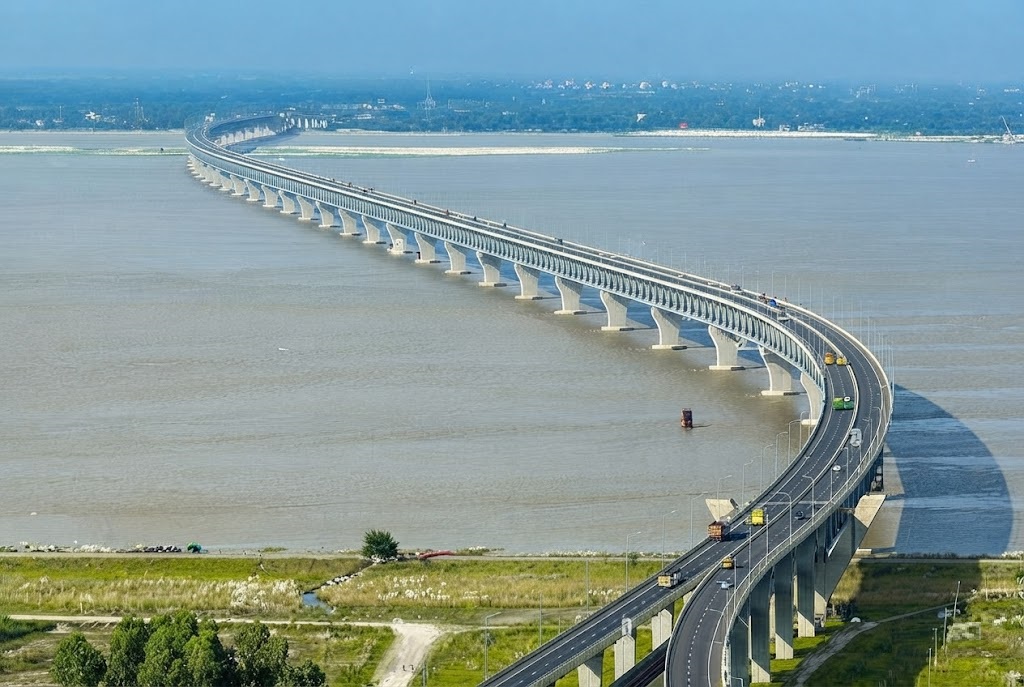
Padma Multipurpose Bridge, Munshiganj-Shariatpur.
By creating a direct connection with Dhaka and linking the capital with 21 districts in the southern and southwestern parts of Bangladesh, the bridge has changed the country's transport network in a fundamental way. It has also affected trade, agriculture, tourism, investment, and everyday life in regions that were previously heavily dependent on ferries and long river crossings. Built across one of Bangladesh's most powerful and unpredictable rivers, the bridge has also become an important example of large-scale civil engineering in the country.
🌍 1. Geographical Location, Precise Measurements, and Strategic Junction
The Padma Multipurpose Bridge has created a direct road and rail connection between Dhaka and 21 districts in the southern and southwestern regions of Bangladesh. Geographically, the bridge connects the Mawa point of Louhajang upazila in Munshiganj with Jajira in Shariatpur and Shibchar upazila in Madaripur. Building such a large structure across the Padma required careful planning around the river's depth, current, erosion, and constantly changing riverbed.
📏 Precise Length, Viaduct, and Total Measurements of the Bridge
The main bridge itself is 6.15 kilometers (6,150 meters) long. But the complete project extends well beyond the main river crossing. Including approximately 3.68 kilometers of viaducts on both sides of the river, along with the connecting roads and other approach infrastructure, the total length of the Padma Bridge project is approximately 9.83 kilometers. So the project is not simply a bridge across the river; it is a complete transport connection across the surrounding floodplains and approach areas.
🛣️ Connection with the National Highway Network (N8 Highway)
The bridge is an important part of the national N8 Highway network. The road connection from Jatrabari in Dhaka through Mawa, across the Padma Bridge, and onward through Jajira, Shibchar, and the Bhanga interchange has created a much more direct route toward Payra seaport, Kuakata, Barisal, Khulna, and Benapole. The location of the bridge was therefore not chosen simply to shorten one river crossing. It was planned as a strategic link between Dhaka and a large part of the country's southern and southwestern transport network.
Memories of traveling at the Padma Bridge premises.
Crossing the bridge is also a very different experience from the old ferry journeys. The wide Padma stretches out on both sides while vehicles move across the deck above it. Not long ago, passengers could spend hours waiting at Paturia or Mawa ferry terminals, and delays could sometimes stretch much longer. Today, the river crossing takes only a fraction of that time. The open river, afternoon breeze, sunset over the water, and the bridge's illumination at night have also made the journey itself part of the experience.
The Padma Bridge standing firmly across the wide Padma River.
📜 2. From the Beginning of the Dream to the Long Path of Overcoming Challenges
💰 Initial Financing Plan and the World Bank Dispute
The initial estimated cost of the project was around 10,161 crore Taka, which later increased to approximately 30,193 crore Taka. Financing a project of this scale was a major challenge for Bangladesh. The country therefore entered into loan agreements worth about 1.2 billion USD with the World Bank, Asian Development Bank (ADB), JICA, and Islamic Development Bank (IsDB). However, in 2012, the World Bank withdrew its financing over allegations of corruption related to the project. The decision created serious uncertainty around the future of the bridge and became a major international issue for Bangladesh.
⚖️ The Canadian Court Case and the Corruption Allegations
The allegations eventually led to an investigation by the Royal Canadian Mounted Police (RCMP). The case later came before a Canadian court, where the evidence connected to the alleged corruption scheme was examined. The court ultimately found insufficient evidence to support the allegations and dismissed the case. The episode became an important part of the history of the Padma Bridge project, particularly because the withdrawal of international financing forced Bangladesh to reconsider how the project could be completed.
Historic Turnaround: Implementing the Mega-Project with Domestic Funds
Instead of abandoning the project, the Government of Bangladesh decided in July 2012 to finance the Padma Bridge with domestic resources. It was a major financial and political decision. With the government taking responsibility for the funding, construction of the main bridge officially began in December 2014. The decision also turned the Padma Bridge into something larger than a transport project: it became a national example of Bangladesh taking responsibility for a major infrastructure investment on its own.
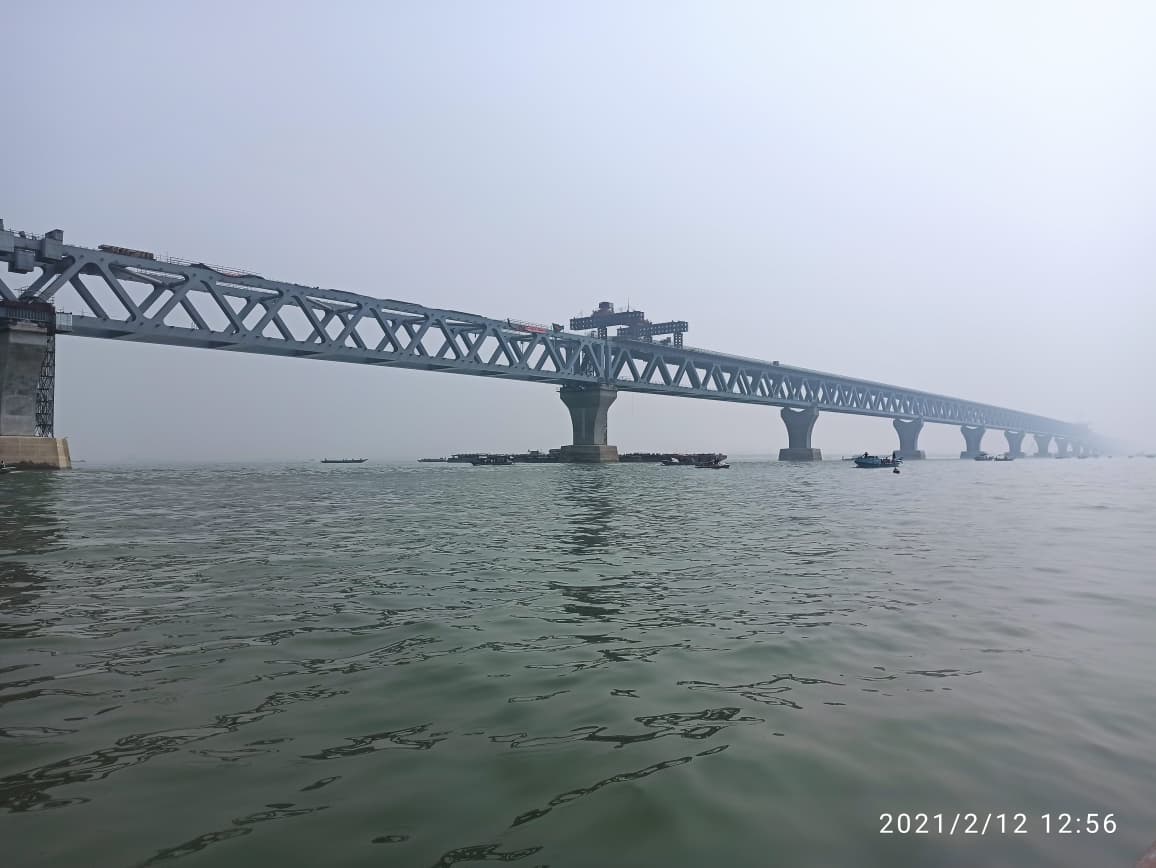
The strong piles and main structure of the bridge standing in the heart of the Padma River
🗓️ Construction Timeline, Contracts, and Historic Inauguration Moment
Several major contracts were awarded to international and local contractors to carry out the different parts of the project:
• Main Bridge Construction: China Major Bridge Engineering Company Limited (MBEC).
• River Training Works: Sinohydro Corporation.
• Approach Roads and Infrastructure: Domestic and foreign joint consortiums.
Construction continued through difficult conditions, including strong river currents, changes to the project schedule, and the disruption caused by the COVID-19 pandemic. After years of construction, the bridge was inaugurated on June 25, 2022, and opened to public traffic from June 26. The opening finally removed one of the biggest transport barriers between Dhaka and the southern and southwestern parts of the country.
⚙️ 3. Engineering Marvel: Deepest Piles, Hostile Nature of the River, and Complex Structural Data
The engineering challenge of the Padma Bridge came largely from the river itself. The designers and contractors had to deal with a deep and shifting riverbed, strong currents, heavy sediment movement, erosion, and the risk of scour around the foundations. Every major part of the bridge had to be designed with these conditions in mind.
🌊 Powerful Water Flow of the Padma and River Depth Complexities
The Padma is a powerful and highly dynamic river. During the monsoon, its depth increases significantly, and the river carries an enormous volume of water. In some locations, the depth can reach around 40 to 50 meters (approximately 130–160 feet). The river can also experience very high discharge and strong currents, while the riverbed itself continues to change because of erosion and sediment movement.
For the bridge, this created a serious foundation problem. Engineers had to consider not only the depth of the river at the time of construction, but also how much the riverbed could scour and change over time. A foundation that appears secure today must remain stable even after years of powerful water flow and shifting sediment.
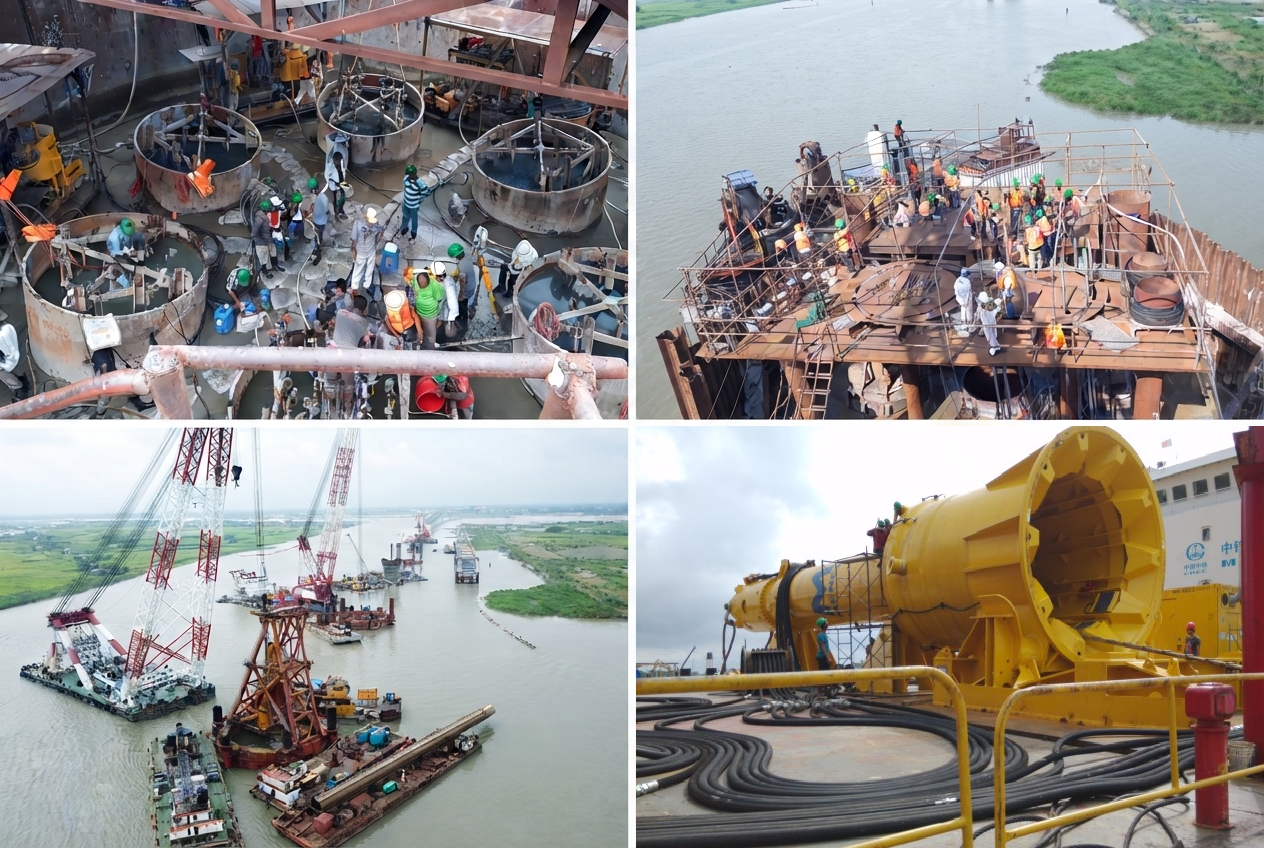
Various steps of bridge pillar construction activities (clockwise) 1. Grouting for skin friction enhancement. 2. Base grouting for end-bearing capacity enhancement. 3. Piling hammer - MENCK MHU 3500S, and 4. The world's largest hammer busy placing pillars from a bird's-eye view.
🏗️ Deep Pile Foundations: Dimensions, Diameters, and Technical Data
Because a reliable rock layer was not available at the required foundation depth, the bridge needed exceptionally deep pile foundations. A total of 262 piles were installed beneath the bridge's 42 piers, with several piles supporting each pier.
• Length of Piles: Some piles extend to approximately 120 meters below the riverbed, making them among the deepest bridge piles of their kind.
• Diameter and Thickness of Piles: The steel piles have a diameter of approximately 3 meters (about 10 feet), with very thick steel walls.
These large steel tubular piles were driven deep into the riverbed using high-capacity piling equipment. Reinforcement was then placed inside the piles and concrete was poured into them, creating extremely strong composite foundations capable of carrying the enormous loads of the bridge.
⚖️ Massive Structural Loads, Span Dimensions, and Seismic Technology
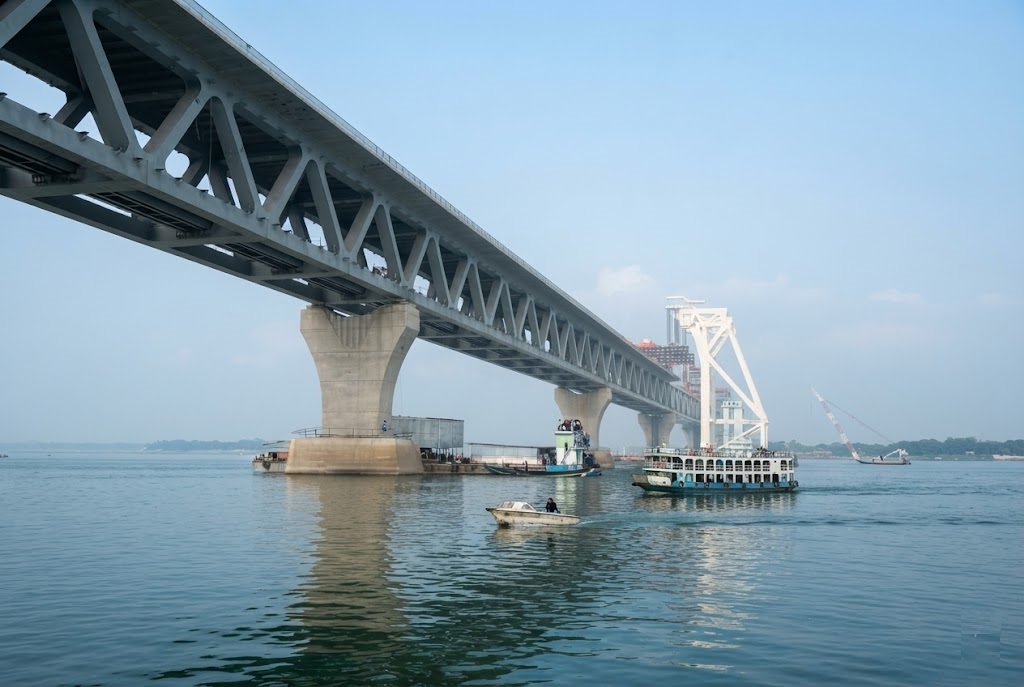
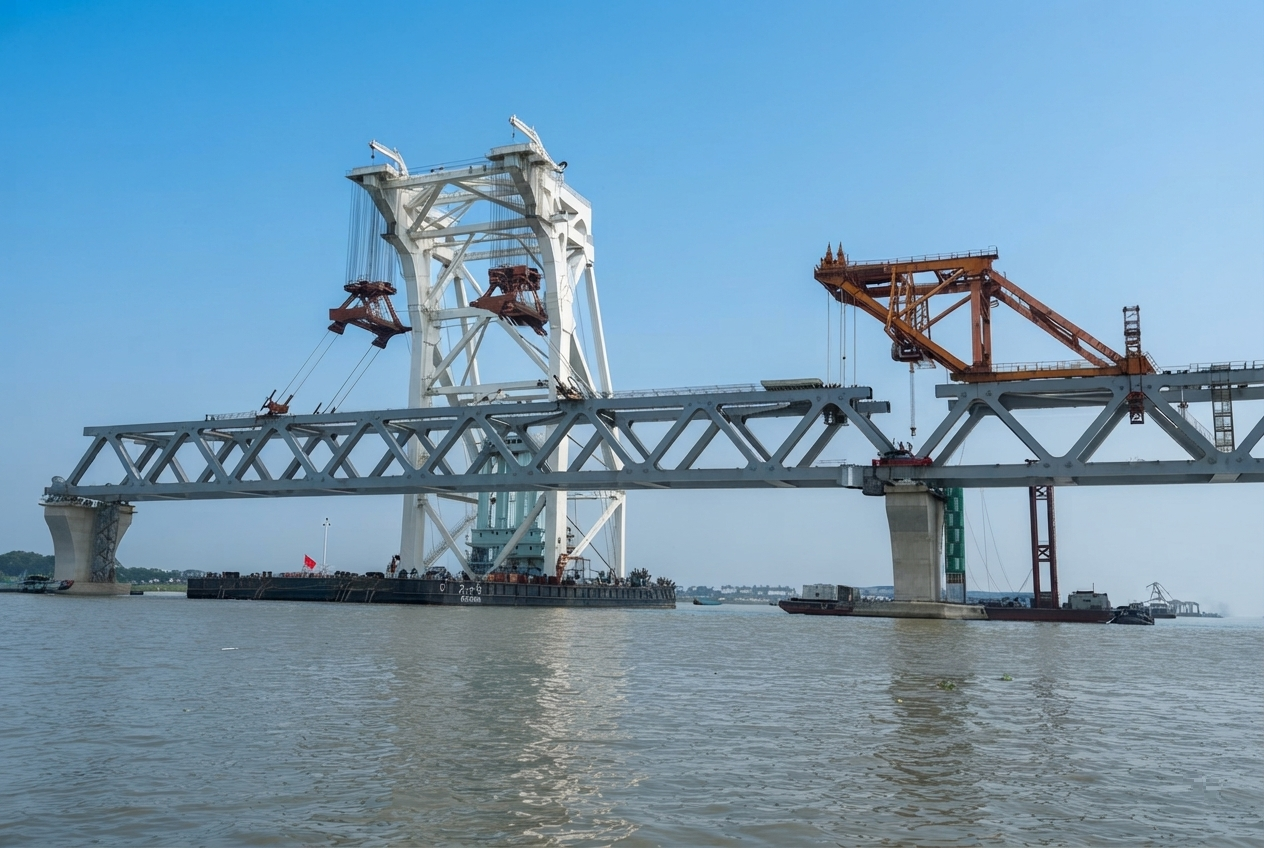
The bridge's main deck is supported by large steel truss spans.
• Weight and Dimensions of Spans: Each of the 41 main spans is 150 meters long and weighs approximately 3,140 tons. The piers and pier heads beneath these spans were also designed to carry extremely large structural loads.
• Seismic Isolators (Vibration Tolerance): Because Bangladesh is located in a seismically active region, the bridge incorporates advanced Friction Pendulum Bearings and other structural systems designed to manage earthquake forces. These systems allow controlled movement and help reduce the forces transferred to the bridge structure during strong seismic events.
Structural view of the giant steel spans and piers of the bridge
🌉 Double-Deck Structure and Modern River Training Works
The Padma Bridge is a double-deck composite truss bridge. The upper deck carries a four-lane road, while the lower deck accommodates the railway line. This arrangement allows road and rail transport to share the same major river crossing.
The project also included extensive river training works around the Mawa and Jajira approaches. These works were designed to protect the bridge and its approach infrastructure from erosion and to guide the river flow away from vulnerable areas. Large quantities of geo-bags, concrete blocks, and other protective materials were used across the river training zones.
Bridge Information at a Glance
📈 4. Economic Revolution, GDP Growth, and Multipurpose Transformation of the Southern Region
The opening of the Padma Multipurpose Bridge has changed the economic geography of Bangladesh, particularly for the southern and southwestern regions. The direct road connection with Dhaka has reduced travel time and made the movement of people, goods, agricultural products, and industrial materials much easier.
📊 Direct Contribution to National GDP and Growth Trajectory
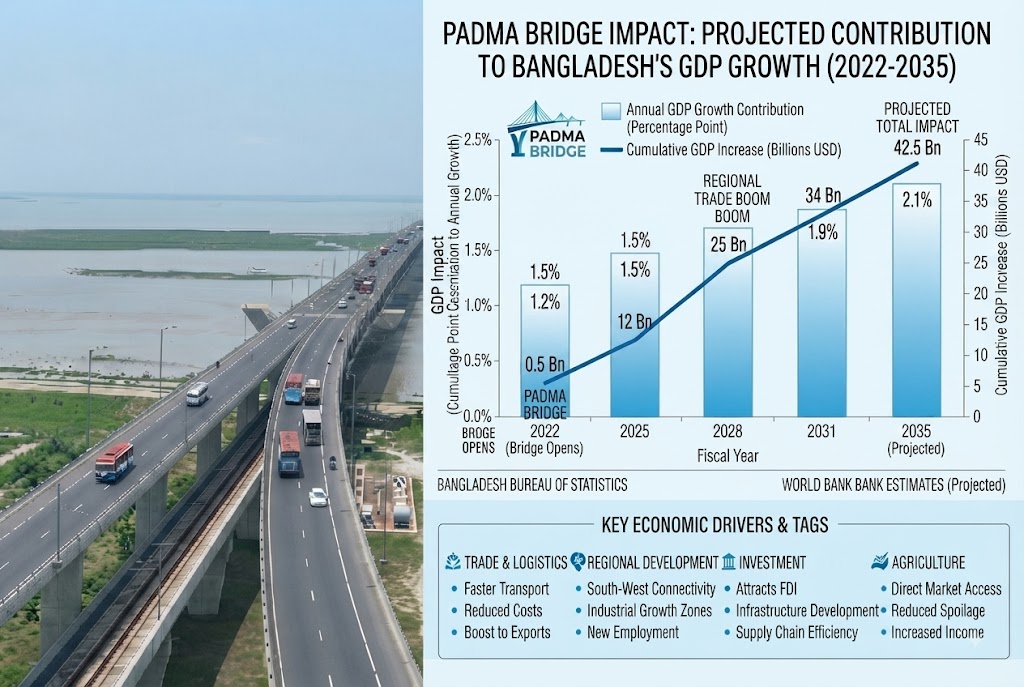
According to estimates cited by economists and researchers, the Padma Bridge could contribute around 1.23 percent to 1.4 percent to national GDP over time. The bridge is also expected to contribute to poverty reduction in the connected regions. These figures should be understood as economic projections rather than money generated by the bridge itself. The larger effect comes from improved connectivity, lower transport costs, greater market access, and new economic activity around the transport corridor.
Padma Bridge's Contribution to GDP
🚢 Full Utilization of Mongla and Payra Seaports and International Trade
The improved road connection has also strengthened the potential of Mongla Seaport and Payra Seaport. In the past, long travel times and ferry crossings made movement between Dhaka and these ports more difficult. The Padma Bridge has shortened the road distance and reduced travel time, giving importers and exporters another practical route for moving goods between the capital, industrial areas, and the country's southern ports.
🐟 Agriculture, Fishery Sector, Industrialization, and Employment Opportunities
Southern Bangladesh produces large quantities of fish, shrimp, mangoes, vegetables, and other agricultural products. Faster transport means these goods can reach Dhaka and other major markets more quickly, which is particularly important for products that lose quality when transportation takes too long.
The improved highway corridor has also encouraged investment in factories, warehouses, cold-storage facilities, hotels, restaurants, and tourism-related businesses. Areas around Bhanga and other transport junctions are increasingly important because they connect several major routes. As economic activity grows along these corridors, new employment opportunities are also emerging.
Mawa Toll Plaza and Modern Connecting Road
For ordinary travelers and businesses, one of the biggest changes is simply the time saved. Long ferry queues and unpredictable crossing times have been replaced by a much more reliable road connection. That means less waiting, lower fuel consumption, and a more predictable domestic supply chain.
🌄 5. New Attraction for Travelers, Tourism Development, and the Royal Taste of Mawa Ghat's Padma Hilsa
The Padma Bridge has also become a popular destination for people who simply want to experience the river and see the bridge up close. The Mawa and Jajira areas attract visitors on weekends, holidays, and during the late afternoon. The combination of the wide Padma River, the bridge itself, the surrounding landscape, and the sunset makes the area particularly attractive for short trips.
🌉 Spots and Sightseeing Places on Both Banks
The areas around the Mawa end and the Jajira side have developed into popular spots for day trips. Riverfront areas, nearby resorts, restaurants, walkways, and boat trips have added to the attraction. During the monsoon, the Padma becomes especially impressive as the river expands and the surrounding landscape changes with the rising water.
🍽️ The Unforgettable Tradition of Mawa Ghat's Famous Fried Padma Hilsa
For many visitors, a trip to the Padma Bridge is not complete without eating Hilsa at Mawa Ghat. Fresh Padma Hilsa, fried and served with mustard, onion, chili, and hot rice, has become part of the local travel experience. People often come not only to see the bridge but also to enjoy the food associated with the river and the region.
The famous fried Padma Hilsa of Mawa Ghat and other local dishes
That combination of modern infrastructure and traditional Bengali food gives the Padma Bridge area a character of its own. One moment you are looking at a massive piece of modern engineering; the next, you are sitting beside the river eating a dish deeply connected with Bengal's food culture. That contrast is part of what makes a visit to the Padma Bridge memorable.
📌 Conclusion: A New Monument of Self-Confidence
The Padma Bridge is more than a transport structure. It is one of the most ambitious infrastructure projects Bangladesh has ever completed and a clear example of what can be achieved when a difficult engineering problem is matched with long-term planning, technical expertise, and sustained financial commitment.
Its massive foundations, double-deck design, river training works, and road and rail connections have created a new transport corridor between Dhaka and the southern part of the country. The real value of the bridge, however, will be measured over time through the economic activity, trade, mobility, and opportunities that develop around it.
For future generations, crossing the Padma Bridge will probably feel ordinary. But behind that ordinary journey is a long story of engineering challenges, financial uncertainty, construction difficulties, and national determination. Protecting the bridge, maintaining it properly, and making full use of the connectivity it has created will be the next responsibility.