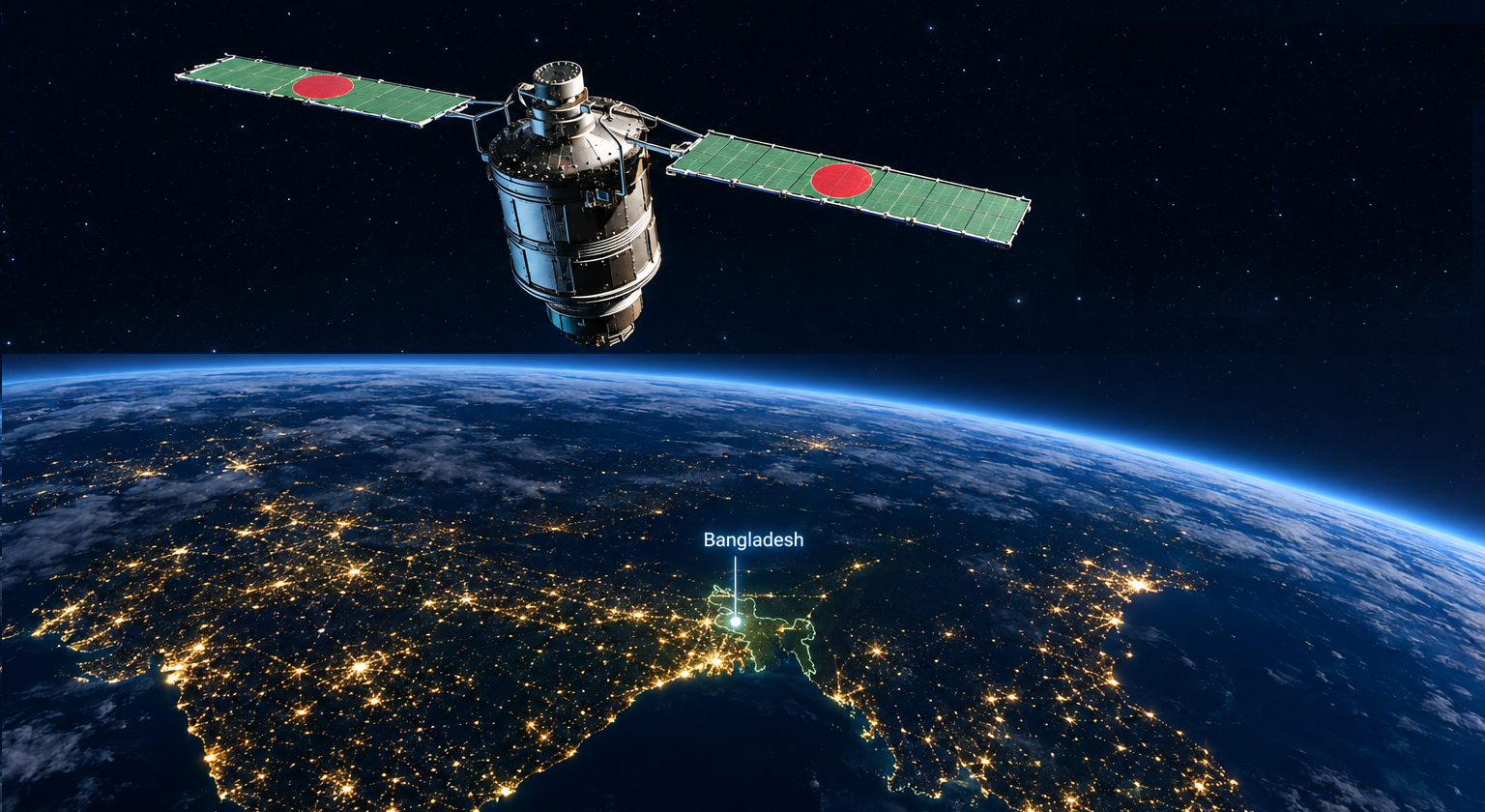
Bangabandhu-1 Satellite — A Structural Embodiment of Bangladesh’s Space Ambitions.
Space Technology · Aerospace Engineering · Telecommunications · Bangladesh
Bangabandhu-1 Satellite: Bangladesh's Future Space & Communications Hub
Published:
When we think about Bangladesh's major infrastructure projects, bridges, metro rail, tunnels and deep-sea ports usually come to mind. But one of the country's more unusual technological milestones happened far above the Earth, in geostationary orbit roughly 36,000 kilometres above the equator.
Bangabandhu-1 is more than a communications satellite. It gave Bangladesh its own satellite capacity for broadcasting and telecommunications, reducing reliance on foreign operators and creating new opportunities for communication and digital services.
But putting a satellite into orbit is only part of the story. Bangabandhu-1 involved finding the right orbital position, selecting and financing a launch vehicle, building the spacecraft, establishing ground stations, and developing the systems needed to control the satellite and deliver services back on Earth.
So how did Bangladesh go from planning a satellite to actually operating one in geostationary orbit? Let's look at how Bangabandhu-1 was planned, financed, built and launched, how its ground infrastructure works, and what the project has meant for Bangladesh's communications and technological capabilities.
At a glace
Satellite: Bangabandhu Satellite-1
Orbit: Geostationary Earth Orbit (GEO)
Altitude: ~35,786 km above Earth's equator
Orbital period: ~23h 56m (sidereal day)
Orbital position: Geostationary orbital slot around 119.1°E
Launch: 11 May 2018
Launch vehicle: SpaceX Falcon 9
Operator: Bangladesh Satellite Company Limited (BSCL)
Bangabandhu Satellite-1
GEOSTATIONARY ORBITAL VISUALIZATION
MISSION TELEMETRY
SatelliteBS-1
OrbitGEO
Altitude35,786 km
Orbital Slot119.1° E
Orbital Period23h 56m
Launch11 May 2018
Launch VehicleFalcon 9
● SATELLITE OPERATIONAL
MISSION :
BANGLABANDHU-1
ORBIT :
GEOSTATIONARY
ALTITUDE :
35,786 KM
LONGITUDE :
119.1° E
STATUS :
NOMINAL
🛰️ The Big Dream: Project Planning, Feasibility & Strategic Vision
Every major project begins with a basic question: What problem are we trying to solve? A satellite project is no different. Long before the rocket launch and countdown, Bangladesh had to decide why it needed a satellite, what it could realistically use it for, and what the country expected to gain from the investment.
At the time, Bangladesh depended heavily on foreign satellites for television broadcasting, telecommunications and data services. Satellite transponder capacity had to be leased from overseas operators, which meant continuing payments for services that Bangladesh did not control directly. Owning a satellite offered a way to reduce some of that dependence while also building local experience in satellite operations.
The basic idea was straightforward: instead of depending entirely on foreign satellites, Bangladesh wanted to operate one of its own.
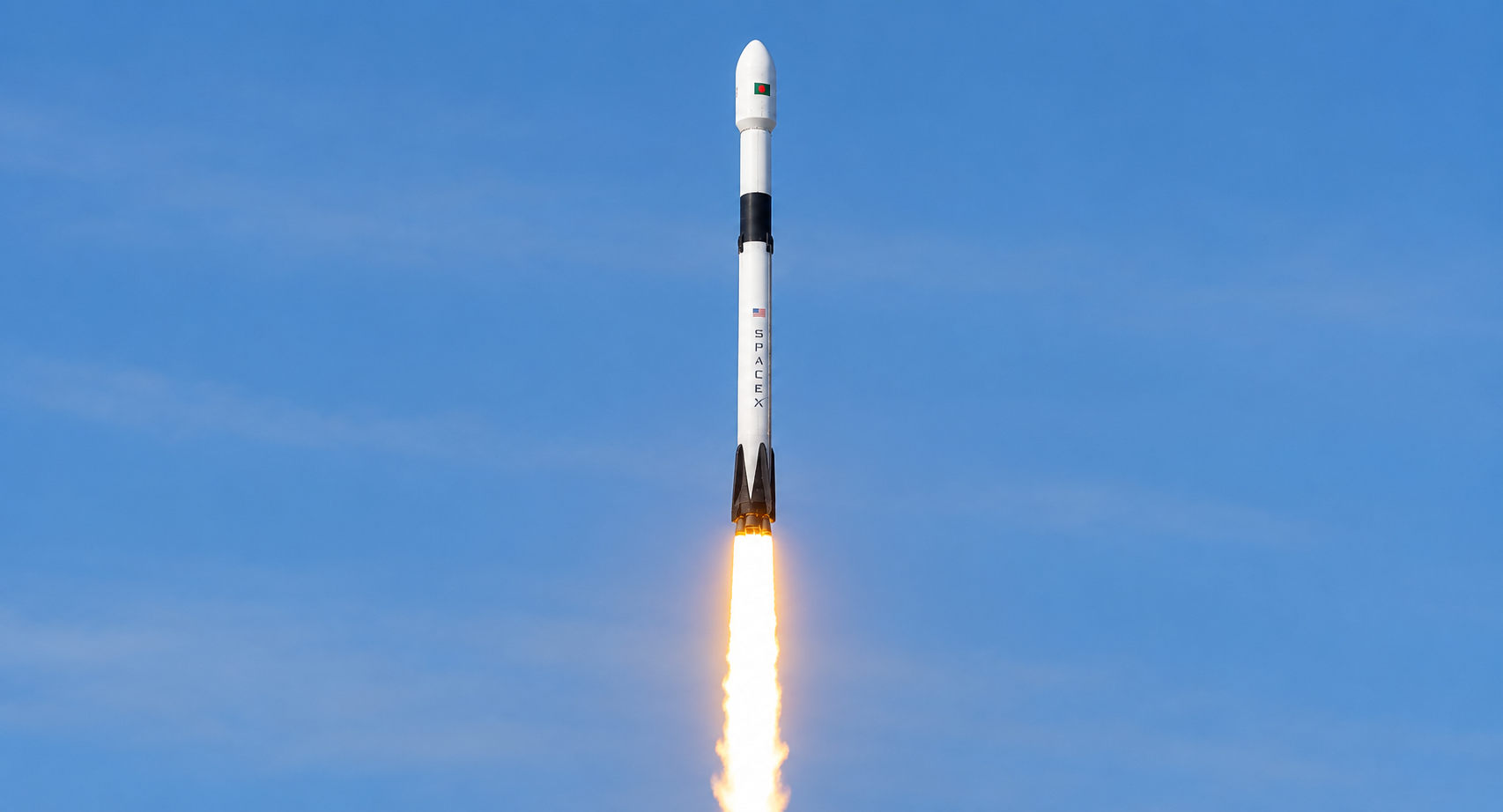
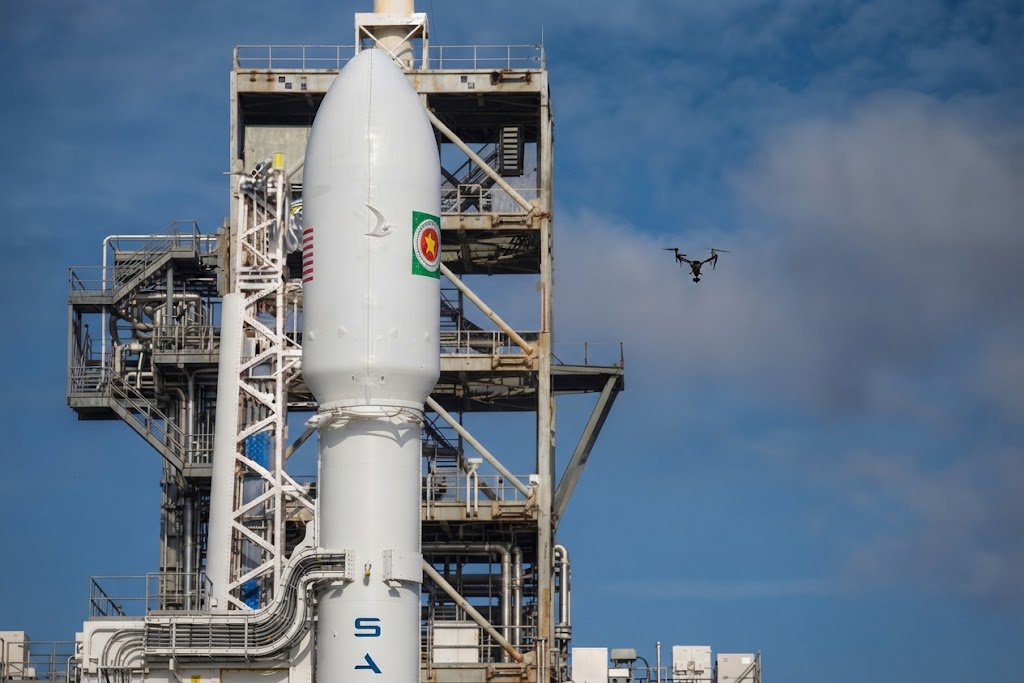
The Falcon 9 Block 5 rocket carrying Bangabandhu-1 lifts off from Kennedy Space Center.
That was the starting point for Bangabandhu-1. The objective was not simply to put a satellite into orbit, but to establish national infrastructure that could support television broadcasting, satellite communications, connectivity in areas where terrestrial networks are difficult to extend, and emergency communications during disasters. There was also a commercial objective: unused satellite capacity could potentially be leased to customers outside Bangladesh.
📍 Orbital Slot: Why 119.1° East?
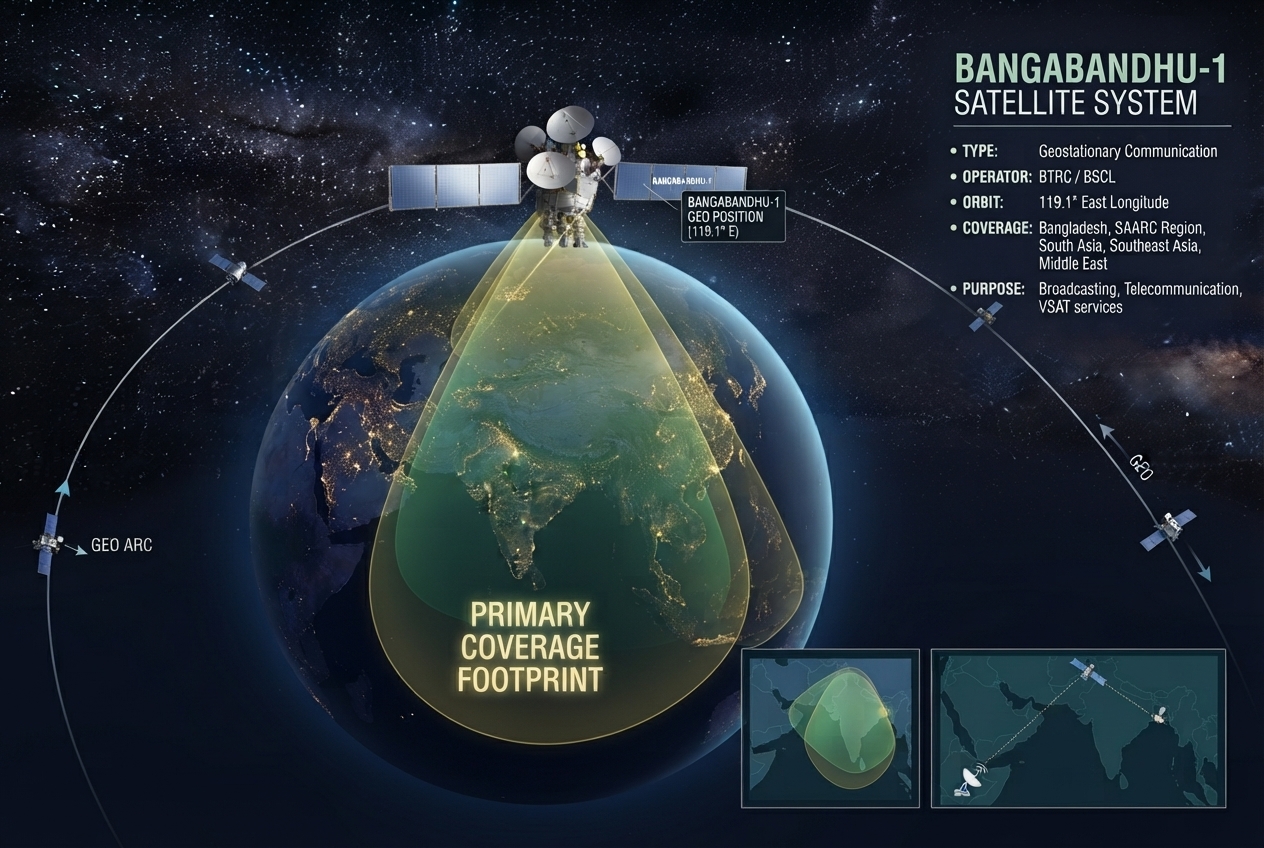
Bangabandhu-1 was assigned the 119.1° East geostationary orbital position. A geostationary satellite orbits at a speed that matches Earth's rotation, so from the ground it appears to remain over roughly the same region of the planet. That makes this type of orbit particularly useful for communications because ground antennas can maintain a fixed direction toward the satellite.
Getting access to an orbital position is only part of the process. The associated radio frequencies also have to be coordinated through the International Telecommunication Union (ITU). The orbital location matters because it affects the regions the satellite can cover and how its communication beams can be arranged.
For Bangladesh, the intention was to serve domestic users while also leaving room to offer capacity in neighbouring markets. Whether that becomes a strong commercial opportunity depends on several practical factors, including coverage, pricing, available capacity, customer demand and competition from other satellite operators.
Bangabandhu-1's orbital position and regional coverage.
🎯 From Satellite to Digital Infrastructure
A satellite by itself does not provide much value. It needs ground facilities, communications networks, customers and trained people to operate the system. Bangabandhu-1 was therefore planned as part of a larger infrastructure made up of several connected elements:
The satellite: Its onboard transponders receive communication signals and retransmit them back toward Earth.
Ground stations: Engineers use these facilities to monitor the spacecraft, send commands and track its position.
Television broadcasting: Satellite capacity can support direct-to-home (DTH) television and the distribution of broadcast signals.
Telecommunications: Satellite links can provide connectivity or backup communication paths where terrestrial networks are unavailable or disrupted.
Disaster management: Satellite communications can help maintain links during cyclones, floods and other emergencies, especially when ground infrastructure has been damaged.
Regional business: Available capacity can potentially be leased to customers in other markets.
The practical and commercial value of the project depends on how well all of these pieces work together. The satellite provides the capacity, the ground infrastructure makes that capacity usable, and service providers connect it to broadcasters, businesses, government users and other customers.
Regional sales can provide additional revenue, but that is not automatic. The service has to be competitively priced, technically suitable and backed by enough demand to make the business worthwhile.
Launching a satellite is only the first step. Its real value comes from the services it provides and the people and organisations that actually use them.
💰 Project Financing: Who Paid for Bangabandhu-1?
A communications satellite costs much more than the spacecraft itself. The overall project includes the satellite, launch service, ground stations, insurance, testing and the people and systems needed to operate everything over many years. Bangabandhu-1 therefore required a financing structure involving international lenders, export credit support and Bangladesh's public-sector institutions.
💴 Satellite Financing and Pre-Export Credit
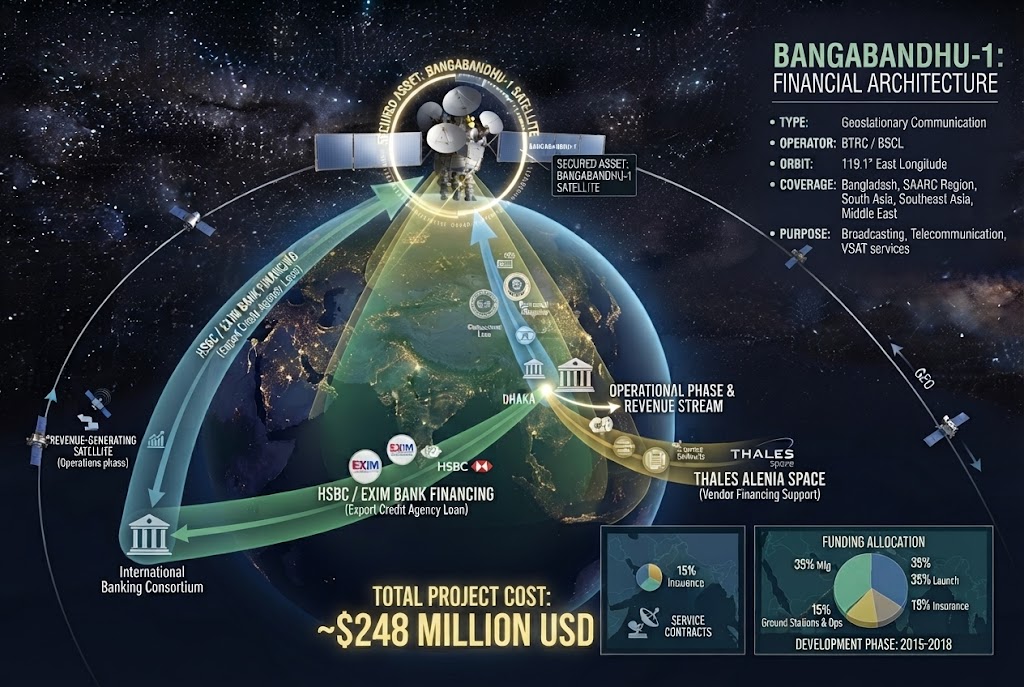
Financing arrangement: The project used a pre-export financing arrangement led by HSBC, with support from French export credit agencies as part of the financing structure.
Total project cost: The commonly cited project cost is approximately Tk 2,968 crore (US$248 million), covering the satellite, launch, ground infrastructure and insurance.
Government involvement: The Bangladesh Telecommunication Regulatory Commission (BTRC) played a central role in coordinating the project and its financing arrangements on behalf of the government.
Ongoing expenses: The financial commitment did not end after launch. Ground station operations, maintenance, insurance and eventual replacement planning all involve continuing costs.
How the Bangabandhu-1 project was financed.
📊 The Cost Reality
Any large public investment in space technology raises a reasonable question:
Will Bangabandhu-1 generate enough value to justify the money spent on it?
There is no single number that answers that question. The project needs to be assessed over the satellite's operating life by looking at revenue, operating costs and the services that would otherwise have required foreign satellite capacity.
Leasing transponder capacity is one source of income. Savings from replacing some foreign satellite services may also have economic value, although those savings depend on which services can actually be shifted to Bangabandhu-1.
There are several other potential benefits, but they should not automatically be counted as direct financial returns:
Reducing spending on foreign satellite capacity where domestic capacity can replace it.
Giving Bangladesh greater control over its satellite broadcasting infrastructure.
Expanding connectivity options for remote and underserved areas.
Providing additional communication options for government and security agencies, subject to the systems and safeguards in place.
Supporting emergency communications when terrestrial networks are disrupted by cyclones, floods or other disasters.
Generating income by leasing available capacity to foreign customers.
Developing local technical skills and transferring knowledge in satellite operations.
Supporting Bangladesh's television broadcasting and satellite service industries.
A proper financial assessment therefore needs to compare actual revenue with operating expenses, debt-servicing costs and the cost of maintaining or eventually replacing the satellite. Looking only at the launch cost or bandwidth revenue would not give the full picture.
🚀 The Spacecraft: Bangabandhu-1 and Its Launch System
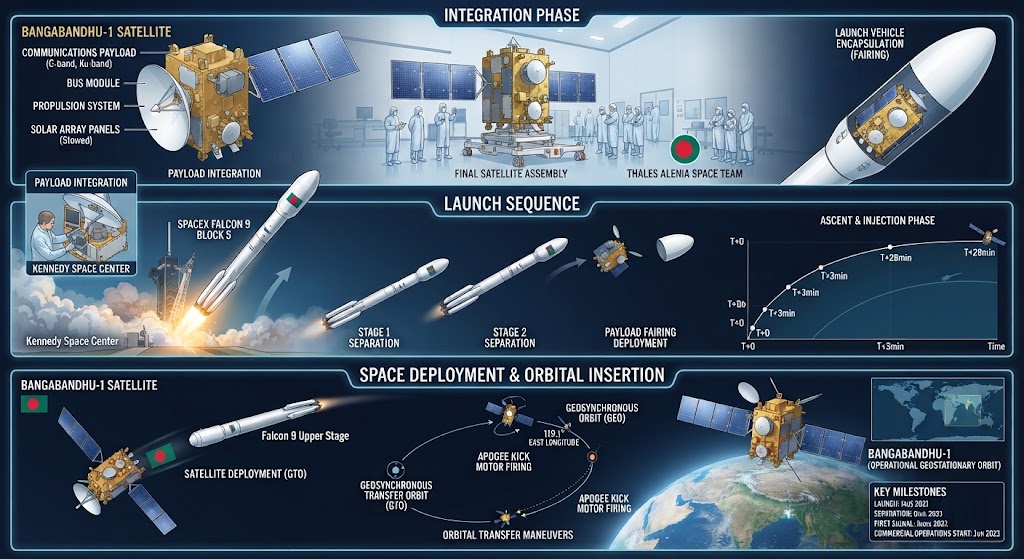
Bangabandhu-1 was built by Thales Alenia Space and launched aboard a SpaceX Falcon 9 Block 5 rocket. The spacecraft had to be designed to survive the violent conditions of launch, operate reliably in the environment of space and maintain communication with Earth throughout its mission.
Some of the main technical details are:
Satellite platform: Spacebus 4000B2.
Transponders: 40 in total—26 Ku-band and 14 C-band.
Launch vehicle: SpaceX Falcon 9 Block 5.
Designed service life: Approximately 15 years.
Launch mass: Approximately 3.5 metric tonnes.
Power supply: Solar arrays generate electricity, while onboard batteries provide power when the satellite passes through Earth's shadow.
Bangabandhu-1's spacecraft systems and deployment into orbit.
🔥 Why the Spacebus 4000B2 Platform?
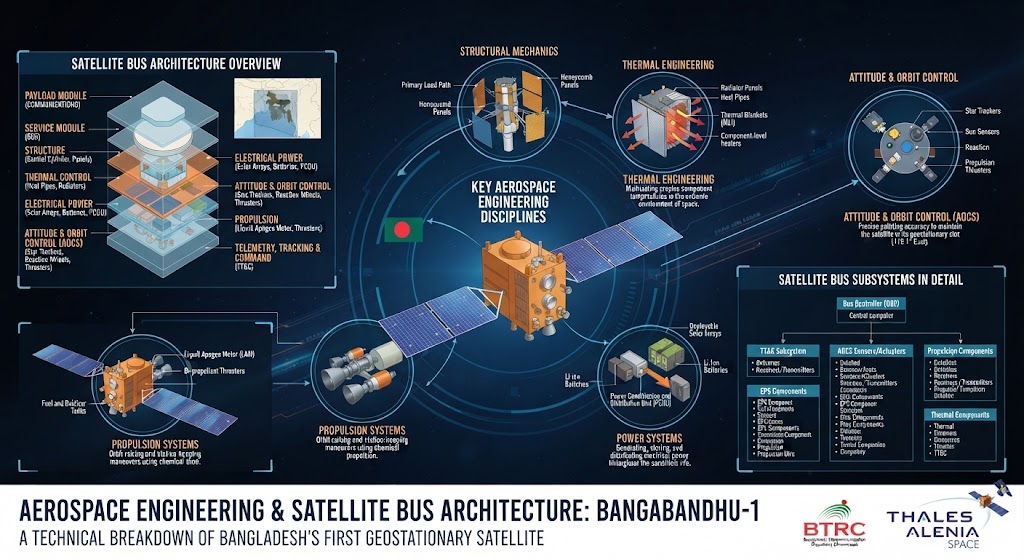
The Spacebus platform provides the satellite's main structure and supports key systems such as propulsion, electrical power and thermal control. These systems have to work together continuously to keep the spacecraft healthy and maintain its position in geostationary orbit.
Once in orbit, the satellite is not simply placed at one point and left there. Its position is gradually affected by gravitational forces and other disturbances. Small corrections, known as station-keeping manoeuvres, are therefore carried out to keep it within its assigned orbital limits.
A reliable satellite is not one that never encounters problems. It is one designed to keep operating despite the risks and limitations of the space environment.
That matters because repairing a satellite in geostationary orbit is extremely difficult. Engineers have to anticipate possible failures, monitor the spacecraft's condition and manage limited resources such as fuel and electrical power carefully.
The Falcon 9 rocket that carried Bangabandhu-1 into space.
⚙️ Design and Engineering: Building a Satellite for Space
Designing a satellite is very different from building equipment on Earth. Once the spacecraft reaches orbit, there is no technician who can visit it for routine maintenance. It has to withstand launch vibrations, radiation, large temperature changes and the long-term effects of operating in space, all while continuing to perform its mission.
🌊 The Main Engineering Challenges
Engineers have to account for several conditions that can affect the spacecraft throughout its mission:
Launch vibrations: The rocket produces intense vibration, acceleration and acoustic loads during liftoff and ascent.
Temperature changes: The spacecraft must operate through periods of direct sunlight and shadow without its equipment overheating or becoming too cold.
Radiation: High-energy particles can damage electronic components or interfere with onboard systems.
Orbital disturbances: The gravitational effects of the Sun and Moon, along with Earth's slightly uneven shape, can gradually change the satellite's orbital position.
Station-keeping: Propellant is required to correct these changes and keep the satellite within its assigned orbital position.
Radio interference: Frequencies must be coordinated to reduce interference with neighbouring satellites and other radio services.
Solar eclipses: When Earth blocks sunlight from reaching the solar arrays, onboard batteries must supply the required power.
System redundancy: Backup components help maintain operation if certain equipment fails.
End-of-life planning: Remaining propellant has to be managed so the satellite can be moved to an appropriate disposal orbit when its useful service life ends.
The engineering systems that help a geostationary satellite operate in space.
🏗️ Antennas, Transponders and the Satellite Bus
The satellite's antennas direct radio signals toward the intended coverage areas. Their design and pointing determine where services can be provided and how effectively the available radio spectrum can be used.
The transponders handle the communication signals. They receive signals sent from Earth, amplify them and retransmit them at different frequencies so they can be received by ground equipment.
None of this works in isolation. The spacecraft structure has to survive launch and the space environment, the radio-frequency equipment has to process signals correctly, and the thermal and electrical systems have to keep the hardware within its operating limits.
All of those systems also have to work within the satellite's limits for mass, available power and onboard propellant. Once the spacecraft is in orbit, those resources cannot simply be replenished during normal operations.
📡 Ground Control and Telemetry: The Work Behind the Satellite
When people think about a satellite, they usually picture the spacecraft moving around Earth. But keeping it operational depends just as much on what happens on the ground. The facilities, networks and engineers that support the spacecraft make up the ground control segment of the mission.
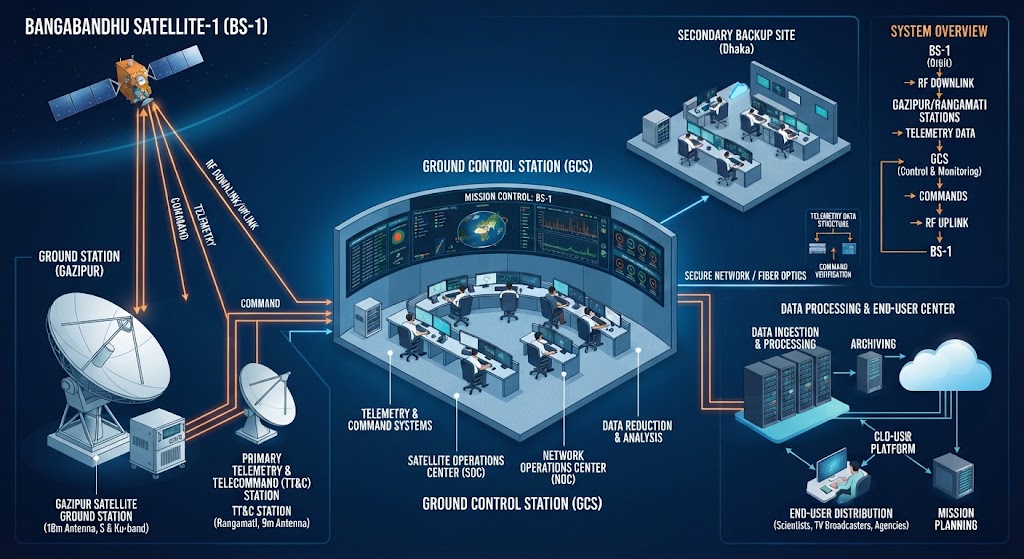
Ground stations communicate with the satellite through large antennas and specialised control systems. Operators monitor telemetry to check the spacecraft's health, track its position, send commands and plan station-keeping manoeuvres. This is ongoing work throughout the satellite's operating life.
The satellite operates in orbit, but the teams on the ground constantly monitor its condition, manage its position and help keep its services available.
Ground control becomes especially important when something unusual happens. Operators have to identify abnormal readings, determine what they mean and take the appropriate action before a relatively small problem becomes a larger one.
Bangabandhu-1 ground control facilities at Gazipur and Betbunia.
🛰️ The Main Ground Infrastructure
Primary ground station: Located in Gazipur, it supports telemetry, tracking and command (TT&C) operations.
Secondary ground station: Located at Betbunia in Rangamati, it provides a backup facility for satellite control operations.
Antenna systems: Large parabolic dishes establish radio links between the ground facilities and the satellite.
Mission control systems: Software and monitoring tools help operators track orbital parameters and assess spacecraft health.
Network and capacity management: Operational teams coordinate satellite capacity and support the delivery of services to customers.
Having two ground stations reduces dependence on a single location. If one facility experiences a technical problem or local disruption, the other can provide an alternative route for control, provided the necessary systems and communication links are available.
Together, the spacecraft and its ground facilities form the operational system behind Bangabandhu-1. The satellite provides the communications capacity, while the ground infrastructure and the people operating it keep that capacity usable.
📦 Payload & Services: Broadcasting, Data and VSAT Networks
Putting a satellite into orbit is only part of the job. The more important question is what services it can actually provide. For Bangabandhu-1, that depends on its transponders, the ground equipment connected to them and the requirements of the organisations using the satellite capacity.
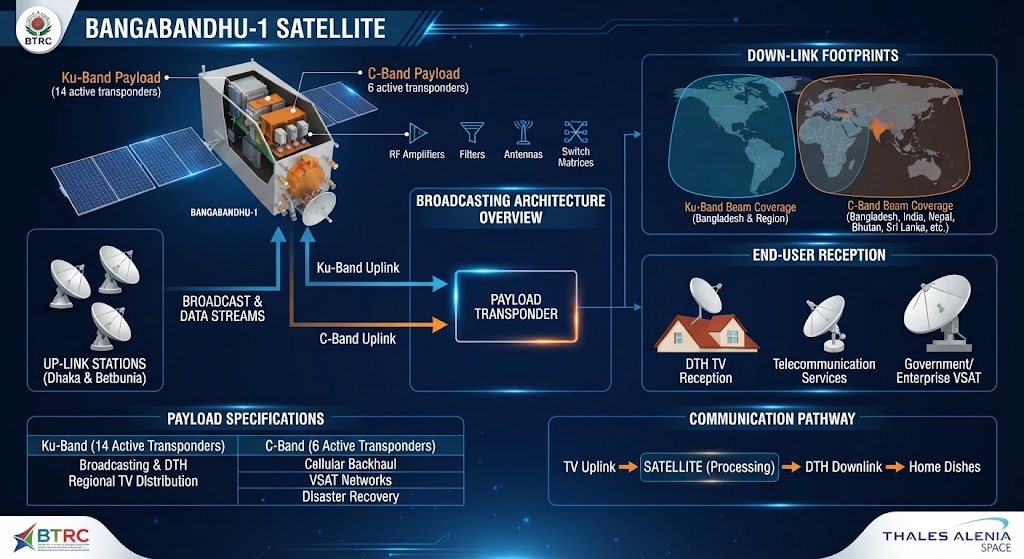
The satellite operates in two frequency bands, Ku-band and C-band. Each has different characteristics, which makes them suitable for different types of communication services.
Ku-band transponders: Can support direct-to-home (DTH) television broadcasting and corporate data links.
C-band transponders: Can support television signal distribution and other communication links where greater resistance to rain-related signal fading is useful.
VSAT networks: Very Small Aperture Terminal (VSAT) systems use satellite links to connect remote offices, banking facilities and other locations where terrestrial connectivity may be limited.
Emergency communications: Satellite links can provide an alternative communication path when local networks are damaged or unavailable during disasters.
Media transmission: Satellite capacity can carry television programme feeds between broadcasters, production facilities and distribution networks.
Using both frequency bands gives Bangabandhu-1 flexibility in the types of services it can support. The actual performance of any service, however, depends on factors such as coverage, available capacity, ground equipment, weather and network configuration.
How satellite payload capacity supports broadcasting and communications.
📋 Project Management & Launch Execution
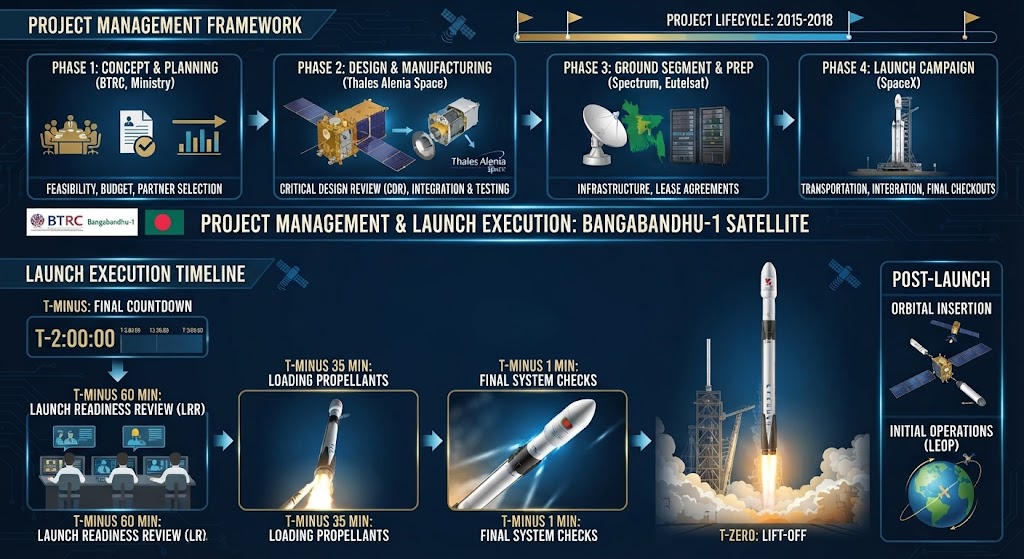
Bangabandhu-1 was really a collection of projects that had to function as one system. Building the satellite was only one part of the work. The launch, ground stations, regulatory approvals, insurance and operator training all had to be completed and coordinated before the mission could become operational.
🧩 Managing the Different Workstreams
Satellite manufacturing: Building the spacecraft, integrating its payload and testing the systems under conditions that simulate launch and the space environment.
Launch services: Preparing the Falcon 9, integrating the satellite with the launch vehicle and carrying out the launch sequence.
Ground infrastructure: Constructing and equipping the ground stations at Gazipur and Betbunia.
Regulatory coordination: Managing orbital filings, frequency coordination and the necessary international approvals.
Insurance and risk management: Arranging coverage for launch-related risks and, where applicable, the satellite's operation in orbit.
Training and knowledge transfer: Preparing Bangladeshi engineers and operators to manage the satellite and its ground systems.
Coordinating the different stages of the Bangabandhu-1 mission.
Coordination mattered because the different parts of the project depended on one another. The satellite had to be ready for launch, the ground stations had to be capable of communicating with it, and the people who would operate the system had to be trained beforehand. Once the spacecraft was in orbit, there would be no practical way to bring it back to Earth for routine repairs.
The satellite, launch vehicle and ground stations each have a separate job, but the mission only works when all three work together.
📈 Mission Timeline & Key Milestones
Bangabandhu-1 was launched on May 11, 2018, local time in Florida, aboard a SpaceX Falcon 9 Block 5 rocket from Kennedy Space Center. Because of the time difference, the launch was May 12 in Bangladesh.
After launch, the satellite still had several important steps to complete before it could enter commercial service:
Separation from the Falcon 9's second stage.
Deployment of the solar arrays and antennas.
Orbital manoeuvres to reach its assigned geostationary position.
In-orbit testing of the satellite's systems and communications payload.
Transfer to operational service after the necessary checks and commissioning were completed.
These steps are standard parts of a geostationary communications mission. A successful launch is a major milestone, but it does not by itself mean that every onboard system is working as intended or that commercial services are immediately ready.
📑 Procurement & Contract Management
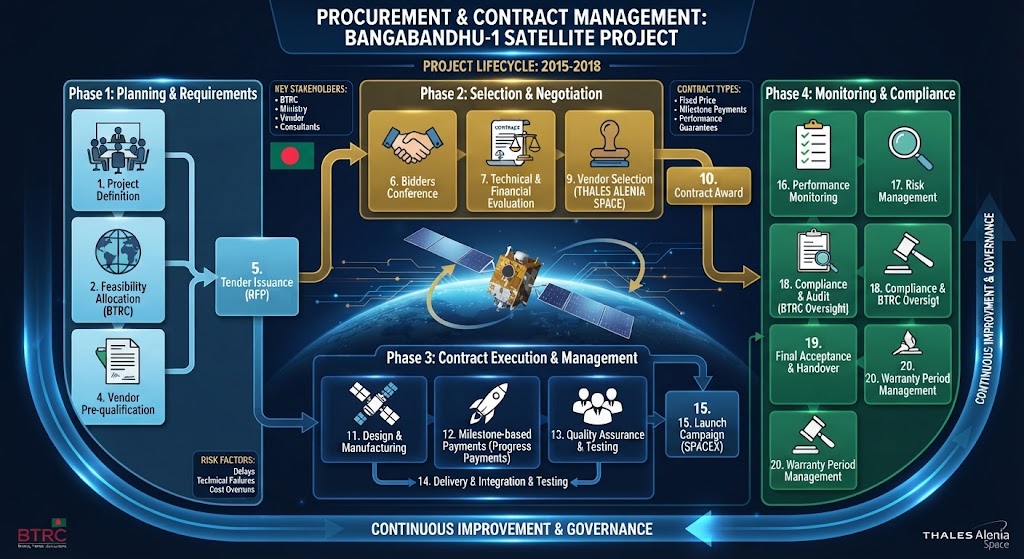
A satellite programme depends on more than engineering. The project also has to establish who will build the spacecraft, who will launch it, who will construct the ground facilities and who will provide technical support once the satellite is operating.
Bangabandhu-1 involved international suppliers as well as local contractors, with different organisations responsible for different parts of the programme.
Managing suppliers, contracts and technical responsibilities throughout the project.
Satellite manufacturing: Thales Alenia Space was responsible for building and delivering the satellite under the project arrangement.
Launch services: SpaceX provided the Falcon 9 launch vehicle and launch service.
Technical consultancy: Specialist consultants can provide independent monitoring, engineering advice and quality oversight where these services are included in project contracts.
Ground infrastructure: Contracts covered the construction and equipment of the ground facilities, including supporting power systems.
Insurance: Insurance arrangements covered risks associated with launch and satellite operations, subject to the terms of the relevant policies.
The launch ends one stage of the project, but it does not end the need for technical support. A satellite still needs monitoring, ground-system maintenance and specialist engineering support throughout its operating life.
Software, specialised equipment and technical expertise may also remain connected to the original suppliers. Managing those relationships over time is part of keeping the satellite and its supporting infrastructure operational.
🔬 Quality Management & Quality Assurance
On Earth, a faulty component can usually be replaced. In space, the same problem may be extremely difficult or impossible to repair. Once a satellite is in orbit, engineers have to depend on the systems already onboard and the commands they can send from Earth.
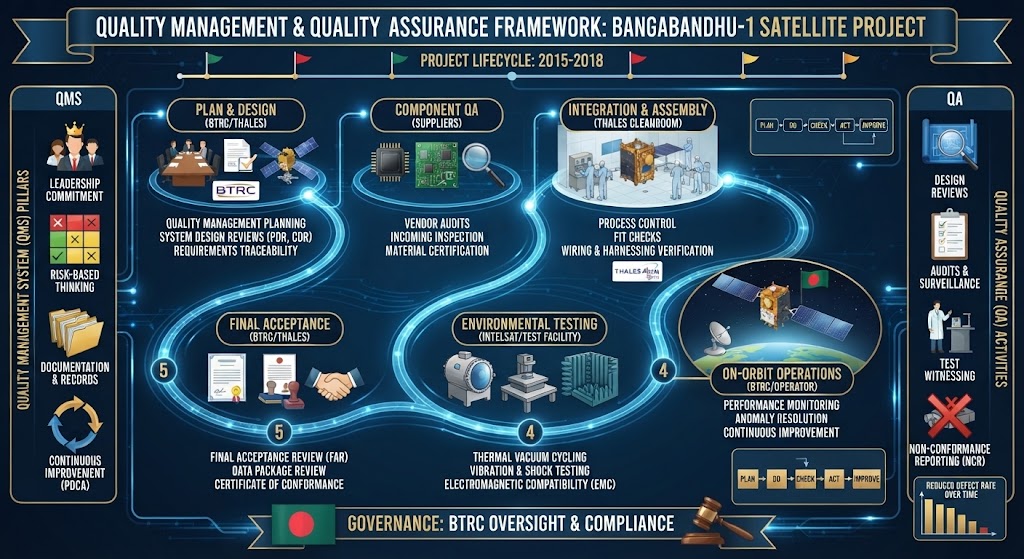
That is why testing and quality assurance are such important parts of satellite development. Components, software and complete systems have to be tested before launch to reduce the chance of a failure that cannot be easily corrected later.
Testing and quality assurance before a satellite is launched.
Quality assurance for a satellite project can include:
Component screening: Checking electronic components for reliability and their ability to withstand radiation and temperature extremes.
Vibration testing: Subjecting equipment to simulated launch vibrations and mechanical loads.
Thermal-vacuum testing: Testing the spacecraft in a chamber that reproduces important aspects of the vacuum and temperature conditions of space.
Software verification: Checking that onboard software performs its intended functions and responds correctly to faults.
Ground station calibration: Verifying antenna alignment, tracking performance and signal quality.
Redundancy checks: Confirming that designated backup systems can take over when required.
These checks are part of a larger process in which engineers test equipment, analyse the results, correct problems and verify that the system meets its requirements before launch.
Test the hardware, verify the software, study the results and fix problems before launch. Once the satellite is in orbit, the options for correcting mistakes become very limited.
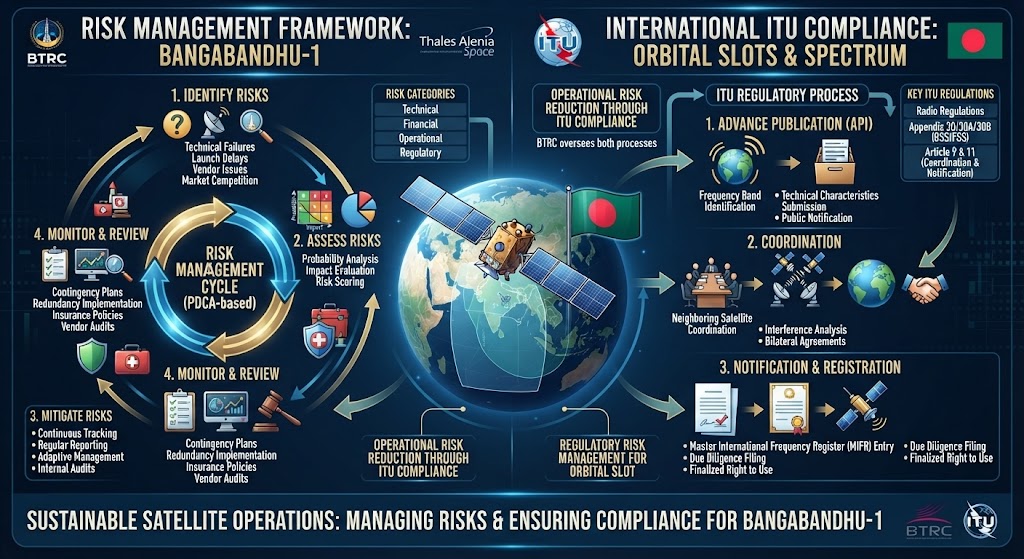
🛡️ Risk & Compliance: Managing the Hazards of Space
Satellite operations involve risks that continue long after the rocket leaves the launch pad. The spacecraft has to survive launch, operate in a harsh environment, avoid harmful radio interference and remain within its assigned orbital limits.
Managing technical risks and complying with international satellite regulations.
Some of the main risks and the measures used to manage them include:
Launch failure: Launch vehicle reliability, pre-launch checks and appropriate insurance help manage the technical and financial consequences of a failed launch.
Orbital debris: Tracking available information about space objects helps operators assess collision risks and plan avoidance manoeuvres when necessary.
Radio-frequency interference: Coordination under International Telecommunication Union (ITU) rules helps reduce harmful interference between satellite systems and other radio services.
Solar activity: Radiation protection, fault monitoring and safe-mode procedures help the spacecraft respond to certain space-weather events.
Fuel depletion: Careful planning of station-keeping manoeuvres helps conserve propellant and manage the satellite's useful operating life.
There is no routine repair visit in space. Engineers have to anticipate possible failures, build in safeguards and plan how the spacecraft should respond when conditions change.
Risk management cannot eliminate every possibility of failure. Its purpose is to understand the risks, reduce them where possible and prepare for their consequences. Regulatory compliance, operating procedures and insurance are all important, but none can guarantee uninterrupted satellite operation.
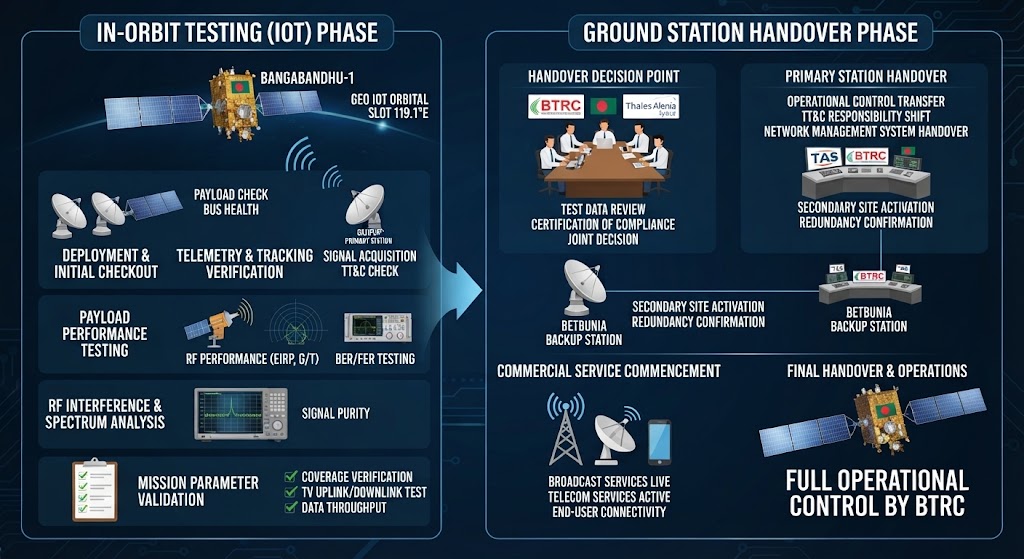
🧪 Testing, Commissioning & Handover
Getting Bangabandhu-1 into orbit was a major milestone, but the mission was not finished at launch. Before the satellite could enter commercial service, engineers had to test its systems, fine-tune its orbital position and confirm that it could communicate properly with the ground stations.
In-Orbit Testing (IOT) and Ground Station Handover
Payload Calibration: Testing the 40 transponders to check signal quality, gain and frequency response.
Antenna Pattern Verification: Checking the satellite's coverage across Bangladesh and its intended regional service areas.
Ground Segment Integration: Connecting and synchronising the control systems at Gazipur and Betbunia with the satellite.
Trial Broadcasts: Testing direct-to-home (DTH) television signals and emergency communication links.
Formal Handover: Transferring operational responsibility from Thales Alenia Space engineers to Bangladeshi operators.
Once these checks were completed, Bangladesh could move into the day-to-day operation of its own communications satellite.
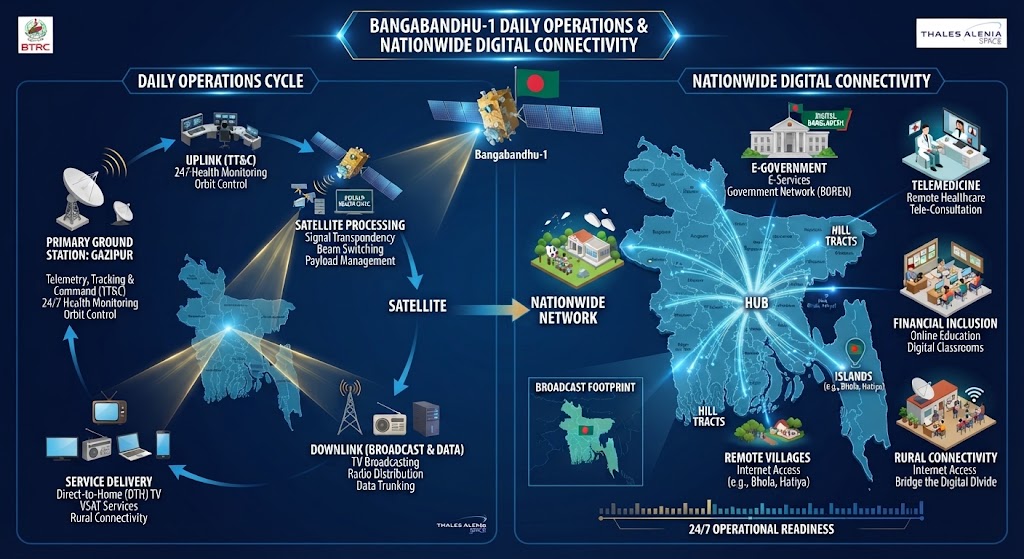
🌐 Operations & Connectivity: Bringing the Sky Down to Earth
After commissioning, Bangabandhu-1 moved into regular service. Its purpose was to support television broadcasting and telecommunications, including services in places where building and maintaining terrestrial infrastructure can be difficult or expensive.
Daily Operations and Nationwide Digital Connectivity
DTH Broadcasting: Providing satellite capacity for direct-to-home television services, allowing broadcasters to deliver channels directly to viewers' homes.
Rural and Island Connectivity: Providing an option for connecting offshore islands, hilly areas and remote communities where terrestrial fibre-optic networks may be difficult or costly to extend.
Cellular Backhaul: Supporting mobile network operators with satellite links in locations where conventional network connections are limited.
Disaster Communications: Helping maintain communication links during cyclones, floods and other emergencies when ground infrastructure is damaged or disrupted.
A satellite's real value is measured by the connections and services it helps deliver to people.
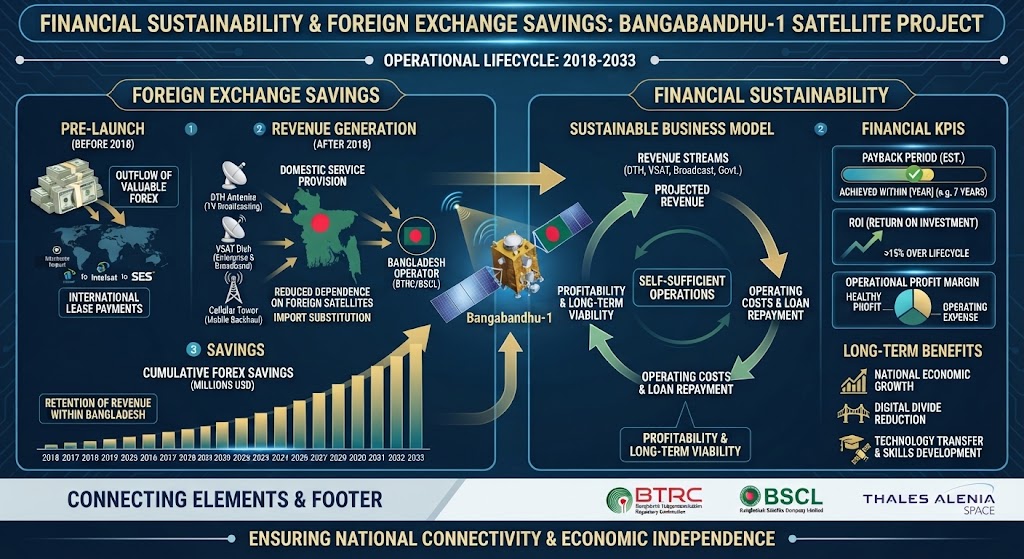
💵 Cost & Financial Sustainability
Bangabandhu-1 required a substantial financial investment. To understand whether that investment can be sustained over time, we need to look at how much of the satellite's capacity is being used, what revenue it generates and what costs it can help Bangladesh avoid.
Financial Sustainability and Foreign Exchange Savings
Reducing Dependence on Foreign Satellites: Using domestic satellite capacity for services that might otherwise require bandwidth leased from foreign operators, potentially reducing some overseas payments.
Leasing Commercial Capacity: Earning revenue by leasing available transponder capacity to broadcasters and other customers, including clients outside Bangladesh where demand exists.
Managing Operating Costs: Using local infrastructure and personnel to manage satellite services and support telecommunications and broadcasting operations.
Long-Term Cost Recovery: Comparing revenue and operating expenses over the satellite's expected 15-year design life to understand how much of the initial investment can be recovered.
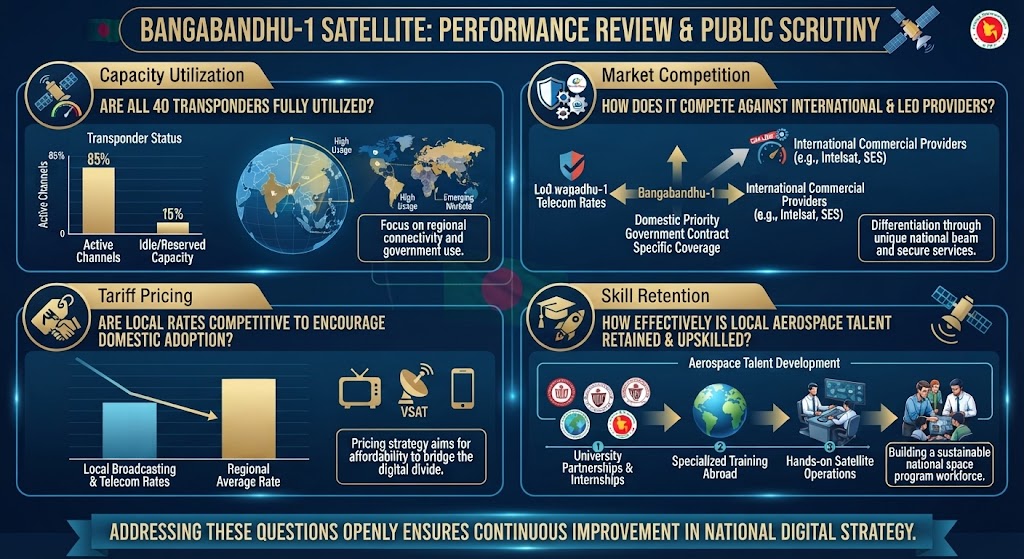
❓ Critical Questions: Evaluating the True Impact
Launching a national satellite was a major undertaking, but the launch itself does not tell us how successful the project has been over the long term. That requires looking at how much the satellite is actually being used, what it earns and how well it meets Bangladesh's needs.
Critical Evaluation of Satellite Utility and ROI
Capacity Utilization: How much of the satellite's 40 transponders is being used, and how much capacity remains available?
Market Competition: How does Bangabandhu-1 compare with international commercial satellite operators and newer low-Earth-orbit (LEO) satellite networks?
Pricing: Are satellite service rates competitive enough for domestic broadcasters and telecom operators to use its capacity?
Skills and Expertise: How effectively is Bangladesh developing and retaining specialists who can operate the satellite and contribute to future space projects?
Clear answers to these questions, supported by actual operational and financial data, would give a much better picture of where the project is meeting its goals and where changes may be needed.
🏛️ Government Actions & Policy Initiatives
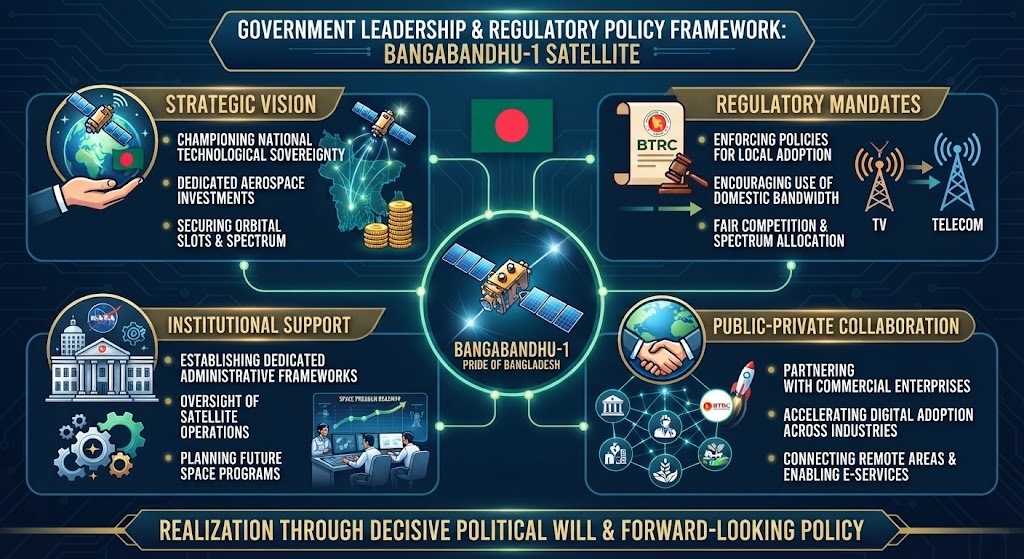
Bangabandhu-1 required government investment, long-term planning and regulatory support. The Bangladesh Telecommunication Regulatory Commission (BTRC), together with the relevant public institutions, has a role in maintaining the regulatory environment in which satellite services operate.
Government Leadership and Regulatory Policy Framework
Long-Term Planning: Treating satellite technology as part of Bangladesh's wider telecommunications and technology development plans.
Regulatory Framework: Setting clear rules for satellite services and considering how local broadcasters and telecom operators can use domestic satellite capacity.
Institutional Support: Maintaining the organisations, technical teams and administrative arrangements needed to operate the satellite and plan future missions.
Public-Private Cooperation: Working with commercial service providers to identify practical uses for satellite connectivity across different sectors.
📈 Post-Implementation & Present Status
Since its launch, Bangabandhu-1 has moved from being a national space milestone to becoming an operational communications asset. To understand its present status, however, it is not enough to look at the original mission objectives. Its actual performance, service use and commercial results also need to be considered.
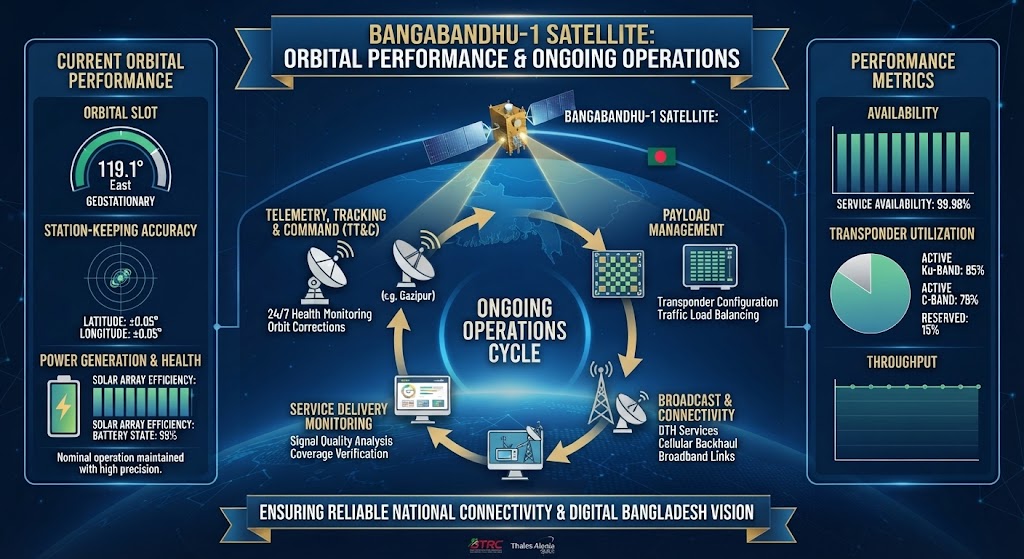
Orbital Performance and Ongoing Operations
Orbital Position: Operating at its assigned geostationary orbital location of 119.1° East, subject to ongoing station-keeping and monitoring.
Broadcasting Services: Providing satellite capacity for television broadcasters and direct-to-home platforms, depending on their individual service arrangements.
Government Communications: Supporting communication requirements where satellite links are appropriate, subject to the services and capacity actually in use.
Commercial Performance: Evaluating revenue from capacity leasing alongside transponder utilisation, operating costs and actual demand for satellite services.
To determine how well the satellite is performing today, these points need to be compared with current operational reports, service agreements and published financial information.
🔭 Future Planning: Looking Beyond Bangabandhu-1
Bangabandhu-1 gave Bangladesh practical experience in owning and operating a communications satellite. The next question is what the country should do with that experience and which space technologies would be most useful for future needs.
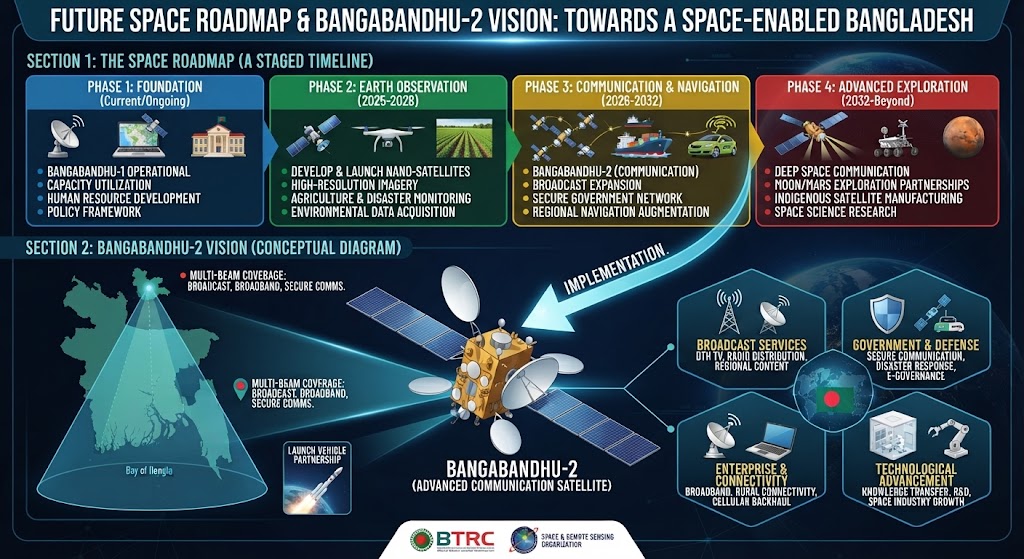
Future Space Roadmap and Bangabandhu-2 Vision
Bangabandhu-2 Planning: Exploring capabilities such as Earth observation and optical remote sensing that could support agriculture, environmental monitoring and security-related applications.
Developing Local Expertise: Expanding opportunities for aerospace education, university research and practical work in satellite engineering and design.
Regional and International Cooperation: Working with international space agencies and research institutions on joint projects, technical training and data sharing.
Next-Generation Communications: Studying technologies such as high-throughput satellites (HTS) and other satellite architectures to understand how they could meet future connectivity requirements.
The experience gained from one satellite can give Bangladesh a practical foundation for the next stage of its space programme.
Bangabandhu-1 Mission Video
Conclusion: Bangabandhu-1 Is Bigger Than a Satellite
Bangabandhu-1 is more than a story about launching a satellite. It represents Bangladesh's decision to invest in its own space-based communications infrastructure and develop the ability to operate that infrastructure.
The goal was not simply to put a satellite in orbit, but to secure an orbital position and build the technical and operational systems needed to make use of it.
The project brought together several different fields: satellite engineering, rocket launch operations, transponder technology, ground control, international financing, risk management, testing, commissioning and day-to-day operations. Every one of these pieces was necessary to turn an idea into a functioning communications system in orbit.
It was a step toward extending Bangladesh's communications infrastructure beyond the physical limits of ground-based networks.