Swatch of No Ground: The Hidden Underwater Canyon of the Bay of Bengal
The oceans cover nearly 71% of Earth's surface, and much of what lies beneath them is still poorly understood. One of the most interesting deep-sea features in our region is the Swatch of No Ground, a large submarine canyon in the Bay of Bengal with considerable geological and ecological importance.
It lies just offshore from the Sundarbans, the world's largest mangrove forest, and extends into the deeper waters of the Bay. The canyon was shaped over millions of years by sediment carried by major rivers, powerful underwater currents, and ongoing geological processes. Its great depth, strong currents, and nutrient-rich waters create conditions that support a diverse marine ecosystem.
The Swatch of No Ground is important not only because of its marine life, but also because it helps scientists understand how sediments move from rivers and coastal areas into the deep ocean. Studying this underwater canyon can also tell us more about marine biodiversity, ocean circulation, and the geological history of the northern Indian Ocean.
Where is the Swatch of No Ground? – Location & Introduction
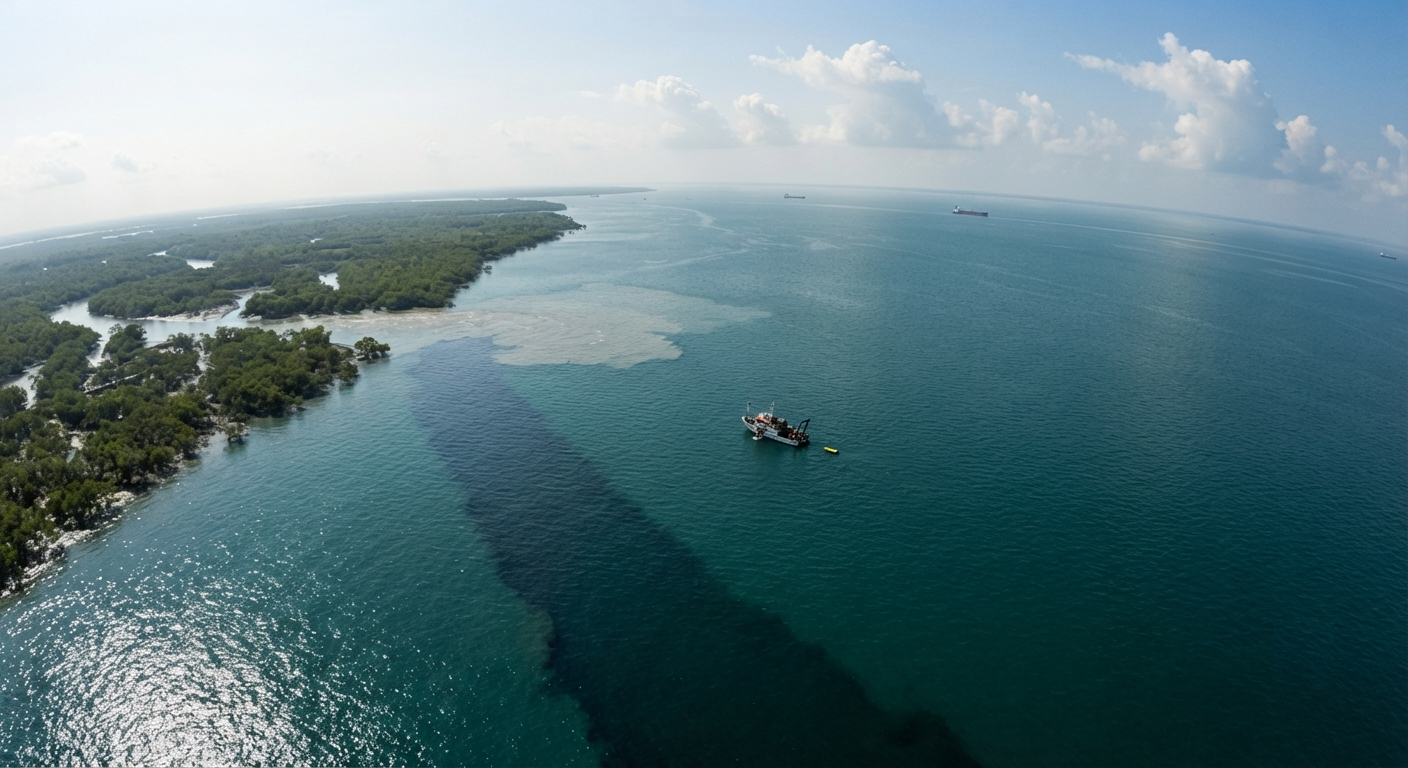
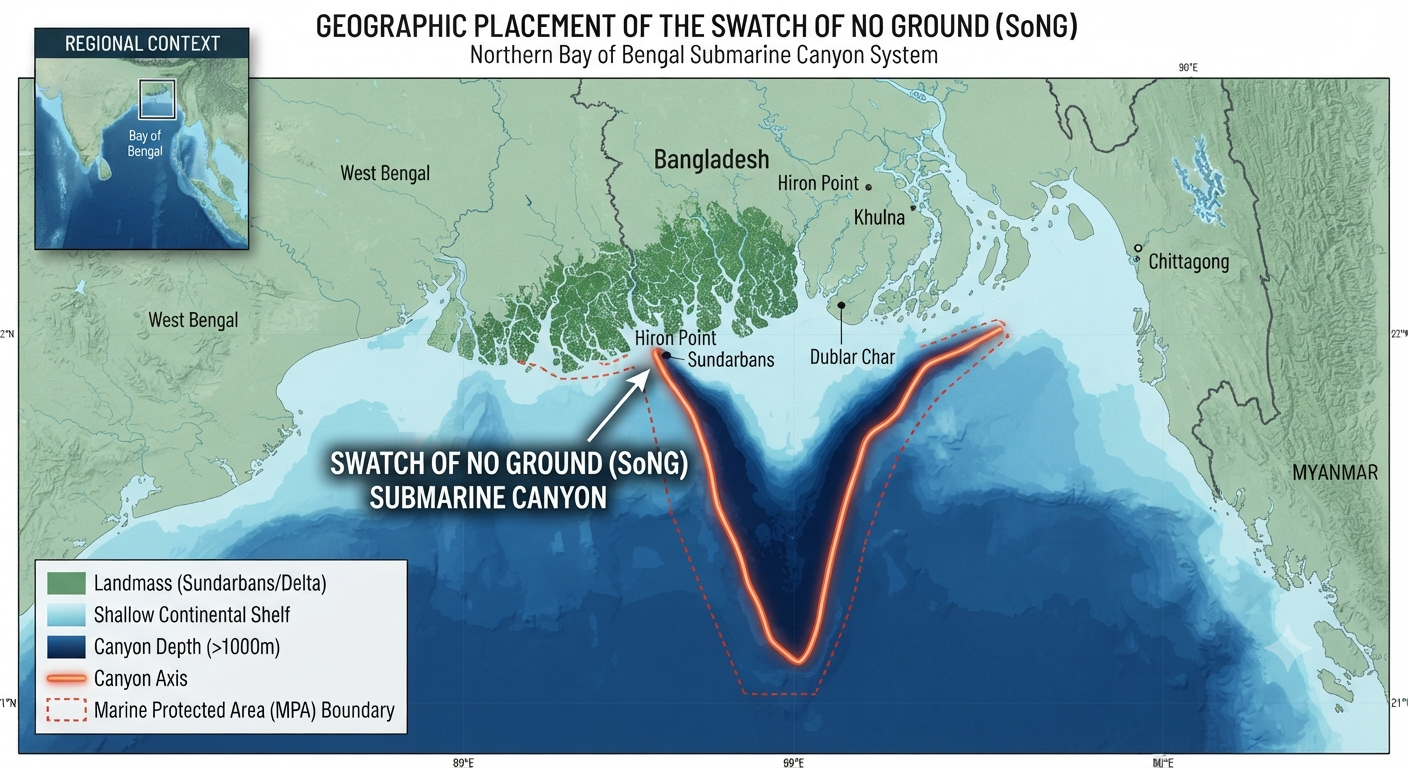
The Swatch of No Ground, often abbreviated as SoNG, lies in the northern Bay of Bengal, roughly 30 kilometres south of Dublar Char in the Sundarbans. It is a large, trough-shaped submarine canyon that cuts diagonally across the continental shelf and extends into the deeper part of the Bay.
Swatch of No Ground, Bay of Bengal
The name "Swatch of No Ground" dates back to early British hydrographic surveys. The canyon drops so sharply from the relatively shallow continental shelf that early sounding measurements gave the impression that there was no bottom within reach.
The underwater landscape here is very different from the surrounding shelf. In some parts, the canyon reaches depths of around 900 to more than 1,200 metres. As the water gets deeper, sunlight gradually disappears and temperatures fall, but that does not mean the area is lifeless. The canyon and its surrounding waters support whales, dolphins, fish, sea turtles, and many other marine organisms.
This combination of unusual seafloor topography, deep water, currents, and biological productivity makes the Swatch of No Ground important both as a geological feature and as a marine habitat.
Depth of the Swatch of No Ground
Formation & Submarine Canyon Dynamics – A Geological Highway
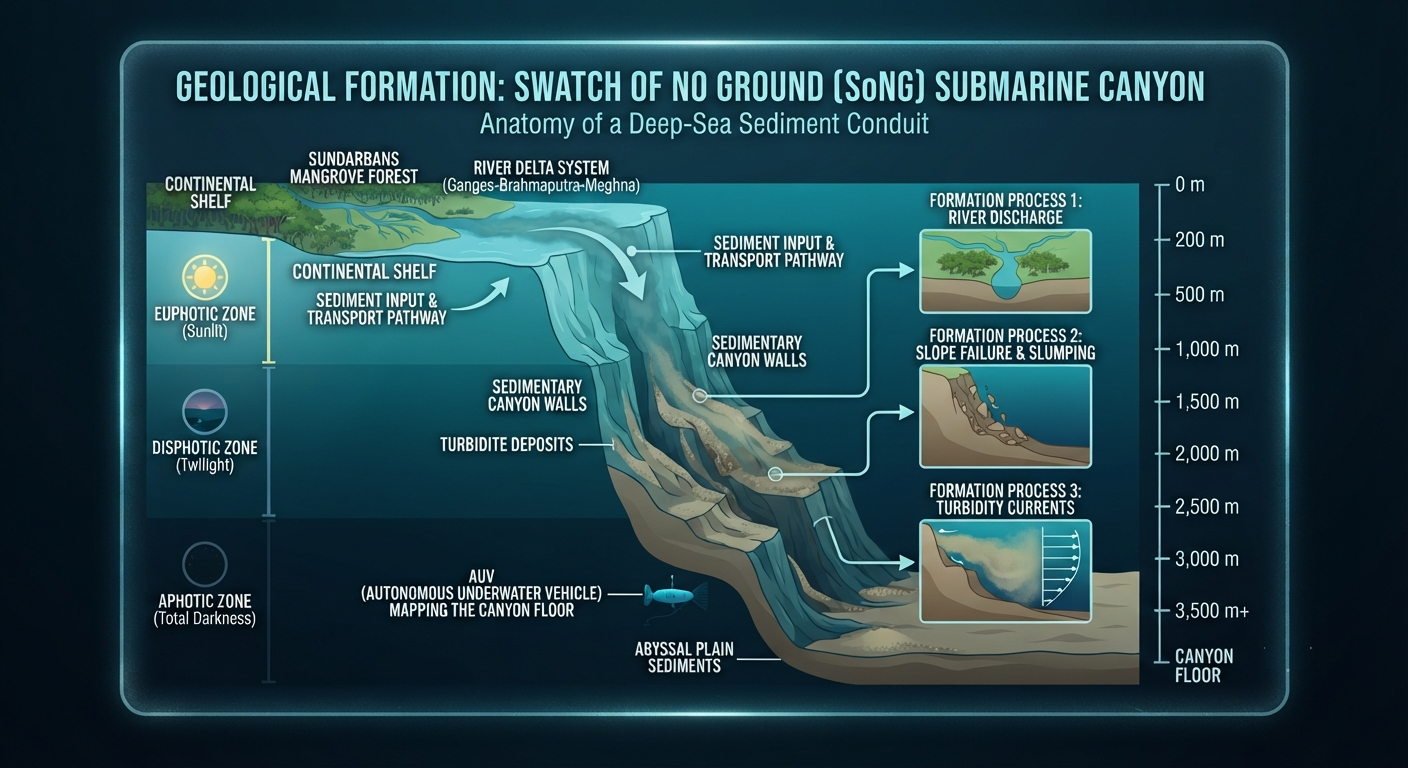
The Swatch of No Ground was not formed by a single geological event. Its present shape is the result of sediment deposition, erosion, gravity-driven flows, and the long-term geological evolution of the Bengal Basin and Bay of Bengal.
One of the main factors behind its development is the enormous amount of sediment carried by the Ganges-Brahmaputra river system. Every year, these rivers transport huge quantities of sediment toward the Bay of Bengal. Some of that material settles near the coast, while a significant amount is carried farther offshore through underwater channels and turbidity currents.
the Ganges-Brahmaputra river system supplies enormous quantities of sediment to the Bay of Bengal,
and gravity-driven turbidity currents transport sediment down the submarine canyon toward deeper water.
Submarine Canyon, Swatch of No Ground, Bay of Bengal
The canyon therefore works much like an underwater route for moving sediment from the continental shelf toward the deep ocean. Much of this material eventually becomes part of the Bengal Fan, the largest submarine fan on Earth.
This sediment movement is not simply a record of the past. Currents, sediment transport, and the interaction between river discharge and the ocean continue to shape the wider system. The Swatch of No Ground therefore provides geologists and oceanographers with an important natural setting for studying how rivers, seafloor processes, and the deep ocean are connected.
Marine Biodiversity – Rulers of the Deep & Coastal Waters
The Swatch of No Ground is also important for its marine biodiversity. Its canyon structure, deep water, currents, and productive surrounding waters create suitable conditions for a wide range of marine species. Because of its ecological importance, the area was declared Bangladesh's first Marine Protected Area (MPA).
Notable species recorded in and around the Swatch of No Ground include:
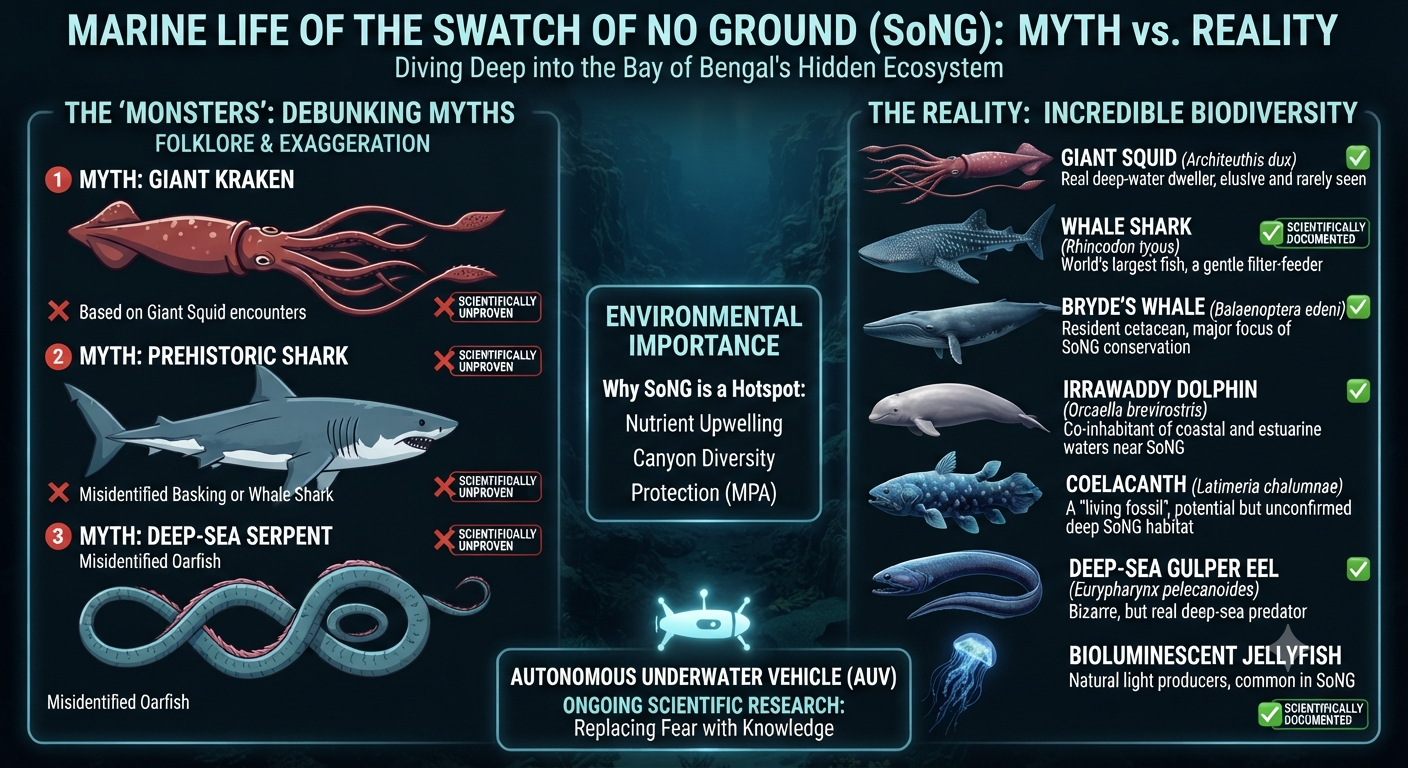
Bryde’s whales, including a likely resident population
Indo-Pacific bottlenose dolphins
Spinner dolphins and pantropical spotted dolphins
Irrawaddy dolphins and finless porpoises
Olive Ridley, green, and hawksbill sea turtles
Whale sharks and a variety of pelagic fish species
Why is this ecosystem so rich?
Abundant Nutrient Supply: Rivers bring large quantities of sediment and nutrients into the Bay, supporting the marine food web.
Complex Topography: The canyon creates a range of depths and underwater habitats, allowing different species to occupy different parts of the ecosystem.
Feeding and Nursery Areas: Productive coastal and offshore waters provide important feeding and breeding grounds for marine animals and commercially important fish.
Protected Status: Restrictions on certain activities, including commercial fishing, are intended to reduce pressure on vulnerable marine species and habitats.
The whales, dolphins, turtles, and other animals found here are adapted to an environment where coastal and deep-water systems meet. Their movements, feeding patterns, communication, and interactions with their surroundings are important subjects for marine researchers studying the Bay of Bengal.
Scientific Exploration & Conservation – Protecting the Blue Frontier
1. Discovery and Early Mapping
Early hydrographic surveys carried out by British mariners identified the unusual depth and shape of the Swatch of No Ground. Its sharp contrast with the relatively shallow surrounding continental shelf made the feature particularly noticeable during early mapping of the Bay.
2. WCS Bangladesh & Marine Protected Area Declaration (2014)
Later research, including work by conservation organizations such as the Wildlife Conservation Society Bangladesh, helped establish the importance of the area for whales, dolphins, and other marine species. In 2014, the Government of Bangladesh declared the Swatch of No Ground a Marine Protected Area covering more than 1,700 square kilometres, making it the country's first MPA.
3. Modern Research Initiatives
Research continues through boat-based surveys, acoustic monitoring, biodiversity assessments, and other marine research techniques. Scientists use these methods to study whale and dolphin populations, fish communities, habitat conditions, and changes in the wider ecosystem.
These studies are helping us understand not only the physical structure of the canyon but also its role in the marine environment. Continued monitoring is particularly important because a protected area can only work effectively when its ecosystem is properly understood and the rules governing it are enforced.
Threats Facing the Swatch of No Ground
Being a Marine Protected Area does not make the Swatch of No Ground completely isolated from human activity. Fishing, shipping, plastic pollution, and waste from coastal areas can all affect the wider marine environment.
Discarded fishing nets and other ghost gear
Plastic waste and microplastics
Shipping traffic and the risk of oil pollution along nearby maritime routes
Fishing pressure around the boundaries of the protected area
Lost fishing gear is particularly concerning because it can continue trapping marine animals long after it has been abandoned. Plastic waste can also enter the food chain, while increasing vessel activity can create noise and other disturbances in an environment used by whales and dolphins.
These pressures show why simply declaring an area protected is not enough. Effective conservation also requires regular monitoring, control of harmful activities, proper waste management, and enforcement of marine protection rules.
Light in the Darkness — Bioluminescence in Deep Waters
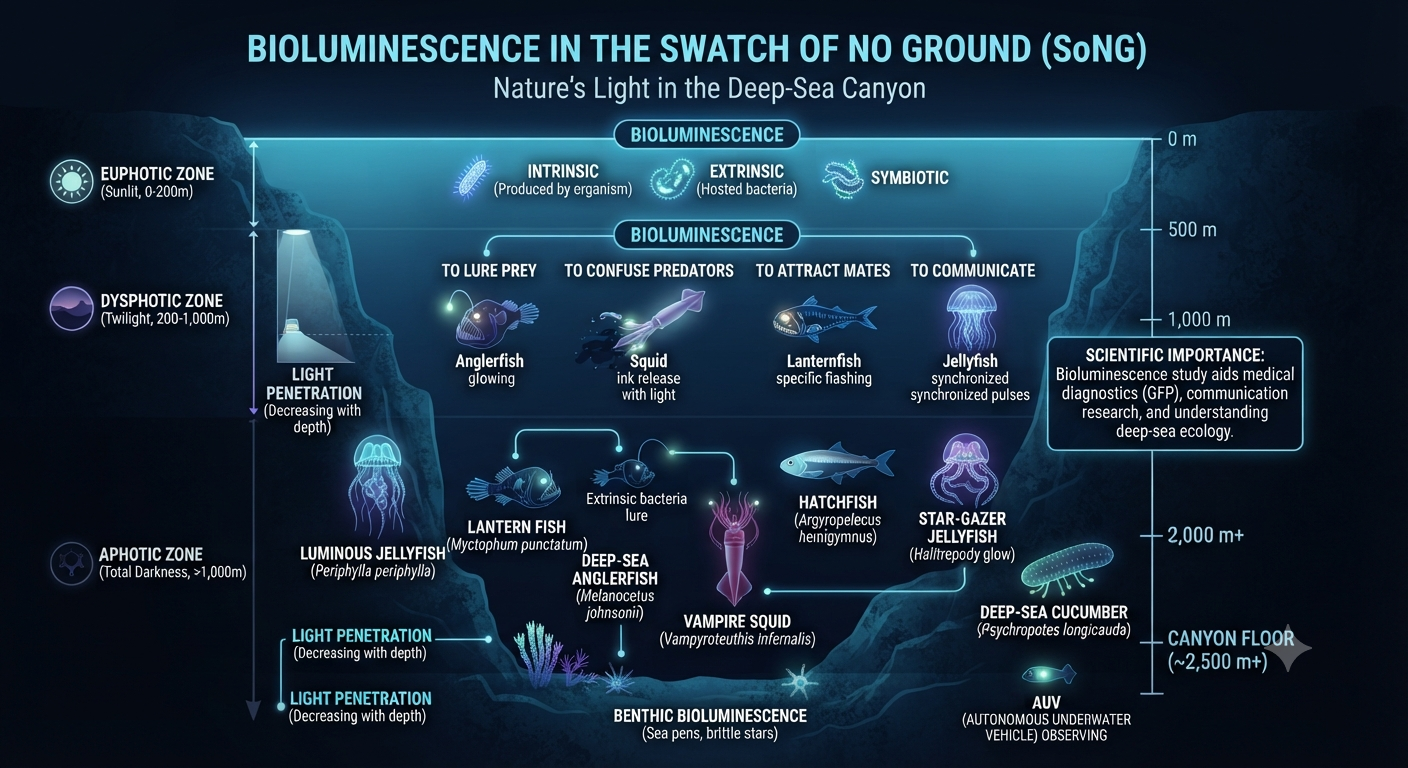
The upper waters around the Swatch of No Ground receive sunlight and benefit from the productivity of the surrounding Bay. Farther down, however, sunlight becomes weaker and eventually disappears. In these deeper and darker parts of the ocean, some organisms produce their own light through a process known as bioluminescence.
Bioluminescence occurs when chemical reactions inside an organism produce visible light. One important component of these reactions is often a light-producing molecule called luciferin, which reacts with oxygen with the help of other biochemical components.
Uses of bioluminescence
To hunt: Some deep-sea animals use light to attract or locate prey.
To escape predators: Sudden flashes or clouds of light can startle or confuse a predator.
To find mates: Some species use species-specific light signals during reproduction.
To communicate: Certain marine organisms use light patterns as signals in dark environments.
Bioluminescent organisms glowing in the twilight zones of the submarine canyon
Why bioluminescence matters to science
Bioluminescence has also become important beyond marine biology. Scientists study the chemistry and genetics behind biological light production for applications in biotechnology, medicine, laboratory research, and biological imaging. What evolved as a survival mechanism in nature has therefore become a useful tool for understanding living systems.
Popular Myths & Misconceptions About the Swatch of No Ground
Myth 1: The trench has literally no bottom and connects straight to the other side of the planet.
Incorrect. The name may sound mysterious, but the Swatch of No Ground has a solid seafloor. Although parts of the canyon reach more than 1,200 metres in depth, it is a submarine canyon within the continental margin, not a bottomless hole or tunnel through Earth.
Bryde's whale in the deep waters of the Bay of Bengal
Myth 2: Giant sea monsters or unknown prehistoric beasts hide at the bottom.
There is no scientific evidence for such claims. The Bay of Bengal does contain large and fascinating marine animals, including Bryde's whales and various deep-water species, but stories about giant monsters belong to folklore rather than marine science.
Myth 3: It is completely isolated from human influence.
That is also false. The Swatch of No Ground is connected to the wider Bay of Bengal, which receives river-borne material and supports busy fishing and shipping activities. Plastic pollution, fishing pressure, underwater noise, and other human activities can therefore affect the ecosystem.
The mystery surrounding the canyon is understandable. It is deep, difficult to explore, and largely invisible from the surface. But the real story is more interesting than the myths. Modern sonar, marine surveys, acoustic monitoring, and biological research are gradually revealing how this unusual part of the Bay actually works.
The Swatch of No Ground does not need mythical creatures to be fascinating. Its geology, currents, sediment movement, and marine life already make it an important natural feature of Bangladesh and the northern Indian Ocean.
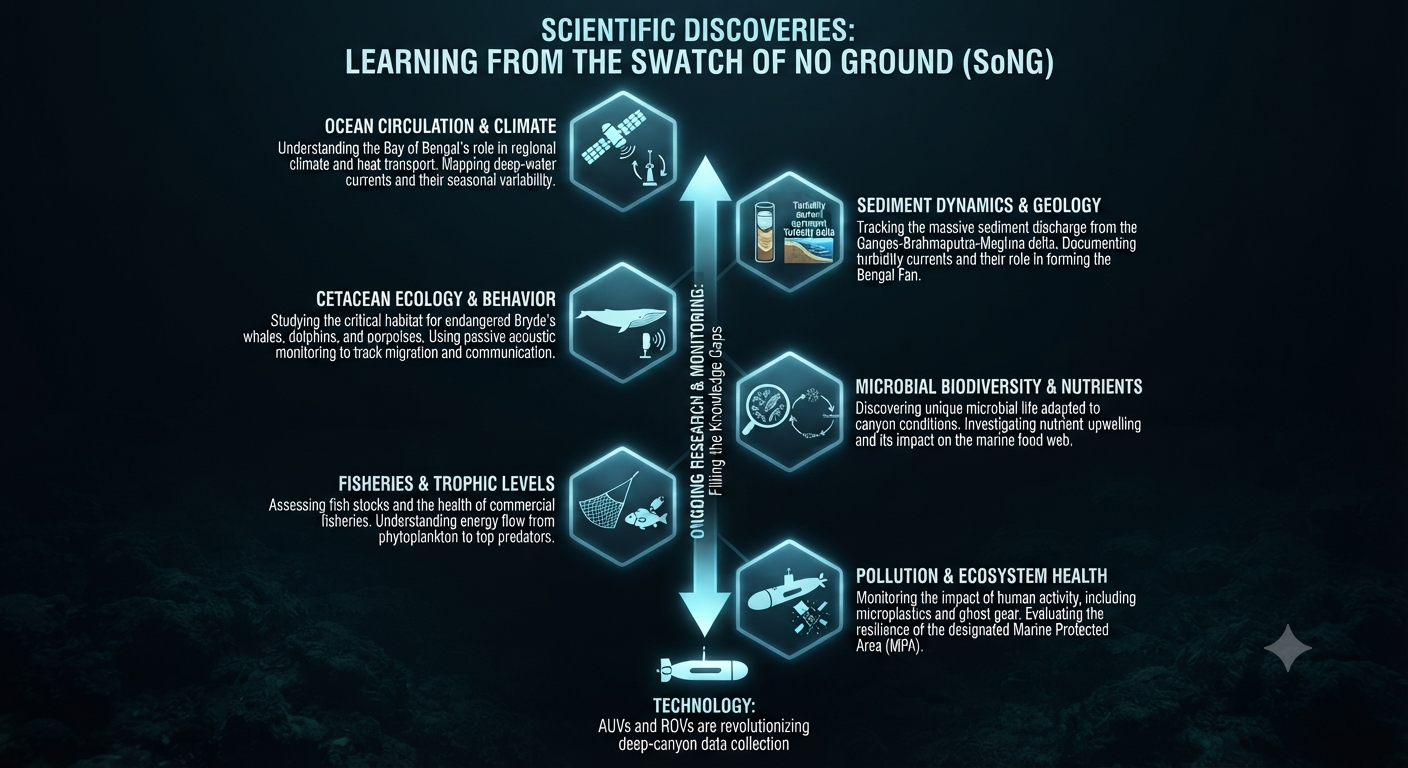
What Are Scientists Learning from the Swatch of No Ground?
Submarine canyon formation and sediment dynamics
Cetacean migration, genetics, and behaviour
Coastal and marine biodiversity conservation
The effects of marine pollution on protected habitats
How river-ocean interactions influence regional marine food webs
Research in these areas helps scientists understand how the northern Bay of Bengal functions as a connected marine system. It also provides information that can be useful for fisheries management, marine spatial planning, species conservation, and long-term environmental monitoring.
What Scientists Are Learning from the Swatch of No Ground
Studies of the Swatch of No Ground can also help us understand the relationship between Bangladesh's rivers and its coastal waters. The enormous amount of sediment carried downstream does not simply disappear at the shoreline; much of it continues moving through the marine environment and eventually contributes to the formation of the Bengal Fan.
For that reason, the Swatch of No Ground is more than a local marine feature. It is a valuable natural laboratory for studying geology, oceanography, marine biodiversity, and the environmental pressures affecting the northern Bay of Bengal.
Comparison with Other Submarine Features
Name of Feature
Depth (meters)
Location
Significance
Cause of Formation
Swatch of No Ground
~900 – 1,200+
Northern Bay of Bengal, Bangladesh
Bangladesh's first MPA; important habitat for whales, dolphins, sea turtles, and other marine life; also provides a major pathway for sediment moving toward the Bengal Fan.
Developed through long-term sediment transport, erosion, and turbidity currents associated with the Ganges-Brahmaputra sediment system.
Indus Trough
~1,000+
Arabian Sea, off the Indus River mouth
A major sedimentary feature associated with the Indus River system and the transport of sediment toward deeper parts of the Arabian Sea.
Shaped by sediment discharge from the Indus system together with gravity-driven sediment flows and turbidity currents.
Mississippi Trough
~1,000+
Gulf of Mexico
An important geological and sedimentary feature associated with the Mississippi River system and the deep-water Gulf.
Developed through long-term sediment deposition, erosion, and gravity-driven movement of material from the continental shelf and Mississippi delta region.
The Future of the Swatch of No Ground – A New Horizon of Research
There is still much to learn about the Swatch of No Ground. Future research will likely depend increasingly on better seafloor mapping, acoustic monitoring, autonomous instruments, and remotely operated systems that can collect data without requiring researchers to remain at sea for long periods.
Acoustic hydrophones for monitoring whale and dolphin vocalizations
Autonomous underwater and remotely operated monitoring systems
More detailed water-quality and microplastic testing
Improved monitoring of marine traffic and protected areas
These technologies can help researchers build a much clearer picture of what happens below the surface. High-resolution mapping can reveal changes in the canyon floor, while acoustic instruments can provide information about marine mammals that are difficult to observe directly.
Long-term monitoring is equally important. Comparing data collected over many years can show whether whale populations are changing, whether pollution is increasing, how fishing pressure is affecting marine life, and how sediment and currents are behaving within the wider system.
The challenge will be finding a practical balance between human activity and conservation. Bangladesh depends on the Bay of Bengal for fisheries, transportation, coastal livelihoods, and economic activity. Protecting important marine habitats therefore requires good scientific information as well as effective management.
Conclusion: Swatch of No Ground — Bangladesh's Marine Treasure
The Swatch of No Ground is one of the most interesting natural features beneath Bangladesh's coastal waters. Its deep canyon, powerful currents, sediment pathways, and rich marine life make it important from both geological and ecological perspectives.
There is still a great deal we do not know about the deep waters of the Bay of Bengal. But that is exactly why places like the Swatch of No Ground matter. Studying them helps us understand how rivers, sediments, currents, marine animals, and coastal ecosystems are connected.
We often look toward deep space when we think about unexplored frontiers. Yet there are still remarkable places much closer to home that remain difficult to reach and understand. The Swatch of No Ground is one of them. Protecting it while continuing to study it is not only about preserving a fascinating part of Bangladesh's marine environment; it is also about understanding the larger ocean system on which so many coastal communities depend.