One day, humans looked up at the sky and asked themselves—where are our limits? Is it possible to leave our footprints in the endless darkness of the stars? From that curiosity, from that restlessness, Voyager 1 was born.
On a day in September 1977, a small spacecraft departed from Earth. It was not a traveler set to return—but a messenger racing into the infinite cosmos, carrying Earth’s story, humanity’s songs, and dreams of billions of years.
Today, it is far away from Earth’s green shadow, beyond the halo of our Sun. It is as though humanity has sent a poem into the universe—where there are no words, only signals from machines; where there are no melodies, only the harmonious voices of Earth preserved in the Golden Record.
Voyager 1 is not just a spacecraft—it is a reflection of our existence. From our limited Earth into the infinity of the cosmos, that courage has a name: Voyager 1.
History of Voyager 1
Launch and Purpose
Launch: Voyager 1 was launched on September 5, 1977.
It was part of NASA’s larger Voyager program, intended to observe Jupiter, Saturn, and other planets up close, and then go beyond the edge of the Solar System into interstellar space.
The first image of Earth and the Moon in a single frame, taken by Voyager 1.
Journey Past the Planets into the Outer Solar System
It performed flybys of Jupiter in 1979 and Saturn in 1980, collecting data.
Its primary planetary mission ended afterward, but Voyager 1 continued, crossing the boundaries of the Solar System.
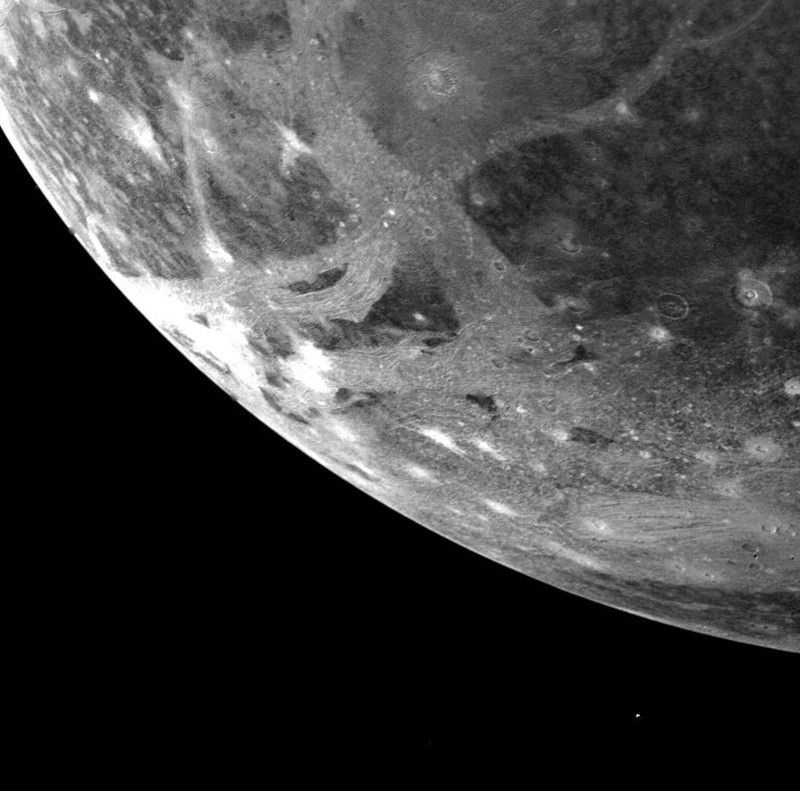
Ganymede—Jupiter’s largest moon: This image was taken by Voyager 1 on March 5, 1979, from a distance of 151,800 miles (243,000 km).
Crossing the Boundary of the Solar System
On August 25, 2012, Voyager 1 approximately entered beyond the Sun’s “heliosphere.”
It became the first human-made object in history to reach that position.
Technology and Instruments
The structure and technological features of Voyager 1 are astonishing in many ways:
It weighed about 721 kilograms.
It used Radioisotope Thermoelectric Generators (RTG) for power supply.
It carried many instruments: cameras, spectrometers, magnetometers, plasma analyzers, radio science equipment, etc.
It had a radio communication system capable of sending even the faintest signals back to Earth.
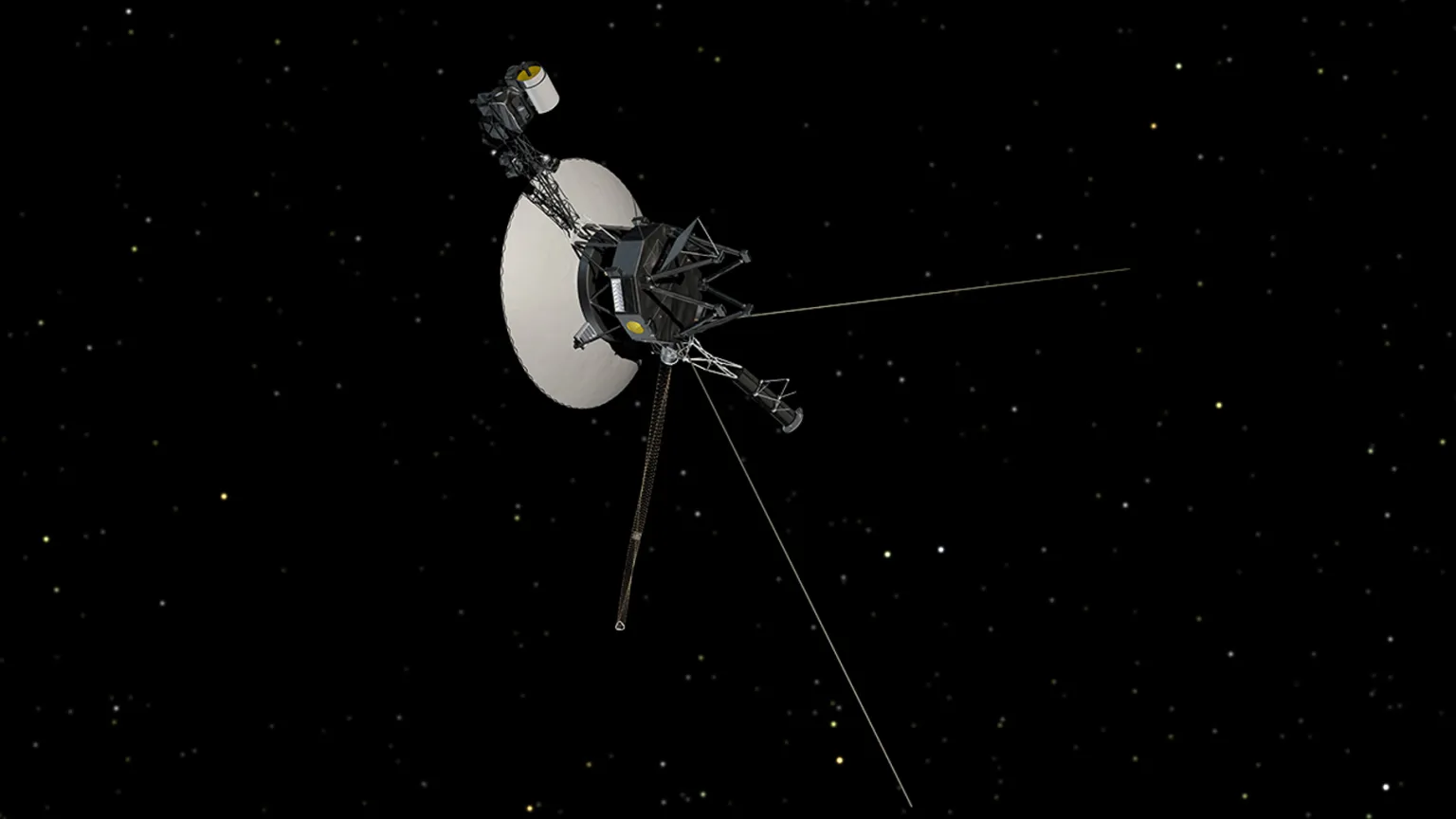
The instruments of Voyager 1
The Golden Record
Its purpose was to deliver a cultural time capsule to intelligent life beyond the Solar System.
A Bengali greeting was included: “Namaskar! Let there be peace in the world.”
Greetings and conversations in a total of 55 languages were recorded.
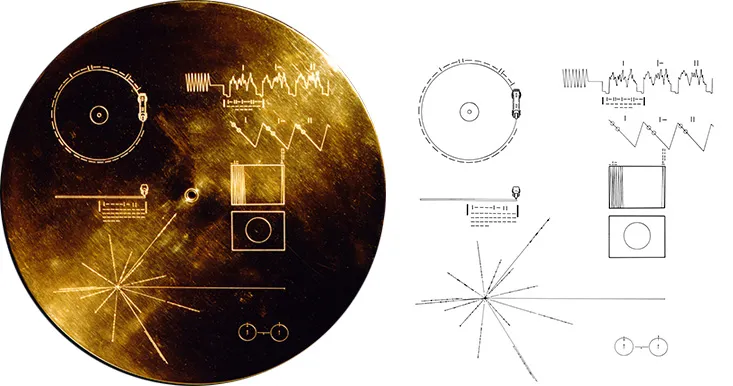
The Golden Record cover with instructions for extraterrestrial beings
The Golden Record Cover: A Message to Cosmic Beings
The cover illustration of NASA’s Voyager Golden Record is essentially a “message to cosmic beings”—delicately designed instructions showing how to play the record and decode its content.
1. Pulsar Map
The Sun’s position is shown relative to 14 pulsars (rapidly rotating stars emitting radio waves). Binary numbers indicate their frequencies, helping advanced civilizations locate the Solar System.
2. Diagram of the Hydrogen Atom
At the top is a simple illustration of the two lowest energy states of hydrogen. Since hydrogen is the most common element in the universe, it serves as a universal reference. This transition was used as the basic unit of time and distance.
Explanation of the Golden Record cover illustration
3. Instructions for Playing the Record
The diagram shows how to place the stylus and rotate the record.
It also illustrates how to read the modulated signals containing sounds and images.
Greetings from the earthBangladesh · Space · Voyager 1
00:00 / 00:00
Keyboard shortcuts:
Space = play/pause · ←/→ = seek 5 seconds ·
↑/↓ = volume · M = mute
4. Image Encoding
The images on the Golden Record are stored as analog signals.
The diagram shows how pixels are stored and reconstructed when the record is played.
Engineers sealing the cover on Voyager 1’s Golden Record in this archival photo from 1977.
Scientific Contributions and Research
Jupiter and Saturn data: information about their atmospheres, magnetic fields, moons’ structures, and other details of their systems.
Saturn and its satellites: Tethys (outer left), Enceladus (inner left), and Mimas (right of rings). This photo was taken by Voyager 1 on October 30, 1980, from about 18 million km (11 million miles).
Heliosphere and heliosheath data: the extent of the Sun’s influence, solar wind speed and oscillations, differences between solar wind and interstellar space.
Interstellar medium: contents beyond the Solar System—protons and fundamental particles, magnetic field variations, electrons, and other cosmic particles.
Voyager 1’s image of Jupiter and its Great Red Spot, with Io (left) and Europa transiting in front.
Current Status and Challenges
Power and communication: As the distance increases, signals weaken.
From November 2023 to December 2024, Voyager 1 stopped transmitting data.
Engineers restored communication in December 2024.
Current Position of Voyager 1
Data point
Voyager 1
Voyager 2
Launch Date
Mission Elapsed Time
— CALCULATING —
— CALCULATING —
Distance from Earth
,
,
Distance from the Sun
,
,
Velocity with Respect to the Sun, estimate (est.)
One-Way Light Time
(hh:mm:ss)
(hh:mm:ss)
IMP
MET
Philosophical and Human Significance
Symbol of hope: We are not confined only to Earth; some part of human civilization has reached cosmic light.
Culture and communication: The Golden Record preserved a small sample of humanity.
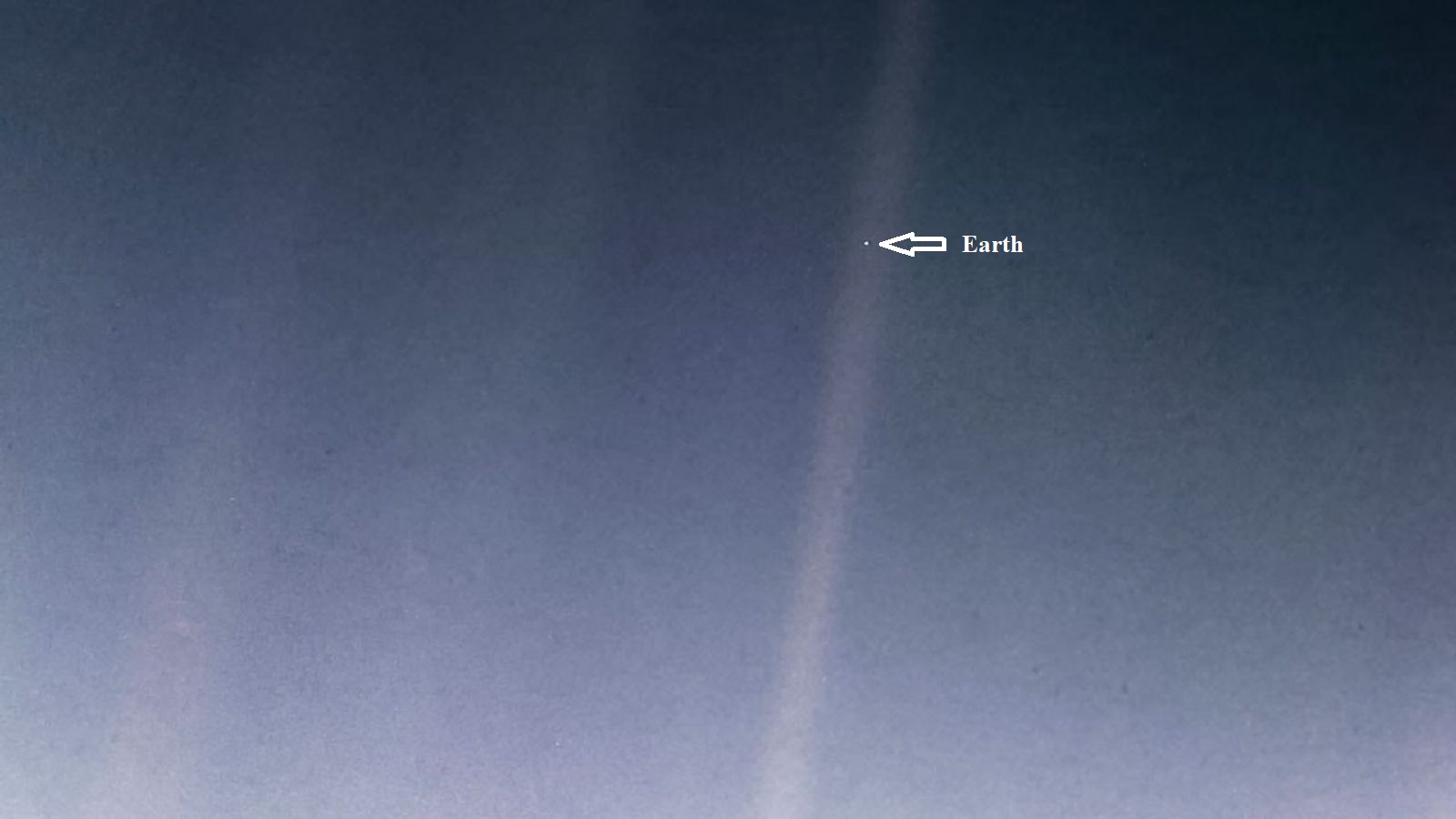
Humility and caution: The “Pale Blue Dot” photo shows that we are just a small blue speck in the vast cosmos.
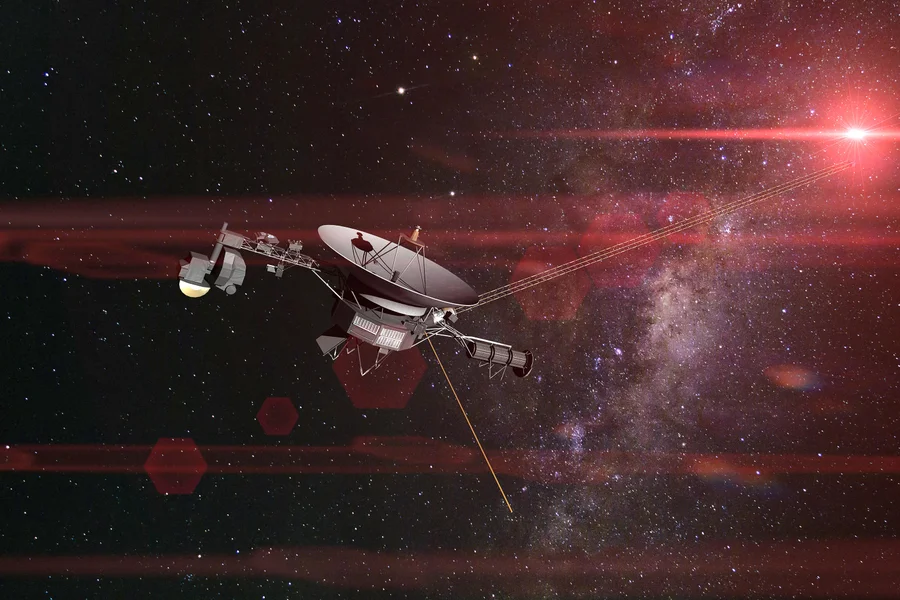
An artist’s rendering of Voyager 1’s interstellar journey into the Milky Way galaxy and infinite space.
The Blue Pale Dot: Our Home
The Pale Blue Dot: This photo of Earth was taken by Voyager 1 on February 14, 1990, from a distance of 3.7 billion miles (6 billion km) away.
"We succeeded in taking that picture [from deep space], and, if you look at it, you see a dot. That's here. That's home. That's us.
On it, everyone you ever heard of, every human being who ever lived, lived out their lives. The aggregate of all our joys and sufferings, thousands of confident religions, ideologies and economic doctrines, every hunter and forager, every hero and coward, every creator and destroyer of civilizations, every king and peasant, every young couple in love, every hopeful child, every mother and father, every inventor and explorer, every teacher of morals, every corrupt politician, every superstar, every supreme leader, every saint and sinner in the history of our species, lived there on a mote of dust, suspended in a sunbeam.
The earth is a very small stage in a vast cosmic arena. Think of the rivers of blood spilled by all those generals and emperors so that in glory and in triumph they could become the momentary masters of a fraction of a dot. Think of the endless cruelties visited by the inhabitants of one corner of the dot on scarcely distinguishable inhabitants of some other corner of the dot. How frequent their misunderstandings, how eager they are to kill one another, how fervent their hatreds. Our posturings, our imagined self-importance, the delusion that we have some privileged position in the universe, are challenged by this point of pale light.
Our planet is a lonely speck in the great enveloping cosmic dark. In our obscurity -- in all this vastness -- there is no hint that help will come from elsewhere to save us from ourselves. It is up to us. It's been said that astronomy is a humbling, and I might add, a character building experience. To my mind, there is perhaps no better demonstration of the folly of human conceits than this distant image of our tiny world. To me, it underscores our responsibility to deal more kindly and compassionately with one another and to preserve and cherish that pale blue dot, the only home we've ever known."
-The very famous passage "The Blue Pale Dot" by Carl Sagan
Conclusion: Not the End, but Only the Beginning!
Voyager 1 is like a floating messenger of human dreams. The same eyes that once looked at the sky from Earth now extend their vision deep into the universe.
Now it is no longer just a spacecraft—it is a poem, a prayer, an eternal monument. In the darkness of space floats humanity’s identity, as though our autobiography is written among the stars.
While Earth remains busy with its own troubles, far away, along unknown starlit paths, Voyager 1 sails like an invisible navigator. Perhaps it will never be seen by anyone. Yet every second of its journey reminds us—we are small, but our dreams are infinite.
Voyager 1 tells us: “Human, you are mortal, yet your voice can echo through the universe. You are small, yet your dreams can touch the stars.”